News Citation : 2026 LN (HC) 386
June 18, 2026 : The Chhattisgarh High Court has acquitted a Rajnandgaon-based government accountant who had been convicted by a Special Court under the Prevention of Corruption Act, holding that mere recovery of tainted currency notes is insufficient to sustain a conviction unless the prosecution establishes a clear and reliable demand for illegal gratification.
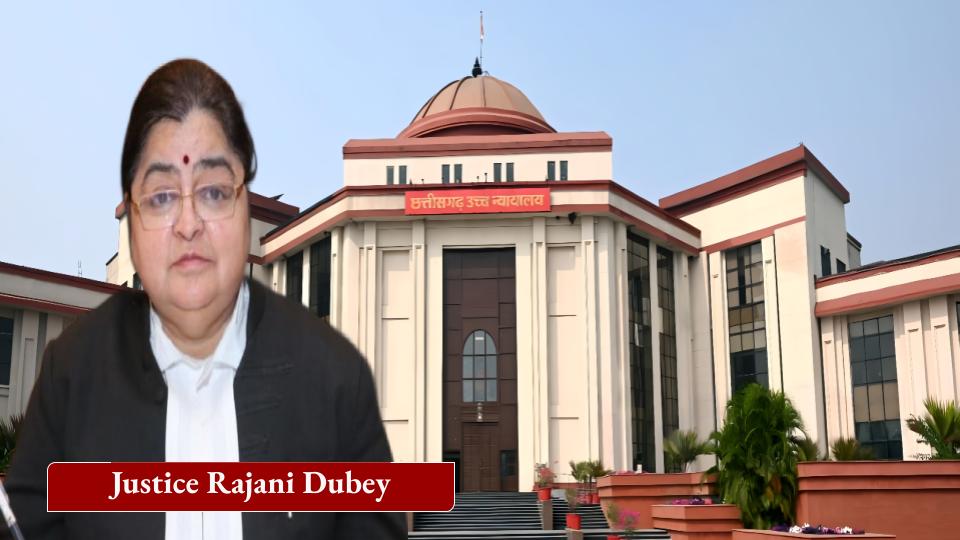
In a significant judgment reinforcing the settled legal principle governing corruption prosecutions, Justice Rajani Dubey allowed the criminal appeal filed by Prakash Narayan Kaumarya, who was working as an Accountant in the office of the Chief Medical and Health Officer (CMHO), Rajnandgaon. The High Court found serious deficiencies in the prosecution’s evidence regarding the alleged demand of bribe and concluded that the foundational requirement for conviction under the Prevention of Corruption Act had not been proved beyond reasonable doubt.
The case originated from a complaint lodged by Vinod Kumar Bagde, a Rural Health Coordinator posted at Dongargarh. According to the prosecution, Bagde had applied for withdrawal of Rs.50,000 from his General Provident Fund account for the medical treatment of his wife. It was alleged that the appellant demanded Rs.1,000 as illegal gratification for processing and passing the GPF withdrawal application. Acting on the complaint, the Anti-Corruption Bureau conducted verification proceedings and later organized a trap operation on 29 January 2014. During the trap, tainted currency notes treated with phenolphthalein powder were allegedly handed over to the accused, following which the ACB team entered the office and recovered the amount. The chemical test reportedly yielded positive results for contact with the tainted notes.
Following investigation, a charge sheet was filed under Sections 7 and 13(1)(d) read with Section 13(2) of the Prevention of Corruption Act, 1988. The Special Judge (Prevention of Corruption Act), Rajnandgaon, convicted the accused on 4 February 2017 and sentenced him to two years’ rigorous imprisonment with fine under both provisions, directing the sentences to run concurrently.
Before the High Court, the appellant challenged the conviction by arguing that the prosecution had failed to establish the crucial element of demand of bribe. The defence pointed out that the alleged demand was said to have taken place through a telephone conversation, yet investigators neither collected call detail records nor seized and examined the mobile phones involved. It was further argued that no scientific verification was conducted to establish whether the recorded voice actually belonged to the accused. The defence also relied upon documentary evidence suggesting that the complainant’s GPF sanction order had already been issued and delivered before the trap proceedings, indicating that no official work was pending with the accused at the relevant time.
The High Court closely examined the evidence of the complainant, the panch witness and the investigating officer. The Court noted that although the complainant claimed to have recorded conversations relating to the alleged demand, the investigating officer admitted during cross-examination that he had not obtained call records, mobile details, IMEI numbers or any forensic examination of the voice recording. The officer also acknowledged that he accepted the complainant’s version regarding the conversation without any independent verification and could not confirm whether the recorded voice belonged to the accused or someone else.
The Court also found significance in the testimony of defence witness Manmohan Giri, an Assistant Grade-III in the CMHO office. He stated that the sanction order for withdrawal of Rs.50,000 had already been delivered to the complainant on 27 January 2014 and that acknowledgment of receipt was available in the dispatch register. According to the witness, after issuance of the sanction order, no further action was required from the CMHO office for release of the amount. This evidence, the Court observed, cast doubt on the prosecution’s theory that a bribe was demanded for processing a pending file.
Another factor that weighed with the Court was the testimony of the panch witness, who admitted that he did not witness the alleged exchange of money between the complainant and the accused. He further acknowledged that the tainted currency notes were found lying on the accused’s table rather than being recovered from his person. The witness stated that he was not present at the time of the alleged transaction and had entered the office only after receiving information from the complainant that the work had been completed.
Relying upon authoritative Supreme Court precedents, including Krishan Chander v. State of Delhi, B. Jayaraj v. State of Andhra Pradesh and P. Satyanarayana Murthy v. District Inspector of Police, the High Court reiterated that proof of demand of illegal gratification is the sine qua non for offences under Sections 7 and 13 of the Prevention of Corruption Act. The Court emphasized that mere recovery of tainted currency notes or a positive phenolphthalein test cannot automatically lead to conviction unless voluntary acceptance of bribe pursuant to a proven demand is established beyond reasonable doubt.
Highlighting the deficiencies in the investigation, the Court observed that the prosecution failed to produce reliable and independent evidence proving the alleged demand. The absence of call records, lack of forensic voice identification, non-examination of material witnesses and contradictions emerging from the evidence created serious doubts regarding the prosecution story. The Court found that these deficiencies struck at the root of the prosecution case and prevented the statutory presumption under the Prevention of Corruption Act from being safely invoked.
The judgment underscores a recurring principle in anti-corruption jurisprudence that investigative agencies must establish demand, acceptance and recovery through legally admissible and credible evidence. It serves as an important reminder that while recovery of tainted money may create suspicion, criminal conviction cannot rest on suspicion alone. The prosecution must prove every essential ingredient of the offence, particularly the demand for illegal gratification, which remains the cornerstone of corruption offences under the Prevention of Corruption Act.
As a result, the High Court allowed the appeal, set aside the conviction and sentence imposed by the Special Court, and extended the benefit of doubt to the appellant.
Case Reference : Prakash Narayan Kaumarya v. State of Chhattisgarh