News Citation : 2026 LN (HC) 353 | 2026:CGHC:23095
May 15, 2026 : The High Court of Chhattisgarh has acquitted a senior veterinary officer in a corruption case, holding that the prosecution failed to conclusively establish the essential ingredients of bribery, particularly the demand for illegal gratification. In a significant ruling interpreting provisions of the Prevention of Corruption Act, the court observed that mere recovery of tainted currency notes is insufficient for conviction unless the prosecution proves beyond reasonable doubt that the accused had demanded and voluntarily accepted the bribe.
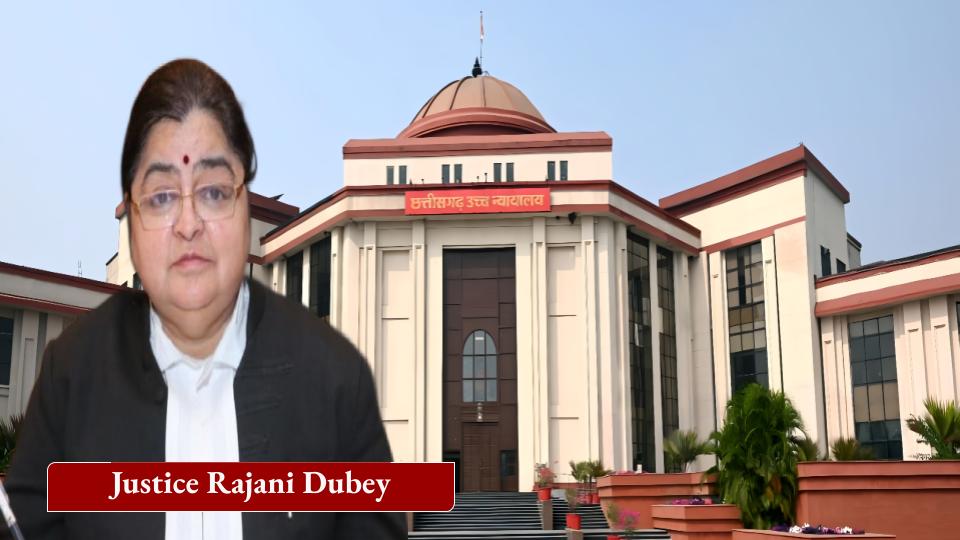
Justice Rajani Dubey delivered the judgment in Criminal Appeal No. 1043 of 2019, allowing the appeal filed by Dr. Narayan Prasad Pandey, who was serving as Deputy Director of Veterinary Services in Bijapur district. The court set aside the 2019 conviction order passed by the Special Judge under the Prevention of Corruption Act in Dantewada, which had sentenced him to five years’ rigorous imprisonment.
According to the prosecution case, complainant Ganesh Ram Pradhan, an Assistant Veterinary Area Officer posted at Bhairamgarh Hospital, had applied for a General Provident Fund (GPF) advance of Rs. 1.5 lakh for his marriage in May 2014. The prosecution alleged that after sanction of the advance amount, Dr. Pandey demanded a bribe of Rs. 10,000 for processing the payment. The Anti-Corruption Bureau (ACB), Jagdalpur, subsequently organized a trap operation after the complainant lodged a written complaint. During the trap, Rs. 5,000 coated with phenolphthalein powder was allegedly handed over to the accused at his official residence in Bijapur, following which the ACB team entered the premises and seized the money.
The trial court had convicted the appellant under Sections 7A and 13(1)(d) read with Section 13(2) of the Prevention of Corruption Act, 1988, concluding that he had demanded and accepted illegal gratification while functioning as a public servant.
However, while examining the appeal, the High Court found serious inconsistencies and procedural lapses in the prosecution’s evidence. The court noted that the prosecution heavily relied upon a digital voice recording allegedly capturing the demand for bribe, but neither the original recording device nor any forensic verification was produced before the trial court. The investigating officer admitted during cross-examination that no voice samples of the complainant or the accused were collected, the recordings were never sent to the Forensic Science Laboratory for authentication, and no certificate under Section 65B of the Indian Evidence Act was produced to establish the admissibility of the electronic evidence.
The High Court also pointed out that several portions of the transcription prepared from the alleged audio recording were marked “unclear,” casting doubt on the reliability of the conversation itself. The court further observed discrepancies regarding the timing of preparation of the transcription and the submission of the recorder to the ACB office.
Importantly, the court found that both independent panch witnesses admitted they were standing outside during the alleged transaction and had neither heard the conversation nor directly witnessed the exchange of money. One of the witnesses also stated that when the trap team entered the room, the cash was lying on a newspaper placed on a chair or table, rather than being recovered from the conscious possession of the accused.
The judgment also took note of the defence claim that departmental proceedings had earlier been initiated against the complainant based on a complaint allegedly made by the accused officer. During cross-examination, the complainant admitted that disciplinary proceedings were indeed pending against him and that he had not disclosed in his GPF application that the advance was sought for a second marriage, which could amount to misconduct under service rules.
The High Court further observed that treasury objections had already been raised regarding the complainant’s GPF advance application, indicating that delays in processing the file could not automatically be attributed to corrupt motives on the part of the accused.
Relying extensively on recent Supreme Court precedents, including State of Lokayuktha Police v. C.B. Nagaraj, B. Jayaraj v. State of Andhra Pradesh, and N. Vijayakumar v. State of Tamil Nadu, the High Court reiterated that “proof of demand and acceptance of illegal gratification is sine qua non” for sustaining a conviction under the Prevention of Corruption Act. The court emphasized that recovery of currency notes alone cannot establish guilt unless demand for bribe is independently and convincingly proved.
In one of the key observations, the court held that “the prosecution has failed to prove any demand by the accused/appellant beyond any reasonable doubt” and that “mere possession or recovery of currency notes is not sufficient to constitute such offence.”
The court concluded that the prosecution evidence suffered from material contradictions, unreliable electronic evidence, and lack of corroboration from independent witnesses. It held that the trial court had failed to properly appreciate these deficiencies and had recorded “perverse findings.” The High Court ultimately extended the benefit of doubt to the appellant and acquitted him of all charges.
The ruling is likely to have broader implications for corruption prosecutions involving trap proceedings and electronic evidence. The judgment reinforces judicial insistence on strict compliance with evidentiary safeguards, especially in cases involving digital recordings and allegations of bribery against public servants. It also reiterates the constitutional principle that criminal convictions must rest on proof beyond reasonable doubt, particularly in corruption cases where conviction carries severe professional and social consequences.
The High Court directed the appellant, who was already on bail, to furnish a personal bond under Section 481 of the Bharatiya Nagarik Suraksha Sanhita (BNSS), 2023, to secure his appearance in case further proceedings are initiated before the Supreme Court.
Case Reference : CRA No. 1043 of 2019, Dr. Narayan Prasad Pandey vs State of Chhattisgarh through A.C.B. Unit, Jagdalpur, District Bastar (C.G.); Counsel for Appellant: Mr. Ravindra Sharma, Advocate; Counsel for Respondent: Mr. Jitendra Shrivastava, Government Advocate.