News Citation : 2026 LN (HC) 348 | 2026:CGHC:23099-DB
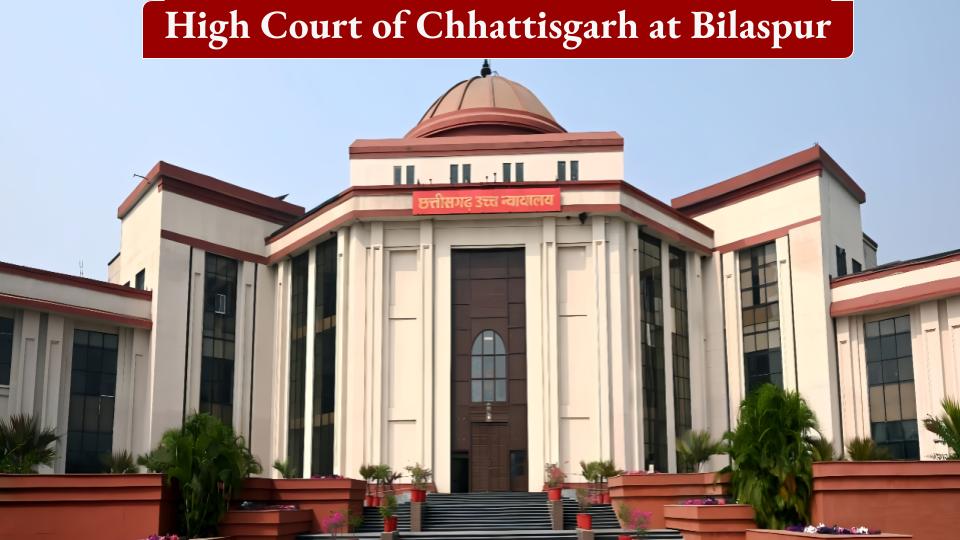
May 15, 2026 : The High Court of Chhattisgarh has dismissed a petition filed by former Chhattisgarh Public Service Commission Chairman R.S. Vishwakarma seeking additional pension benefits under amended service regulations, holding that pensionary entitlements are governed by the rules in force on the date of retirement and courts cannot compel the government to retrospectively alter policy decisions involving financial implications.
In a significant ruling on pension law and retrospective applicability of service regulations, a Division Bench comprising Justice Sanjay K. Agrawal and Justice Sanjay Kumar Jaiswal refused to interfere with the State Government’s decision to deny enhanced pension benefits to the retired PSC Chairman. The Court held that the amended Chhattisgarh Public Service Commission (Conditions of Service) Regulations, 2001, which came into force from April 1, 2018, could not be extended to a person who had retired before that date.
The case arose from a writ petition filed under Articles 226 and 227 of the Constitution challenging an order dated August 13, 2021, by which the State Government rejected Vishwakarma’s representation for enhanced pension. The petitioner had also sought a direction to retrospectively amend the effective date of a 2020 notification increasing the pension ceiling for PSC Chairpersons and Members.
According to the facts recorded by the Court, Vishwakarma retired as Principal Secretary to the Government of Chhattisgarh on January 31, 2015, with an annual pension of ₹11.59 lakh. Thereafter, he joined the Chhattisgarh Public Service Commission as a Member in March 2015 and was later appointed Chairman in June 2015. He superannuated from the post of Chairman on January 16, 2017.
The dispute centered around Regulation 8(3) of the Chhattisgarh Public Service Commission (Conditions of Service) Regulations, 2001, framed under Article 318 of the Constitution. At the time of Vishwakarma’s retirement, the regulation fixed the maximum combined annual pension for a PSC Chairman at ₹4.80 lakh. Since the petitioner was already drawing pension exceeding that limit from his previous government service, he was denied any additional pension for his tenure in the PSC.
Subsequently, after implementation of the Seventh Pay Commission, the State amended the regulations through a notification dated December 5, 2020. The amendment enhanced the pension ceiling for PSC Chairpersons to ₹13.50 lakh annually and increased the yearly pension entitlement. However, the revised regulation was expressly made effective from April 1, 2018.
Vishwakarma argued that since the pay revision itself was implemented from January 1, 2016, the amended pension regulation should also have been given retrospective effect from that date. He further claimed discrimination by comparing his case with that of another PSC member, M.S. Paikra, who had allegedly received pension benefits.
Rejecting these submissions, the High Court held that pension rights crystallize on the date of retirement and are determined strictly according to the rules prevailing at that time. The Bench observed that Vishwakarma had retired on January 16, 2017, more than a year before the amended regulation came into force. Therefore, he could not claim benefits under the revised pension structure.
The Court emphasized that policy decisions involving financial implications fall within the exclusive domain of the executive and rule-making authority. Referring to Supreme Court precedents including Union of India v. Tejram Parashramji Bombhate and State of Maharashtra v. Bhagwan, the Bench stated that courts should refrain from directing governments to retrospectively amend policies or incur additional financial liabilities.
In one of the key observations, the Court said, “It is the complete prerogative of the rule-making authority to make applicable the circular from a particular date, particularly when it involves financial implications.”
The Bench also relied on the Supreme Court judgment in Chief General Manager, Telecom, BSNL v. K.J. George to reiterate that retiral and pensionary benefits cannot be recalculated on the basis of a later pay revision unless the revised scheme expressly applies to retired employees.
On the issue of parity with M.S. Paikra, the Court held that the two cases were fundamentally different. While Paikra’s total pension remained within the permissible ceiling under the old regulations, Vishwakarma’s pension from prior government service itself exceeded the statutory cap. Therefore, the plea of discrimination under Article 14 of the Constitution was rejected.
The judgment carries broader implications for retired public servants seeking retrospective application of revised pension schemes. It reinforces the settled legal principle that pension benefits are governed by the rules applicable on the retirement date unless the amendment specifically provides retrospective operation. The ruling also underscores judicial restraint in matters involving fiscal policy and service conditions framed under constitutional authority.
Dismissing the petition, the Court concluded that no writ of mandamus could be issued directing the State to alter the effective date of the amendment or extend enhanced pension benefits to the petitioner.
Case Reference : WPS No. 5875 of 2021, R.S. Vishwakarma vs State of Chhattisgarh and Others; For Petitioner: Mr. Akhil Kumar Samantray, Advocate; For Respondent No.1/State: Mr. Rahul Tamaskar, Government Advocate; For Respondent No.2: Mr. Anand Mohan Tiwari, Advocate.