News Citation : 2026 LN (HC) 352 | 2026:CGHC:23244
May 15, 2026 : The High Court of Chhattisgarh has upheld the acquittal of two men accused of possessing over six kilograms of ganja, ruling that the prosecution failed to comply with mandatory procedural safeguards under the Narcotic Drugs and Psychotropic Substances (NDPS) Act. The court observed that the manner in which the police collected and handled the seized contraband created serious doubts about the integrity of the evidence, ultimately weakening the prosecution’s case beyond repair.
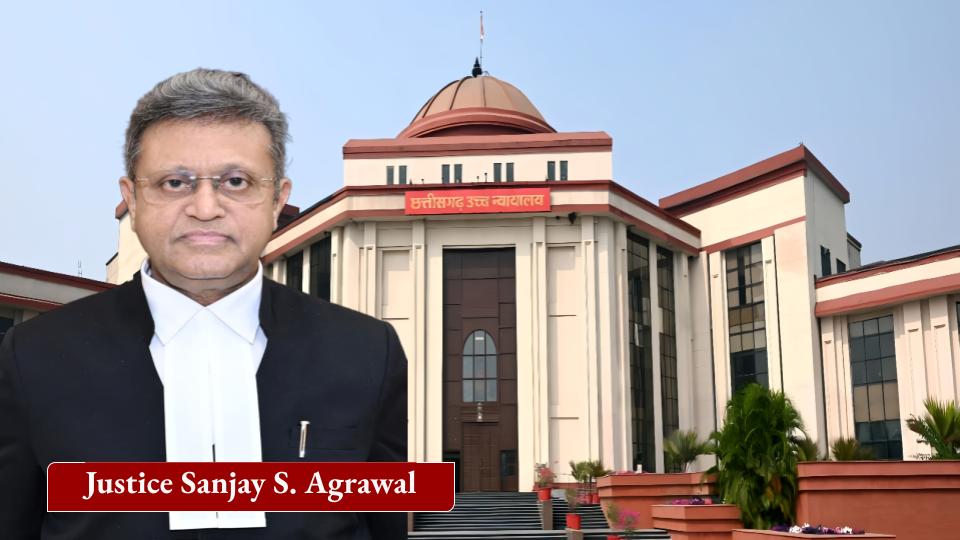
Justice Sanjay S. Agrawal dismissed the State Government’s appeal challenging the acquittal of Sahil Dheevar and Mantudas Mahant in a case registered under Section 20(b)(ii)(B) of the NDPS Act, which deals with possession of intermediate quantity cannabis. The appeal had been filed under Section 378 of the Code of Criminal Procedure against the 2017 judgment of the Special Judge under the NDPS Act at Janjgir-Champa.
According to the prosecution, police officials from Navagarh Police Station received secret information on April 20, 2015, that two men were transporting ganja on a motorcycle towards village Kera. Acting on the tip-off, the police conducted a search operation after allegedly complying with Section 42 of the NDPS Act relating to recording and forwarding secret information. The accused persons were informed about their rights under Section 50 of the Act regarding search before a Magistrate or Gazetted Officer.
During the operation, police claimed to have recovered seven packets of ganja weighing a total of 6.5 kilograms from a plastic bag kept on the motorcycle. The contraband was allegedly mixed together, weighed, and samples of 50 grams each were drawn for chemical examination. The prosecution also stated that the seized material was deposited in the police malkhana and later physically verified before an Executive Magistrate.
However, the trial court acquitted the accused after finding major procedural irregularities in the seizure and sampling process. The court noted that the independent witnesses cited by the prosecution turned hostile and did not support the recovery proceedings. More importantly, the trial court observed that the seized ganja was not shown to have been deposited in the malkhana in a properly sealed condition. The physical verification of the seized material was also conducted 12 days after the seizure, creating doubts regarding the chain of custody and authenticity of the samples sent for forensic examination.
Before the High Court, the State argued that the trial court had wrongly disbelieved the prosecution evidence and incorrectly held that Section 52-A of the NDPS Act had not been complied with. The prosecution contended that the physical verification before the Executive Magistrate was sufficient compliance and that the authenticity of the verification process had never been challenged by the accused.
The High Court, however, rejected the State’s arguments and undertook a detailed analysis of Section 52-A of the NDPS Act, which governs disposal, inventory preparation, photography, and sampling of seized narcotic substances. The court explained that once contraband is seized, the investigating officer must promptly approach a Magistrate for certification of the inventory and for drawing representative samples in the Magistrate’s presence.
The court stressed that the law requires samples to be drawn under judicial supervision to ensure credibility and prevent tampering. Justice Agrawal observed, “The process of drawing of samples has to be done in presence and under the supervision of the Magistrate and, the entire exercise has to be certified by him to be correct.”
The judgment pointed out that in the present case, the samples were drawn immediately at the time of seizure itself without obtaining authorization or supervision from a Magistrate as required under Section 52-A(2). The subsequent physical verification conducted after 12 days could not cure the defect. The High Court held that this non-compliance struck at the root of the prosecution case and rendered the entire recovery process legally suspect.
Relying heavily on the Supreme Court’s landmark ruling in Union of India v. Mohanlal, the High Court reiterated that samples drawn at the time of seizure without the presence of a Magistrate do not satisfy the mandatory requirements of Section 52-A. The Supreme Court had clarified that there is no provision in the NDPS Act mandating sampling at the spot during seizure and that representative samples must be drawn only under judicial supervision.
Applying those principles, the High Court concluded that the prosecution failed to establish the guilt of the accused beyond reasonable doubt. The court observed that the evidence was “not free from suspicion” and held that the acquittal recorded by the trial court did not suffer from any legal infirmity warranting interference in appeal.
The ruling is significant because it reinforces the importance of strict procedural compliance in NDPS cases, where punishments are severe and evidentiary safeguards are treated as mandatory. Courts across India have consistently held that even minor procedural lapses in narcotics investigations can vitiate the prosecution if they create reasonable doubt regarding seizure, sampling, storage, or forensic examination of contraband substances.
The judgment serves as a reminder to investigating agencies that compliance with Sections 42, 50, and 52-A of the NDPS Act is not merely technical but essential to preserving the integrity of criminal prosecutions. The decision may also influence pending NDPS trials where questions have been raised regarding improper sampling procedures or failure to maintain the chain of custody of seized narcotics.
Case Reference : ACQA No. 59 of 2022, State of Chhattisgarh vs Sahil Dheevar and Another. Counsels: For Appellant/State: Mr. Akhilesh Kumar, Government Advocate; For Respondents: Mr. Vivek Singhal, Advocate.