News Citation : 2026 LN (HC) 419
August 14, 2026 :The Chhattisgarh High Court at Bilaspur has directed Guru Ghasidas Vishwavidyalaya to pay 50% back wages to an Associate Professor whose termination from service was subsequently revoked by the Visitor of the University, holding that the employee was entitled to continuity of service and consequential service benefits. The Court, however, declined to grant the entire back wages claimed because the petitioner did not place sufficient material on record regarding his financial circumstances and source of livelihood during the period he remained out of service.
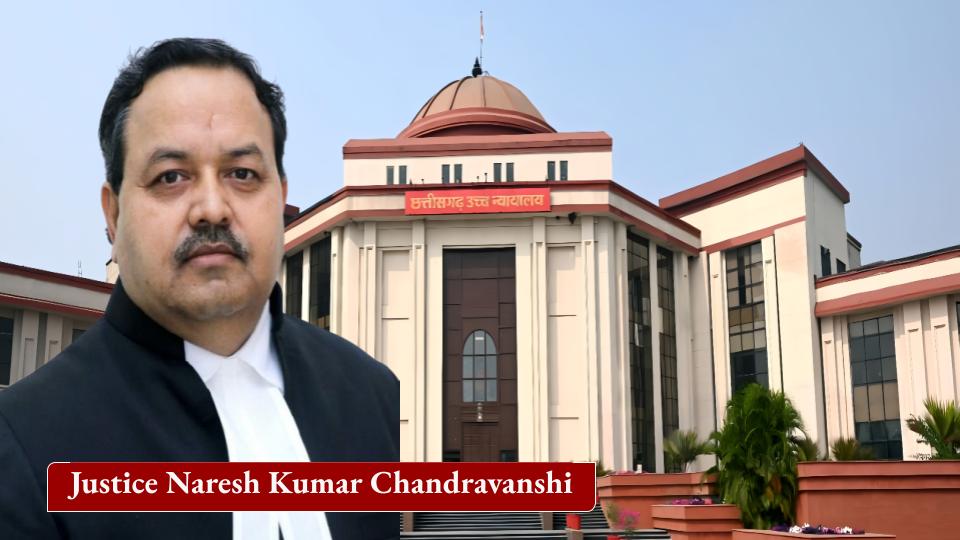
Justice Naresh Kumar Chandravanshi passed the order on August 14, 2026, in WPS No. 8387 of 2023, Dr. Rohit Seth v. Guru Ghasidas Vishwavidyalaya and Others, reported as 2026:CGHC:36128. The order was reserved on August 4, 2026, and uploaded on the High Court website on August 17, 2026.
The dispute arose from the termination of Dr. Rohit Seth, who had initially been appointed as an Associate Professor in the Zoology Department of Guru Ghasidas Vishwavidyalaya on September 29, 2011. During his probation, the University alleged that he had neglected his official duties and obligations. On February 20, 2013, the University terminated his services.
Dr. Seth challenged the termination before the High Court by filing WPS No. 831 of 2013. During the pendency of that litigation, the Visitor of the University, namely the President of India, revoked the termination order through an order dated April 12, 2017. The decision was communicated to the petitioner on April 27, 2017, and his service was restored retrospectively from February 20, 2013. He ultimately joined duty as Associate Professor on June 14, 2017.
Despite the retrospective reinstatement, the University did not grant him back wages or the consequential financial benefits for the period during which he had remained out of service. Dr. Seth therefore made representations before the authorities. He subsequently approached the High Court through WPS No. 3649 of 2020, seeking a decision on his service benefits. On September 17, 2020, the Court directed the University authorities to consider and decide his claim within two months.
When the authorities allegedly failed to take a decision within the stipulated period, the petitioner initiated Contempt Case No. 753 of 2023. During the contempt proceedings, the University informed the Court that it had passed an order dated September 16, 2023, rejecting the claim for back wages. The contempt petition was thereafter disposed of on September 19, 2023. The petitioner then challenged the rejection of back wages in the present writ petition.
Before the High Court, Dr. Seth argued that his termination had been revoked because it was not sustainable in law and that he had been prevented from performing his duties due to an action of the University that did not follow the prescribed procedure. He contended that he had not been gainfully employed elsewhere during the period of termination and therefore should receive back wages from February 20, 2013, until his joining on June 14, 2017.
The petitioner relied particularly on the Supreme Court’s judgment in Deepali Gundu Surwase v. Kranti Junior Adhyapak Mahavidyalaya (D.Ed.) and Others, (2013) 10 SCC 324, besides decisions of the Chhattisgarh High Court. His argument was that the principle of “No Work, No Pay” could not automatically be applied where an employee had been prevented from working because of an unlawful termination.
The University opposed the claim. Its counsel argued that the petitioner had earlier approached the High Court in WPS Nos. 831 of 2013 and 1707 of 2014 without seeking back wages and had also failed to seek such relief in WPS No. 3649 of 2020. According to the University, the claim had therefore been raised at a belated stage.
The University further argued that the Visitor’s order revoking the termination did not itself award back wages. It contended that the petitioner was required to establish through evidence that he had not been gainfully employed during the intervening period. Reliance was placed on Supreme Court decisions including Management of Regional Chief Engineer, Public Health and Engineering Department, Ranchi v. Their Workmen, (2019) 18 SCC 814, Rajasthan State Road Transport Corporation, Jaipur v. Phool Chand, and Senior Superintendent Telegraph (Traffic), Bhopal v. Santosh Kumar Seal, (2010) 6 SCC 773.
The High Court examined the competing submissions and clarified an important legal distinction concerning reinstatement and back wages. The Court held that back wages are not an automatic consequence of reinstatement and must be determined according to the facts and circumstances of each case.
At the same time, the Court found that the petitioner’s termination had been revoked by the Visitor and that he had been retrospectively reinstated. Consequently, the termination could not be treated as legally sustainable. The Court held that he was entitled to continuity of service for service-related purposes, including seniority, increments, leave, pensionary benefits and other consequential service benefits.
The Court observed, “back-wages cannot be claimed as a matter of right, rather it can be granted by the Court in the facts and circumstances of each case.” It further noted that reinstatement by itself does not necessarily mean that an employee must receive 100% back wages.
The Court also considered the principle laid down by the Supreme Court in Deepali Gundu Surwase. That judgment recognises wrongful termination followed by reinstatement with continuity of service and back wages as the normal rule, subject to relevant factors such as the nature of the case, the conduct of the employee, the employer’s financial position and other circumstances. It also explains the evidentiary position concerning gainful employment during the period of termination.
Applying that principle, the High Court noted that Dr. Seth had specifically stated that he was not gainfully employed during the period in question and had supported the assertion through a verified affidavit. The University, however, had not produced evidence showing that he was gainfully employed elsewhere.
The Court nevertheless found that the petitioner had not provided adequate material explaining his means of survival or source of income during the period he remained out of service. In these circumstances, the Court considered it appropriate to balance the equities rather than award the entire amount of back wages.
Accordingly, the High Court partly allowed the writ petition and quashed the University’s September 16, 2023 order to the extent that it rejected the petitioner’s claim for back wages. Instead of awarding 100% back wages, the Court directed the University to pay 50% of the back wages for the period from February 20, 2013, to June 14, 2017.
The Court directed the respondents to make the payment within 60 days from the date of the order. If the amount is not paid within that period, it will carry interest at 9% per annum from the expiry of the 60-day period until actual payment. The Court made no order as to costs.
The ruling is significant because it reinforces that the doctrine of “No Work, No Pay” cannot be applied mechanically where an employee’s inability to work resulted from an unlawful termination that was subsequently revoked. At the same time, the judgment makes clear that even where reinstatement follows an illegal termination, full back wages do not automatically follow. The Court may examine the surrounding circumstances and the evidence concerning gainful employment before determining the appropriate monetary relief.
The principal constitutional provision involved in the proceedings was Article 226 read with Article 227 of the Constitution of India, under which the petitioner invoked the writ jurisdiction of the High Court. The dispute was essentially one concerning service law, reinstatement, continuity of service and monetary consequences of an invalid termination; the order does not involve any criminal offence or application of provisions of the IPC, BNS, CrPC or BNSS.
For university employees and public institutions, the decision underscores the importance of following due process in disciplinary and termination proceedings. It also demonstrates that retrospective reinstatement can have consequences extending beyond restoration to the post, including seniority, increments, leave, pensionary benefits and other service entitlements. However, the monetary component of back wages remains subject to judicial assessment on the facts of each case.
Case Reference: Dr. Rohit Seth v. Guru Ghasidas Vishwavidyalaya & Others, WPS No. 8387 of 2023, 2026:CGHC:36128