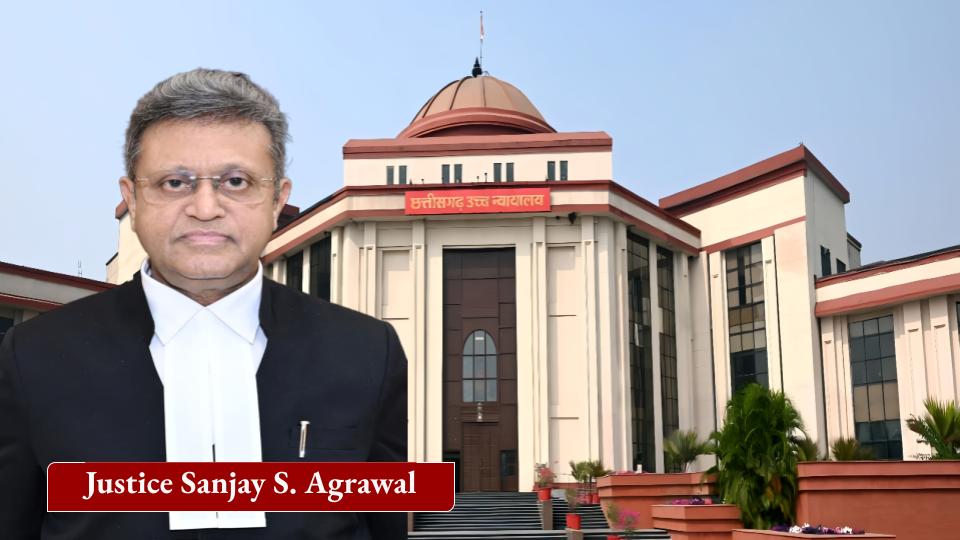
Bilaspur: Justice Sanjay S. Agrawal, a judge of the High Court of Chhattisgarh, will demit office on August 20, 2026, bringing to a close a distinguished legal and judicial career spanning nearly four decades. Born in Bilaspur and shaped by a strong legal and academic family background, Justice Agrawal’s journey from a teacher and practising advocate to the High Court Bench reflects his long-standing association with the legal profession and the judicial institution of Chhattisgarh.
Born on August 21, 1964, in Bilaspur, Justice Sanjay S. Agrawal completed his schooling and graduation in the city before pursuing his LL.B. from Kaushalendra Rao Law College, Bilaspur. His professional journey took him from teaching and legal practice to the High Court Bench, culminating in his elevation as a Judge of the High Court of Chhattisgarh on September 29, 2016, and his appointment as a Permanent Judge on January 8, 2018.
A FAMILY ROOTED IN LAW AND EDUCATION – Justice Agrawal was born into a family with a strong academic and legal background.
His father, Late Shri Shyam Bihari Agrawal, was a retired Professor in the Department of Zoology, while his mother was a homemaker. His grandfather was a prominent and renowned civil lawyer in Bilaspur, providing the family with a strong connection to the legal profession.
His uncle, Shri Ravish Chandra Agrawal, Senior Advocate, also played an important role in shaping his professional journey. Shri Ravish Chandra Agrawal served as the Advocate General of Chhattisgarh and is currently the Advocate General of Madhya Pradesh.
It was under his uncle’s guidance that Justice Sanjay S. Agrawal began his career as an advocate after enrolling with the Bar.
EDUCATION IN BILASPUR – Justice Agrawal completed his schooling and graduation in Bilaspur. He obtained a Bachelor of Science degree in Mathematics before pursuing his Bachelor of Laws from Kaushalendra Rao Law College, Bilaspur.
His academic background in mathematics, followed by legal education, provided a combination of analytical training and legal reasoning that later became part of his professional identity.
FROM TEACHING TO LEGAL PRACTICE – Before entering the legal profession full-time, Justice Agrawal worked as an Upper Division Teacher from 1986 to 1989.
On September 7, 1989, he enrolled as an advocate and began practising law under the guidance of Senior Advocate Ravish Chandra Agrawal.
His early years at the Bar were spent at the District Court in Bilaspur, where he practised from 1989 to January 1997.
He subsequently moved to the High Court of Madhya Pradesh, where he practised from 1997 to 2000. Following the creation of the State of Chhattisgarh and the establishment of the Chhattisgarh High Court in Bilaspur, he continued his practice before the new High Court from 2000 until his elevation to the Bench. The High Court’s official profile confirms these stages of his professional career.
A Broad Practice with Specialisation in Civil Law – During his years as an advocate, Justice Agrawal dealt with several branches of law, including:
- Civil law
- Criminal law
- Constitutional law
Civil law remained his principal area of specialisation.
His experience at both the trial court and High Court levels gave him exposure to litigation at different stages of the judicial process. That experience later became particularly relevant to his work on the Bench, where questions relating to civil disputes, revisions, appeals and constitutional issues formed part of his judicial responsibilities.
While practising before the High Court, he was appointed Government Advocate, a responsibility he continued until 2007.
ELEVATION TO THE CHHATTISGARH HIGH COURT – After several years of practice at the Bar, Justice Agrawal was elevated as a judge of the High Court of Chhattisgarh on September 29, 2016.
He subsequently took oath as a Permanent Judge on January 8, 2018.
His elevation marked the transition from representing litigants before the court to exercising the constitutional responsibility of adjudication.
For a lawyer with decades of experience in civil litigation and exposure to criminal and constitutional matters, the elevation represented another stage in a professional journey that had begun in Bilaspur more than two decades earlier.
NEARLY A DECADE ON THE BENCH – Justice Agrawal’s tenure on the Bench has covered a wide range of legal disputes and judicial responsibilities.
The High Court’s rosters show him handling matters across different categories, including civil revisions, criminal appeals, writ petitions and specially assigned cases.
The nature of the matters assigned to his court over the years reflects the breadth of his judicial work. His court has dealt with both long-pending matters and cases involving important questions of law.
The official High Court records also demonstrate his continued participation in judicial work during the final phase of his tenure.
A SUBSTANTIAL BODY OF JUDICIAL WORK – According to figures available on the High Court of Chhattisgarh website, Justice Sanjay S. Agrawal has delivered approximately 10,000 orders and judgments, with 1,178 judgments approved for publication.
These figures provide an indication of the scale of his judicial work over his tenure.
However, the significance of a judge’s contribution cannot be assessed merely through numerical output. The enduring measure of judicial work lies in the legal principles articulated, the manner in which statutory provisions are interpreted, and the impact of decisions on the development and application of law.
The High Court maintains an official searchable database of its orders and judgments, enabling the public and legal researchers to access judicial decisions and examine the body of work delivered by its judges.
EXPERIENCE ACROSS THE LEGAL SPECTRUM – One of the distinguishing features of Justice Agrawal’s career is the continuity between his years at the Bar and his judicial tenure.
He spent approximately 27 years as an advocate before being elevated to the Bench. His practice included trial court litigation, High Court proceedings, government representation and matters involving civil, criminal and constitutional law.
This experience provided him with a perspective extending beyond a single branch of litigation.
His professional journey can broadly be traced through the following stages:
1986–1989: Served as an Upper Division Teacher.
September 7, 1989: Enrolled as an Advocate.
1989–January 1997: Practised before the District Court at Bilaspur.
1997–2000: Practised before the High Court of Madhya Pradesh.
2000–2016: Practised before the High Court of Chhattisgarh.
Until 2007: Served as Government Advocate while practising before the High Court.
September 29, 2016: Elevated as a Judge of the High Court of Chhattisgarh.
January 8, 2018: Took oath as a Permanent Judge.
August 20, 2026: Scheduled to retire from the High Court.
A CAREER CLOSELY ASSOCIATED WITH BILASPUR – Justice Agrawal’s professional journey has a particularly strong connection with Bilaspur.
It was in Bilaspur that he was born, educated and introduced to the legal profession. He began his legal practice in the Bilaspur District Court and later became part of the legal community of the Chhattisgarh High Court after its establishment.
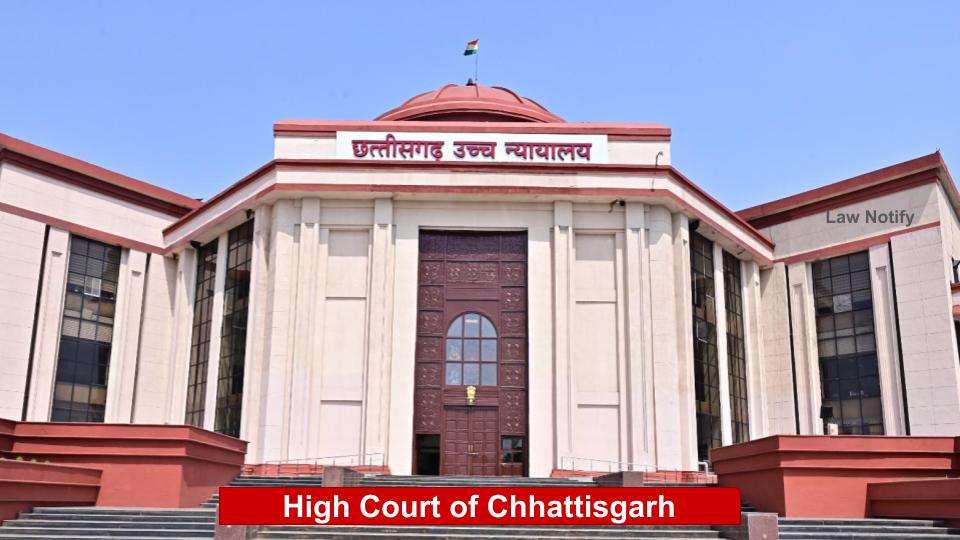
The High Court of Chhattisgarh itself was established on November 1, 2000, following the creation of the State of Chhattisgarh under the Madhya Pradesh Reorganisation Act, 2000.
Justice Agrawal’s career therefore intersects with an important period in the development of Chhattisgarh’s independent judicial identity.
MORE THAN A DATE OF RETIREMENT – August 20, 2026, will mark the formal end of Justice Sanjay S. Agrawal’s tenure as a High Court judge. But a judicial career does not end with the date of retirement in the institutional sense.
The judgments delivered during a judge’s tenure continue to be examined by lawyers, courts, researchers and future generations of judges. Published decisions become part of the body of legal material through which subsequent disputes may be argued and decided.
With approximately 10,000 orders and judgments and 1,178 judgments approved for publication, Justice Agrawal leaves behind a substantial judicial record, according to the figures available on the High Court website.
His journey also represents the evolution of a legal professional who moved through almost every major stage of litigation before assuming constitutional office: teacher, district court advocate, High Court practitioner, Government Advocate and, ultimately, High Court judge.
THE LEGACY OF A LONG LEGAL JOURNEY – Justice Sanjay S. Agrawal’s career is, in many ways, a story rooted in Bilaspur but extending across the wider judicial landscape of Madhya Pradesh and Chhattisgarh.
From enrolling as an advocate in 1989 to taking oath as a Permanent Judge in 2018, his professional journey reflects more than three decades of engagement with law before entering the Bench. His retirement in August 2026 closes a chapter that began in the courtroom of the Bilaspur District Court and ultimately reached the highest judicial institution of the State.
For the legal fraternity of Chhattisgarh, his retirement is therefore not merely the departure of a judge from the Bench. It marks the conclusion of a long professional journey shaped by the Bar, judicial office, civil law practice and sustained engagement with the administration of justice.
The lasting assessment of Justice Agrawal’s tenure will ultimately rest with his judgments and their place in the continuing development of Chhattisgarh’s jurisprudence. But the trajectory of his career, from a young advocate in Bilaspur to a judge of the High Court, remains a significant part of the State’s legal history.