News Citation : 2026 LN (HC) 445
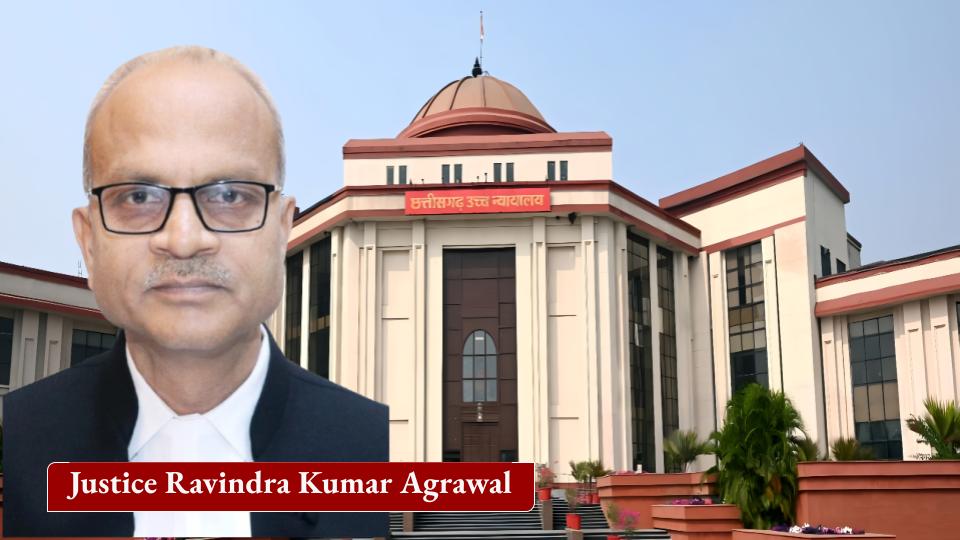
September 15, 2026 : The Chhattisgarh High Court at Bilaspur has held that a Lok Adalat has no adjudicatory power to decide a disputed claim on merits when the parties have not arrived at a compromise or settlement. Justice Ravindra Kumar Agrawal quashed an award passed by the National Lok Adalat, Labour Court, Bilaspur, after finding that the Lok Adalat had exceeded its jurisdiction by recording a finding on the liability of a contractor despite there being no concluded settlement between the parties. The order was delivered on September 15, 2026, in WP227 No. 547 of 2015.
The case arose from a compensation claim following the death of Chhotu alias Shatruhan Patel during the course of his employment. His parents, Meena Bai Patel and Chamru Patel, had filed a claim under Section 22 of the Workmen’s Compensation Act, 1923, seeking Rs.9,00,880 in compensation. The deceased was alleged to have been working under a contractor engaged by Chhattisgarh State Power Distribution Company Limited (CSPDCL).
CSPDCL had disputed its liability but deposited Rs.9,00,880 before the Commissioner on March 10, 2014, provisionally and under protest. The company specifically maintained that the amount could be recovered from the contractor and that the deposit did not amount to an admission of liability.
During the proceedings, the petitioners’ counsel did not appear on November 11, 2014, following which the petitioners were proceeded ex parte. Subsequently, the claimants stated that they did not wish to press their compensation claim on merits because the compensation amount had already been deposited. The matter was thereafter placed before the National Lok Adalat, Bench No. 23, Labour Court, Bilaspur.
On December 6, 2014, the National Lok Adalat passed an award directing payment of the deposited compensation to the legal heirs or dependants of the deceased. At the same time, it recorded that the contractor was not liable to pay the compensation. The proceedings were subsequently kept alive for determining the entitlement of the dependants and for disbursement and apportionment of the deposited amount.
CSPDCL challenged the award, arguing that there had been no compromise or settlement between the parties. Its counsel submitted that the company had deposited the money only provisionally and under protest and had expressly reserved its right to recover the amount from the contractor. The contractor, meanwhile, had denied having an employer-employee relationship with the deceased and had also disputed liability for compensation. According to CSPDCL, the National Lok Adalat therefore had no authority to decide the contractor’s liability.
The contractor opposed the petition and argued that the claimants had voluntarily chosen not to pursue their claim after the compensation amount was deposited. It was contended that the Lok Adalat proceedings had consequently been concluded on the basis of the claimants’ statement and the deposited amount.
The High Court, however, found a fundamental jurisdictional defect in the proceedings. The Court noted that there was no common proposal, mutual acceptance or concluded settlement between CSPDCL, the contractor and the claimants. The company’s deposit had expressly been made under protest and could not be treated as consent to a compromise or as an admission that the contractor was not liable.
The Court explained that the National Lok Adalat had effectively adopted an impermissible course by treating the claim as not pressed while simultaneously deciding the contractor’s liability. “Such a course is legally impermissible,” the Court observed, holding that a Lok Adalat cannot adjudicate a disputed claim on merits.
The High Court relied on the Supreme Court’s decisions in State of Punjab and Others v. Jalour Singh and Others, (2008) 2 SCC 660, and B.P. Moideen Sevamandir & Anr. v. A.M. Kutty Hassan, (2009) 2 SCC 198. These judgments establish that the primary jurisdiction of a Lok Adalat is to facilitate and record a compromise or settlement. If no settlement is reached, the matter must be returned to the court or forum from which it was referred.
The Court also referred to the Supreme Court’s decision in Estate Officer v. Colonel H.V. Mankotia (Retired), (2022) 12 SCC 609, which explained the statutory framework under Sections 19 and 20 of the Legal Services Authorities Act, 1987. Section 19 deals with the jurisdiction of Lok Adalats to determine and arrive at a compromise or settlement, while Section 20 governs the reference and disposal of cases. Where no compromise or settlement is reached, the record is required to be returned to the referring court for disposal in accordance with law.
The High Court emphasised that the consent to refer a matter to a Lok Adalat is consent for settlement or compromise, not consent to have the dispute adjudicated on merits. Referring to the Supreme Court’s reasoning, the Court reiterated that there can be no “third hybrid order” by which a Lok Adalat determines the rights and liabilities of parties in the absence of settlement.
The Court also considered the circumstances in which CSPDCL had been proceeded ex parte. The petitioners explained that their counsel’s daily diary had gone missing and that he had therefore been unable to remember the date of hearing. The Court found this explanation plausible and noted that the petitioners had approached the Labour Court without an inordinate delay. Since they had already disputed liability and had deposited the compensation amount under protest, the Court held that they deserved an opportunity to contest the claim on merits.
Consequently, the High Court allowed the petitioners’ application for setting aside the ex parte order and restoration of the proceedings. It set aside the ex parte order dated November 11, 2014, the Labour Court’s order dated June 15, 2015, and quashed the National Lok Adalat’s award dated December 6, 2014. The compensation proceedings were remitted to the Commissioner for Employees’ Compensation, Labour Court, Bilaspur, for fresh adjudication on merits after giving all concerned parties an adequate opportunity of hearing.
The Court further directed that the amount already deposited by CSPDCL would abide by the outcome of the fresh adjudication. The parties were directed to appear before the Commissioner, and the Labour Court was asked to decide the old matter expeditiously.
The ruling is significant for the functioning of Lok Adalats because it reinforces the statutory distinction between settlement proceedings and adjudication proceedings. Lok Adalats are intended to provide an alternative mechanism for consensual resolution of disputes. They cannot assume the role of a regular court and determine disputed rights or liabilities merely because a matter has been referred to them. The High Court’s decision therefore safeguards the right of parties to have contested legal issues decided by the competent adjudicatory forum in accordance with law.
The ruling also makes clear that a payment or deposit made under protest cannot automatically be converted into a compromise. Where liability itself remains disputed, particularly where the alleged employer-employee relationship is denied, the dispute must be determined by the competent authority after giving the parties an opportunity to present their evidence and arguments.
Case Reference: Chhattisgarh State Power Distribution Company Limited & Anr. v. Commissioner for Employees Compensation Act & Ors., WP227 No. 547 of 2015, Advocates: Mr. Jitendra Pali for the petitioners and Mr. K.P.S. Gandhi for respondent No.4.