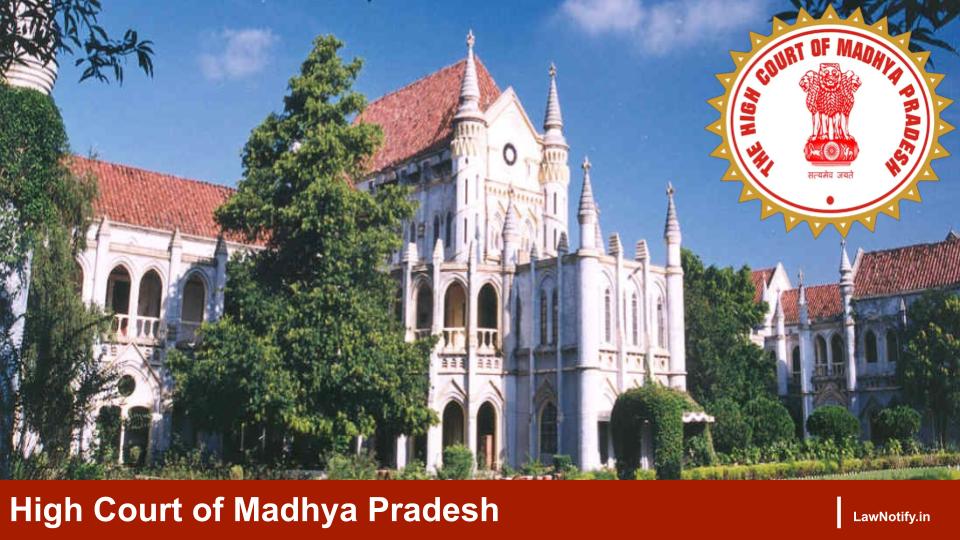
July 18, 2026 : The Madhya Pradesh High Court has issued notice to the State Government and the School Education Department on a public interest litigation (PIL) alleging a deep-rooted crisis in the government school education system caused by a severe shortage of teachers, irrational deployment of teaching staff and inadequate educational infrastructure across the State.
A Division Bench comprising Acting Chief Justice Vivek Rusia and Justice Pradeep Mittal directed the respondents to file their replies within four weeks after taking note of allegations that 1,895 government schools in Madhya Pradesh are functioning without a single teacher.
The PIL is primarily based on the findings of the Comptroller and Auditor General (CAG) Report No. 10 of 2025, which conducted a compliance audit of 66,814 government schools in Madhya Pradesh for the period between 2018 and March 2023. The petition alleges that serious administrative failures in teacher recruitment, deployment and utilisation of public funds have undermined the delivery of quality education and violated the constitutional rights of students.
According to the petition, the CAG audit revealed that 1,379 primary schools and 479 middle schools were operating without any teachers. At the same time, 435 schools with no enrolled students continued to have teachers posted there, while 128 teachers were deployed in 85 schools where no teaching posts had been sanctioned. The petitioner argued that these figures expose arbitrary staffing decisions and the State’s failure to rationalise teacher deployment.
The petition further states that nearly 29,116 government schools are functioning with almost 50 per cent fewer teachers than required, whereas 6,607 schools have 11,733 teachers in excess of the sanctioned strength. It also points out that nearly 1.15 lakh teaching posts, amounting to about 40 per cent of the total sanctioned strength of 2.89 lakh posts, remain vacant, affecting the education of lakhs of students across the State.
Apart from staffing issues, the PIL highlights alarming deficiencies in school infrastructure. It claims that around 5,000 schools are operating from unsafe or dilapidated buildings, more than 3,400 schools lack toilet facilities, nearly 10,000 schools do not have electricity and approximately 40,000 schools are functioning without boundary walls.
The petition also alleges that thousands of schools do not have access to safe drinking water, while over 59,000 schools lack computer facilities despite the State’s emphasis on digital education and technology-enabled learning.
Relying on the CAG report, the petitioner further submitted that these administrative failures have adversely affected academic performance. It was pointed out that the Class X pass percentage dropped significantly from 67.74 per cent in 2018 to 38.53 per cent during the 2021-22 academic session.
The PIL also raises allegations of financial mismanagement, stating that only ₹35.71 crore out of the ₹165.09 crore allocated for teacher training was utilised. It further alleges that 14 officials of the School Education Department remained attached to other departments for periods extending up to 20 years while continuing to receive salaries amounting to ₹3.27 crore from the Education Department.
Appearing for the petitioner, counsel argued that the State’s continued failure to fill sanctioned teaching vacancies, rationalise teacher deployment and provide essential educational infrastructure violates Article 21A of the Constitution, which guarantees the right to free and compulsory education. It was also contended that the State has failed to discharge its statutory obligations under the Right of Children to Free and Compulsory Education Act, 2009.
The petition further submits that these persistent administrative lapses have contributed to declining student enrollment in government schools and have weakened the effective implementation of the constitutional guarantee of quality education.
After hearing the submissions, the High Court directed the State Government to place on record the present status of teacher recruitment, deployment and rationalisation, the utilisation of funds earmarked for teacher training, and the steps taken to address the deficiencies highlighted in the CAG audit report. The matter will be taken up after the respondents file their replies.