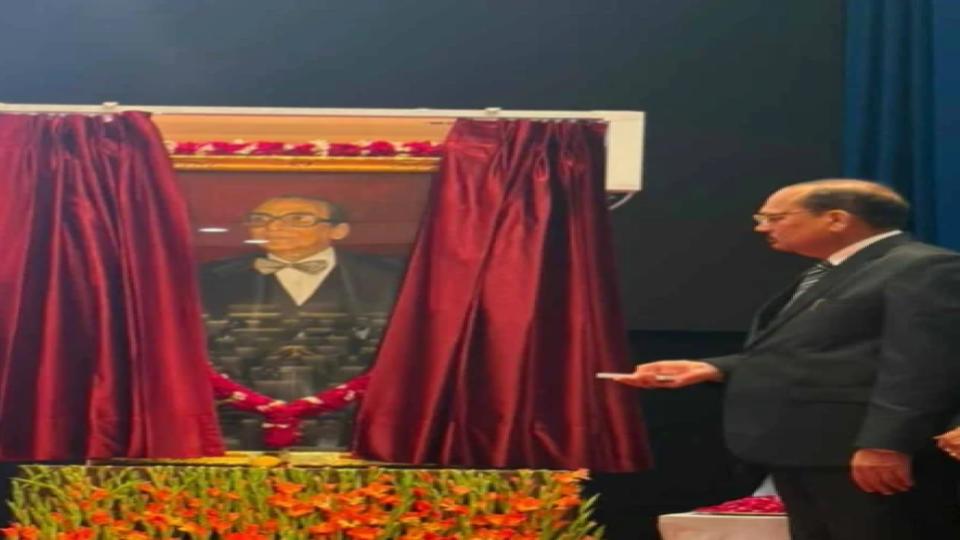
July 30, 2026 : The Supreme Court on Thursday added another chapter to its rich institutional history with the unveiling of the portrait of former Union Law Minister and eminent Senior Advocate Ashoke Kumar Sen at the Supreme Court Library. Speaking at the ceremony organised by the Supreme Court Bar Association (SCBA), Chief Justice of India (CJI) Justice Surya Kant said the memory of the Supreme Court is preserved not only through its landmark judgments but also through the remarkable lives that shaped the institution’s values and conscience.
Describing the occasion as more than a ceremonial tribute, CJI Surya Kant said the portrait symbolises a life dedicated to justice, intellectual excellence and public service. He observed that the installation of Sen’s portrait in the Library permanently honours his contribution to the Indian legal system and serves as an inspiration for generations of lawyers and judges.
Recalling his association with the late legal luminary, the CJI noted that he had delivered the inaugural AK Sen Memorial Lecture two years ago and had reflected on Sen’s extraordinary journey. He described Ashoke Kumar Sen as a scholar of exceptional distinction, a lawyer of immense learning and a statesman who successfully bridged the fields of law and governance with unwavering commitment to the nation.
Justice Surya Kant said the corridors of Supreme Court Library No. 1, adorned with portraits of eminent legal personalities, are not merely spaces of remembrance but sources of inspiration. Every advocate entering the Library in search of legal knowledge, he said, would now encounter Sen’s portrait as a reminder that the legal profession extends far beyond personal ambition and represents a solemn duty towards justice and the Republic.
The Chief Justice also referred to the portraits of former Chief Justices and legendary jurists already displayed across the Supreme Court complex, including Justice H.R. Khanna and Justice B.K. Mukherjea. He said each portrait, whether of a Chief Justice, former Attorney General Soli Sorabjee or now Ashoke Kumar Sen, stands as a guardian of the institution’s ideals while commemorating lives devoted to public service.
According to the CJI, every judge drafting a judgment, every young advocate preparing a petition and every litigant waiting for justice passes beneath these portraits, which silently remind them of the responsibility they carry. He remarked that living up to the standards represented by these towering legal figures is itself an important lesson in the administration of justice.
Highlighting Sen’s exceptional legal abilities, Justice Surya Kant said he was equally proficient in courtroom advocacy and legislative drafting. While most lawyers spend their careers mastering one institution, Sen successfully shaped both the legal profession and public policy through his distinguished service.
The Chief Justice praised Sen’s legendary photographic memory, recalling that he could identify judgments from their exact location on a page within his vast personal legal library. He added that even judges reportedly consulted Sen’s extensive collection while searching for difficult precedents.
Justice Surya Kant observed that official positions and legislative achievements alone cannot explain why certain individuals continue to be remembered with such affection. Rather, he said, it is their personality, character and stories that leave a lasting legacy.
Sharing one such anecdote, the CJI recalled an occasion when a judge questioned Sen’s interpretation of a statutory provision during arguments. Without hesitation, Sen reportedly replied, “Because, My Lords, I drafted it,” prompting laughter in the courtroom while simultaneously demonstrating his unparalleled command over the law.
The Chief Justice also referred to Sen’s famous ability to argue cases with almost no preparation time. Senior members of the Bar, he said, still remember Sen’s remarkable “corridor briefing,” where he would receive a case moments before the hearing and argue it with the confidence and depth of someone who had prepared for weeks. He also cited Justice Dipankar Datta’s observation comparing Sen’s stature to that of Nani Palkhivala, remarking, “You had Palkhivala in Bombay, and Mr. Sen in Kolkata.”
Expressing hope that the portrait would inspire future generations, Justice Surya Kant said young lawyers should constantly ask themselves whether they have prepared adequately, acted fairly towards the Court and their opponents, and used the law to simplify rather than complicate justice.
Concluding his address, the Chief Justice said Ashoke Kumar Sen’s life demonstrates that brilliance without balance is incomplete, public office without service is temporary and law without humanity loses its true purpose. He observed that institutions are strengthened not only through historic judgments and landmark legislation but also through the everyday virtues of preparation, humility, restraint, humour and mutual respect.
Ending on a reflective note, CJI Surya Kant remarked that from this day onward, Ashoke Kumar Sen would remain present within the Supreme Court as “a silent senior, never seeking the floor, yet always entitled to be heard.”