News Citation : 2026 LN (HC) 60 | 2026:CGHC:3318-DB
Bilaspur, January 20, 2026 : The High Court of Chhattisgarh has quashed domestic violence proceedings initiated against a husband and his family, holding that where a Domestic Incident Report (DIR) is vague, lacks material particulars mandated under Section 9 of the Protection of Women from Domestic Violence Act, 2005, and is used as a pressure tactic in matrimonial disputes, the continuation of such proceedings amounts to an abuse of the process of law.
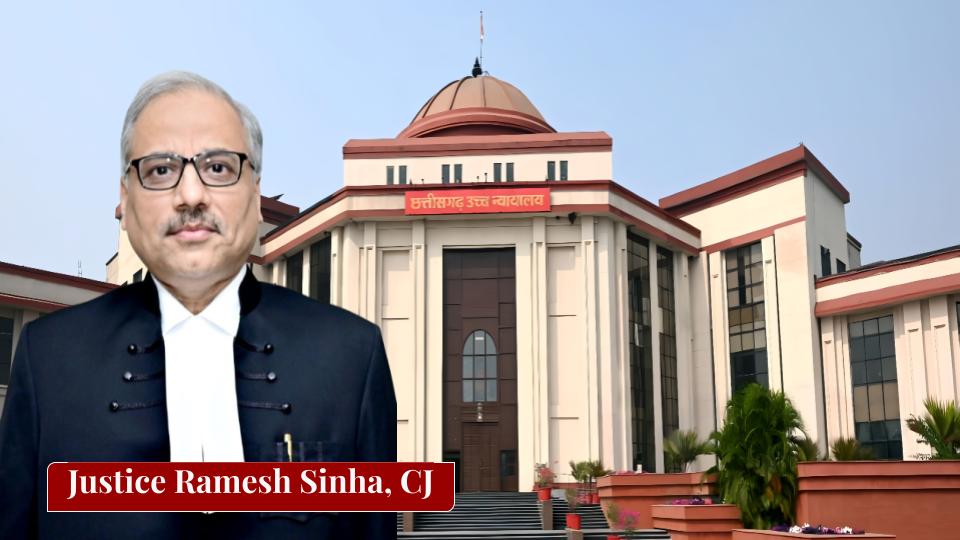
A Division Bench comprising Chief Justice Ramesh Sinha and Justice Ravindra Kumar Agrawal allowed a writ petition filed by the husband, his mother and sister, setting aside the Domestic Incident Report dated 19 October 2022, the application under the DV Act, and an order of the Judicial Magistrate First Class (JMFC), Surajpur, which had earlier refused to drop the proceedings.
The case arose out of a marriage solemnised on 27 June 2018 in Ballia, Uttar Pradesh. Two sons were born from the wedlock, now aged six and four years. The court noted that multiple proceedings had been initiated by both sides across different jurisdictions and that the core dispute between the parties revolved around matrimonial discord and, more particularly, custody of the minor children.
According to the petitioners, marital differences escalated after the birth of the first child, with allegations that the wife insisted on giving the elder son in adoption to her sister, who is separated and childless. When the husband refused, relations allegedly deteriorated further. The wife later left the matrimonial home and, despite a brief return following intervention, disputes continued, culminating in the filing of proceedings under the DV Act in Surajpur. The husband approached the High Court seeking quashing of the DIR and the consequential proceedings, contending that they were a counter-blast in an ongoing custody battle.
After examining the record, the High Court found that the Domestic Incident Report did not disclose essential details such as the date, time, place, or manner of the alleged acts of domestic violence. The allegations of dowry demand and physical or mental cruelty were described as bald and omnibus, with no specific incident, injury, or demand attributed to any particular petitioner. The Bench held that such deficiencies violated the mandatory requirements under Section 9(1)(b) of the DV Act and went to the very root of the proceedings under Section 12 of the Act.
The court also took note of the suppression of material facts relating to other litigations initiated between the parties. It observed that selective disclosure and forum shopping strengthened the inference of mala fide intent. The criminal process, the Bench cautioned, cannot be permitted to be used as a tool for harassment or to gain leverage in collateral matrimonial or custody proceedings.
On the issue of maintainability, the High Court relied on the recent decision of the Supreme Court of India in Shaurabh Kumar Tripathi v. Vidhi Rawal (2025), reiterating that High Courts can exercise jurisdiction under Section 482 of the Code of Criminal Procedure or Article 226 of the Constitution to quash proceedings arising out of applications under the DV Act, though such power must be exercised with caution and only in cases of gross illegality or injustice.
The Bench also found fault with the JMFC’s order dated 26 November 2024, noting that although multiple grounds challenging the maintainability of the proceedings were raised, only one was addressed, rendering the order arbitrary and unsustainable in law.
Applying the principles laid down by the Supreme Court in State of Haryana v. Bhajan Lal (1992), the High Court concluded that allowing the proceedings to continue would amount to an abuse of the process of the court. Accordingly, the writ petition was allowed and all impugned proceedings were set aside. The court clarified that its order would not preclude either party from pursuing appropriate remedies before a competent civil or family court in accordance with law. No order as to costs was passed.
Case Reference : WPCR No. 433 of 2025, Shri Prakash Singh and Others v. State of Chhattisgarh and Others; Counsels: for the Petitioners, Mr. Himanshu Pandey, Advocate; for Respondent No.1–State, Mr. S. S. Baghel, Government Advocate; and for Respondent No.2, Mr. Anurag Singh, Advocate.