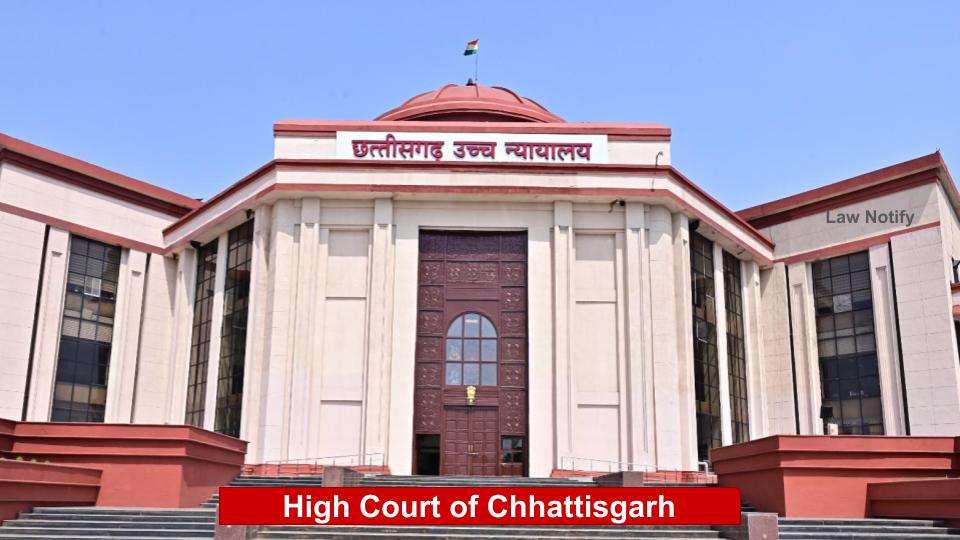
March 15, 2026 : The Chhattisgarh High Court on March 11 directed the District Education Officer (DEO) of Durg to dispose of 118 pending complaints related to the Right to Education (RTE) Act within two weeks, observing that prolonged delays were affecting admissions of poor and disadvantaged students.
The order was passed while hearing a batch of petitions led by WPPIL No. 22 of 2016, C V Bhagvant Rao vs Union of India and Others. The division bench comprising Chief Justice Ramesh Sinha and Justice Ravindra Kumar Agrawal reviewed the status of RTE-related complaints and the implementation of admission provisions for weaker section students.
During the hearing, the court examined an affidavit submitted by the Secretary of the School Education Department, Chhattisgarh, in response to media reports regarding alleged misconduct at DAV Mukhyamantri Public School in Tilsiwa, Surajpur.
According to the affidavit, an inquiry conducted by the District Education Officer of Surajpur revealed that the school principal had allegedly behaved harshly with parents. The investigation also found that the principal was residing on the school premises without authorization from the School Education Department or the DAV management. It further stated that the principal’s husband frequently visited the school campus. While certain complaints regarding harsh behaviour were mentioned, the inquiry could not conclusively verify all allegations.
The court recorded that action had already been taken in the matter. The principal was removed from the post and another teacher was given additional charge of the school.
During the proceedings, counsel representing the petitioner objected to delays in addressing RTE complaints, stating that unresolved cases could disrupt admissions for the upcoming academic session. The bench noted from the affidavit that in Durg district alone, authorities received 172 offline complaints related to RTE admissions. Out of these, only 54 complaints had been resolved, while 118 remained pending.
Taking serious note of the backlog, the High Court directed the DEO of Durg to decide all 118 pending complaints within two weeks from the date of receiving the order.
The court also considered submissions made by intervenor Vikash Tiwari, who appeared in person. He informed the bench that his grievances were forwarded on February 5 by the Deputy Director of the Directorate of Public Instructions (DPI) to DEOs in Durg, Raipur and Bilaspur with directions to take action within one week. However, no action had been taken so far.
The High Court directed the DPI Deputy Director to ensure compliance with the earlier directions and submit a report on the action taken before the next hearing.
In another issue raised before the court, the intervenor alleged that a private school located in Tulsi, Raipur had issued a public advertisement on March 7 inviting admissions for the academic session 2026–27 despite allegedly not having the required government recognition.
Taking note of the allegation, the bench ordered that the school be added as a respondent in the case. The court directed issuance of notice on the intervenor’s application and instructed the state counsel to ensure that the notice is served. The Secretary of the School Education Department was also directed to submit a personal affidavit responding to the allegations.
Separately, the court heard WPC No. 414 of 2026, where the petitioner challenged a communication issued by the School Education Department on December 16, 2025. The communication restricted admissions under Section 12(1)(c) of the RTE Act only to Class 1, excluding pre-school classes from the 25 percent quota meant for children belonging to weaker sections and disadvantaged groups.
Senior counsel Manoj Paranjpe, appearing for the petitioner, argued that the government’s communication was contrary to the provisions of Section 12(1)(c) of the RTE Act and its proviso, which extend the quota to pre-school classes wherever such education is offered by private schools.
He submitted that the state government had consistently implemented the provision since 2010 through circulars issued in 2010, 2015 and 2016. According to him, the new directive created an arbitrary two-tier system by allowing fee-paying students to enter at the pre-school level while excluding children from weaker and disadvantaged backgrounds.
The petitioner also relied on a January 8, 2026 judgment of the Rajasthan High Court that struck down similar restrictions on RTE admissions in pre-school classes.
Considering that the state government was already represented in court, the bench dispensed with the requirement of issuing a formal notice. It directed the respondents to file their reply within one week. The petitioner was allowed to file a rejoinder within an additional week thereafter.
The High Court further asked the Secretary of the School Education Department to explain in his affidavit why the number of reserved seats under the RTE quota had reportedly dropped by about 30,000 from a total of 85,000 seats in the current academic session.
The matters have been listed for further hearing on March 24, 2026.