News Citation : 2026 LN (HC) 239 | 2026:CGHC:16288-DB
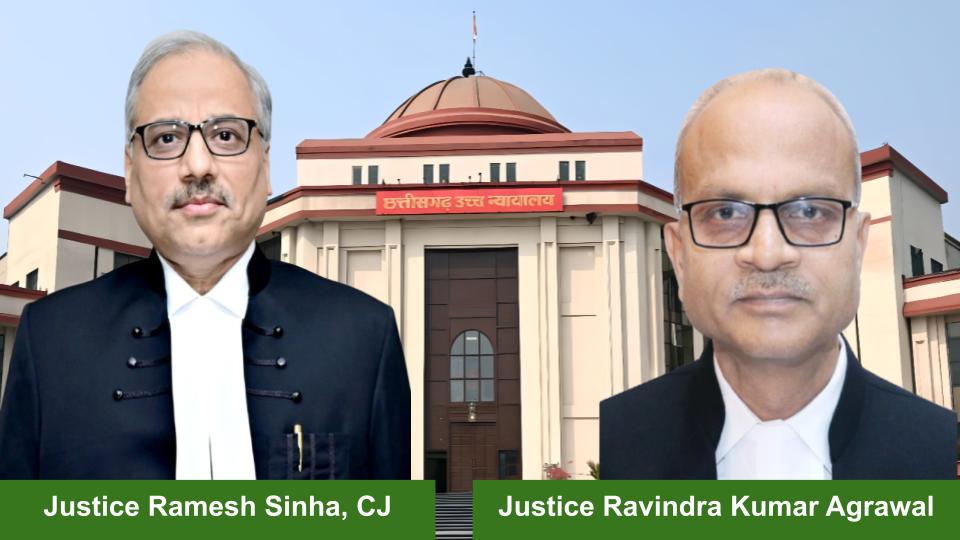
April 9, 2026 : The High Court of Chhattisgarh has delivered a significant ruling emphasizing the necessity for state authorities to strictly adhere to tender conditions, particularly those benefiting Micro and Small Enterprises (MSEs). The Division Bench, comprising Chief Justice Ramesh Sinha and Justice Ravindra Kumar Agrawal, quashed a major dietary services tender after finding that the state had arbitrarily denied mandatory relaxations to a women-led self-help group.
The legal battle began when Adhishri Swa Sahayata Samuh, a self-help group based in Jashpur, challenged the evaluation process of a tender floated by the District Hospital, Jashpur. The tender, valued at approximately Rs. 60,00,000, was intended for providing dietary services. According to the bid documents, any bidder registered as an MSE was entitled to a complete relaxation of the “Experience Criteria” and “Bidder Turnover” requirements. Despite holding a valid Udyam Registration Certificate, the petitioner argued that the authorities failed to apply these exemptions, instead awarding them only partial marks for their turnover.
This administrative decision had a direct impact on the outcome of the contract. During the financial bid stage, the petitioner ended up in a tie with another bidder, M/s Sushil Mishra. However, because of the lower technical marks resulting from the denied relaxation, the petitioner was relegated to the “H2” position while their competitor was declared the successful “H1” bidder. The petitioner contended that had the relaxation been properly applied, they would have secured a superior ranking.
The State defended its actions by claiming the evaluation was conducted objectively under the Quality and Cost Based Selection (QCBS) method. They argued that the turnover requirements were essential to ensure the financial capacity of the service provider and that the petitioner was not entitled to the specific relaxations under prevailing state procurement rules.
However, the High Court found these arguments unsustainable. The Bench noted that once a relaxation is explicitly incorporated into a tender document, it cannot be ignored or diluted during the evaluation phase. The court described the awarding of partial marks rather than a full exemption as a “patent arbitrariness” that destroyed the level playing field essential for public procurement. The judges further criticized the rejection of the petitioner’s initial representation, noting that the authorities failed to address the core grievance and showed a clear non-application of mind.
The court ruled that the entire tender process was vitiated by these illegalities and violated Article 14 of the Constitution, which guarantees equality before the law. Consequently, the High Court quashed the Notice Inviting Tender (NIT) dated February 19, 2026, and set aside all consequential actions, including the declaration of the winning bidder. While the state is at liberty to initiate a fresh tender process, the court mandated that any new process must strictly comply with MSME relaxation provisions to ensure fairness and transparency.
Case Reference : WPC No. 1597 of 2026; Adhishri Swa Sahayata Samuh v. State of Chhattisgarh & Others; Counsels: Mr. Anshul Tiwari for Petitioner, Mr. Shashank Thakur (Addl. AG) for State, and Mr. Jitendra Kumar Saxena for Respondent No. 6.