News Citation : 2026 LN (HC) 301
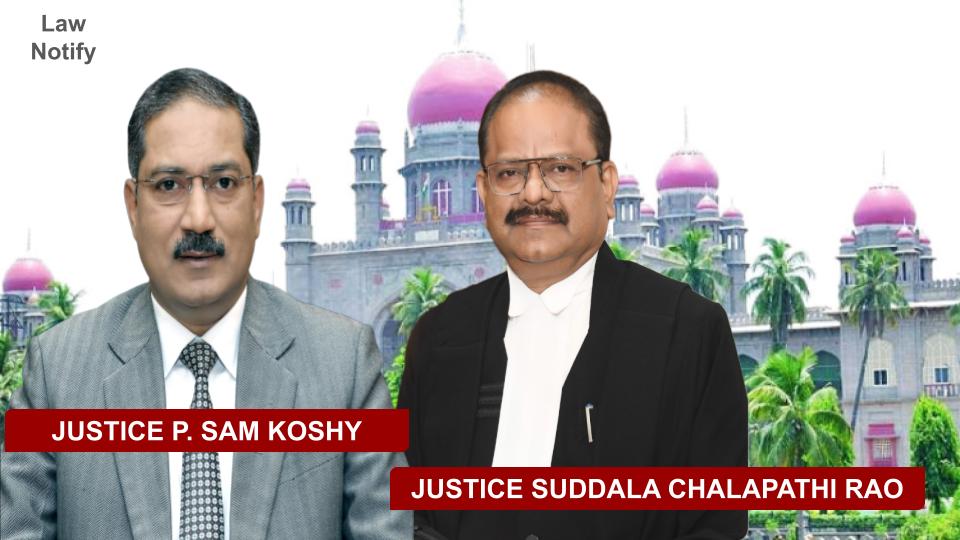
March 26, 2026 : The Telangana High Court has dismissed a batch of writ petitions challenging enforcement action under the Prevention of Money Laundering Act, 2002 (PMLA), upholding both the retention of seized materials and the attachment of properties linked to an alleged large-scale gold smuggling and laundering operation. The ruling came in a common order delivered on March 26, 2026, by a Division Bench comprising Justices P. Sam Koshy and Justice Suddala Chalapathi Rao.
The petitions were filed by Sanjay Agarwal and other family members who questioned orders passed by the Adjudicating Authority permitting the Enforcement Directorate (ED) to retain seized documents and confirming provisional attachment of assets. These actions were part of an investigation into alleged gold smuggling activities traced back to 2018.
According to the case record, the Directorate of Revenue Intelligence (DRI) intercepted one of the accused at Kolkata airport, where gold intended for export was allegedly diverted domestically through cargo channels. Investigators later uncovered what they described as a systematic operation involving the smuggling of large quantities of gold over time. The proceeds of these activities were allegedly routed through multiple bank accounts and layered into business entities and personal accounts, with transactions running into thousands of crores.
Search operations carried out in 2021 led to the seizure of documents and identification of several immovable properties. The ED subsequently issued provisional attachment orders and sought confirmation from the Adjudicating Authority, which upheld the action. These orders were challenged before the High Court.
Before the Court, the petitioners argued that the retention of seized materials was barred by limitation under Section 5(1) of the PMLA and that the adjudicating authority lacked proper composition since the order was passed by a single member. They also contended that there was no credible evidence linking their properties to proceeds of crime and that the findings were based on conjecture.
The High Court rejected these arguments, holding that the statutory framework under the PMLA allows the Adjudicating Authority to function through a bench consisting of one or more members. It clarified that the relevant provisions are directory in nature and do not mandate a multi-member bench in every case. The Court found no jurisdictional error in the order passed by the Chairperson acting alone.
On the issue of limitation, the Bench observed that the Supreme Court’s orders extending limitation during the COVID-19 pandemic were applicable, and therefore the timeline followed by the authority could not be faulted. It further held that even if there were minor procedural irregularities, they would not invalidate the proceedings in the absence of demonstrable prejudice.
Examining the merits, the Court concluded that there was sufficient prima facie material to justify the ED’s action. It noted the pattern of financial transactions, the transfer of properties between related parties, frequent communication between the accused, and the failure of the petitioners to provide verifiable evidence of legitimate sources of income. The Court also took note of their lack of cooperation during the investigation.
The Bench emphasized that proceedings under the PMLA at the stage of attachment require only a prima facie satisfaction based on available material and not proof beyond reasonable doubt. It also reiterated the statutory expectation that individuals must explain the source of assets when questioned in money laundering cases.
Finding no illegality or infirmity in the orders of the Adjudicating Authority, the Court dismissed all three writ petitions and upheld both the retention of seized materials and the confirmation of provisional attachment. It observed that the petitions appeared to be an attempt to delay or obstruct proceedings under the PMLA.
Case Reference : WP Nos.45761, 31957 & 31958 of 2022, Lateef Rahman Sharfan and others vs Union of India, Ministry of Finance; Counsel for petitioners: Mr. Sanjay Agarwal (party-in-person in WP No.45761 of 2022) and Mr. Vedula Srinivas, learned Senior Counsel for Ms. Vedula Chitralekha in WP Nos.31957 and 31958 of 2022; Counsel for respondent: Mr. A.R.N. Sundareshan, learned Additional Solicitor General of India, for Mr. Anil Prasad Tiwari, learned Standing Counsel for ED.