News Citation : 2026 LN (HC) 375
June 15, 2026 : The Chhattisgarh High Court has dismissed a writ appeal filed by the State Government after refusing to condone an extraordinary delay of 751 days in approaching the court. In a significant ruling reinforcing the strict application of limitation laws, the Division Bench observed that government departments cannot seek special treatment merely because administrative procedures and bureaucratic processes consumed time. The court held that the State failed to demonstrate any “sufficient cause” for the prolonged delay and, therefore, was not entitled to the discretionary relief of condonation.
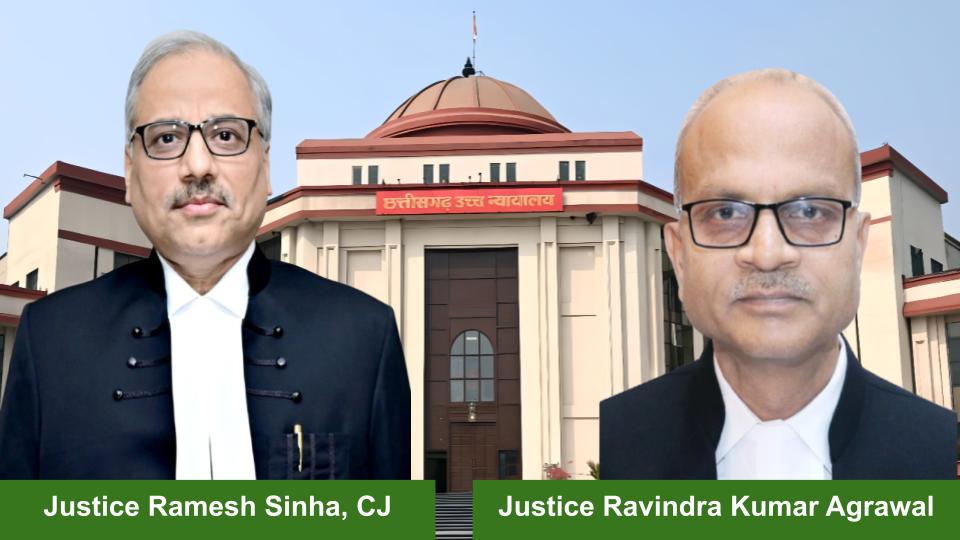
The judgment was delivered by a Division Bench comprising Chief Justice Ramesh Sinha and Justice Ravindra Kumar Agrawal in State of Chhattisgarh v. Praveen Singh and Another (WA No. 464 of 2026). The appeal challenged an order passed by a Single Judge on January 11, 2024, in WPS No. 1658 of 2016. However, the State approached the appellate court after a delay of 751 days and sought condonation under the law governing limitation.
According to the State Government, the delay occurred because time was required to obtain relevant records, secure departmental approvals, process administrative formalities, and complete internal governmental procedures before filing the appeal. The State argued that its administrative structure involves multiple levels of scrutiny and approval, which often results in procedural delays. It contended that the delay was neither deliberate nor intentional and arose solely due to administrative exigencies. The State also relied on Supreme Court precedents including State of Nagaland v. Lipok Ao and State of Manipur v. Koting Lamkang in support of its plea for condonation.
The High Court, however, was not persuaded by these explanations. Referring extensively to the Supreme Court’s decision in Postmaster General v. Living Media India Ltd. (2012), the Bench emphasized that the law of limitation applies equally to all litigants, including government departments. The court reiterated the Supreme Court’s observation that routine explanations involving file movements, bureaucratic red tape, and administrative delays can no longer be accepted as sufficient justification in an era of modern governance and technology.
Quoting the Supreme Court, the High Court highlighted that: “The law of limitation undoubtedly binds everybody including the Government” and that “Condonation of delay is an exception and should not be used as an anticipated benefit for government departments.”
The Bench further relied on the Supreme Court’s recent judgment in State of Madhya Pradesh v. Ramkumar Choudhary (2024), which clarified that courts must exercise their discretion to condone delay judiciously and only when a party establishes a genuine and adequate reason preventing timely filing. The Supreme Court had emphasized that negligence, inaction, lack of diligence, or absence of bona fides cannot constitute “sufficient cause” under limitation law. The High Court observed that the principles laid down by the apex court leave little room for condoning inordinate delays that remain unexplained.
The judgment also discussed a broader concern repeatedly raised by the Supreme Court regarding governmental litigation. The Bench noted that public authorities often attempt to justify delays by referring to internal administrative procedures without adequately explaining why they could not act within the prescribed limitation period. The court stressed that the crucial inquiry is not what happened after the limitation period expired, but what prevented the litigant from filing the case within the statutory period itself.
Significantly, the High Court referred to the Supreme Court’s observations cautioning constitutional courts against becoming enablers of governmental lethargy. It cited the decision in Shivamma (Dead) by LRs v. Karnataka Housing Board & Others (2025), where the apex court held that High Courts must remain particularly vigilant when State authorities seek condonation of delay and should not legitimize administrative apathy.
Applying these principles to the present case, the Bench found that the State had offered only a vague explanation that the Law and Legislative Affairs Department had forwarded a proposal to the Office of the Advocate General and that the matter was thereafter processed through official channels. The court held that such assertions lacked specificity and failed to disclose any compelling circumstances that prevented timely filing.
The court observed that “the State has miserably failed to demonstrate sufficient cause warranting the condonation of an inordinate delay of 751 days.” It further held that no convincing, bona fide, or legally acceptable explanation had been presented to justify exercising discretionary powers in favour of the State.
The ruling carries important implications for government litigation across India. It reinforces the principle that State authorities do not enjoy a separate or relaxed limitation regime and must comply with statutory timelines like any private litigant. The judgment underscores judicial intolerance toward casual explanations based on administrative inefficiency and signals that courts are increasingly insisting on accountability within government departments handling legal matters.
By refusing to condone the delay, the High Court reaffirmed that limitation statutes serve an important public purpose by ensuring certainty, finality, and timely resolution of disputes. The decision also reflects the judiciary’s continuing effort to curb avoidable delays in government litigation, which constitute a significant portion of the country’s court backlog.
Finding no sufficient cause for the delay and no justification for invoking its discretionary jurisdiction, the Division Bench dismissed the writ appeal solely on the ground of delay and laches, bringing the proceedings to an end.
Case Reference: State of Chhattisgarh Through the Secretary, Home Department v. Praveen Singh & Anr., WA No. 464 of 2026,