News Citation : 2026 LN (HC) 376
June 15, 2026 : the Chhattisgarh High Court has reaffirmed that government authorities cannot seek condonation of delay as a matter of routine and must provide a satisfactory explanation for every day of delay when filing an appeal. Dismissing an intra-court appeal filed by the Accountant General’s Office, the Division Bench held that a 65-day delay remained unexplained and therefore the appeal was barred by limitation.
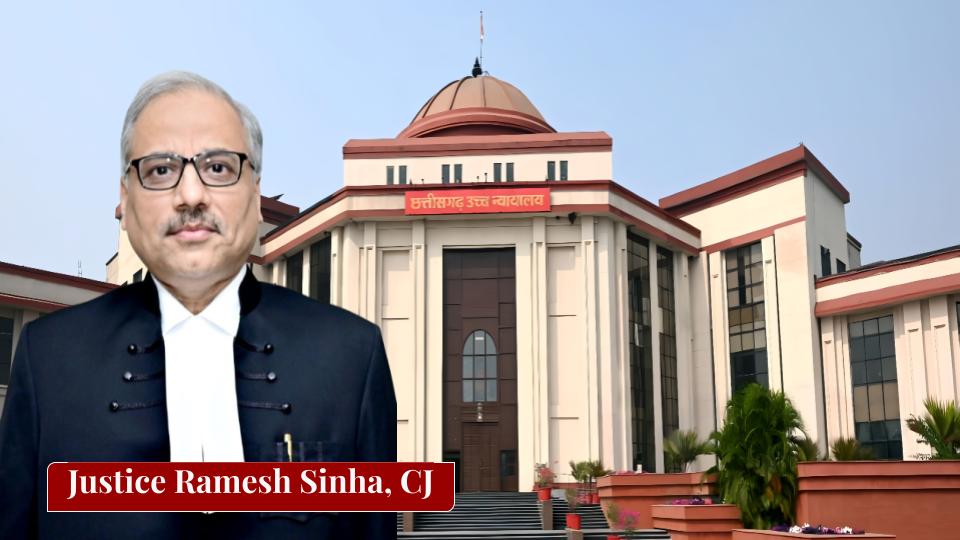
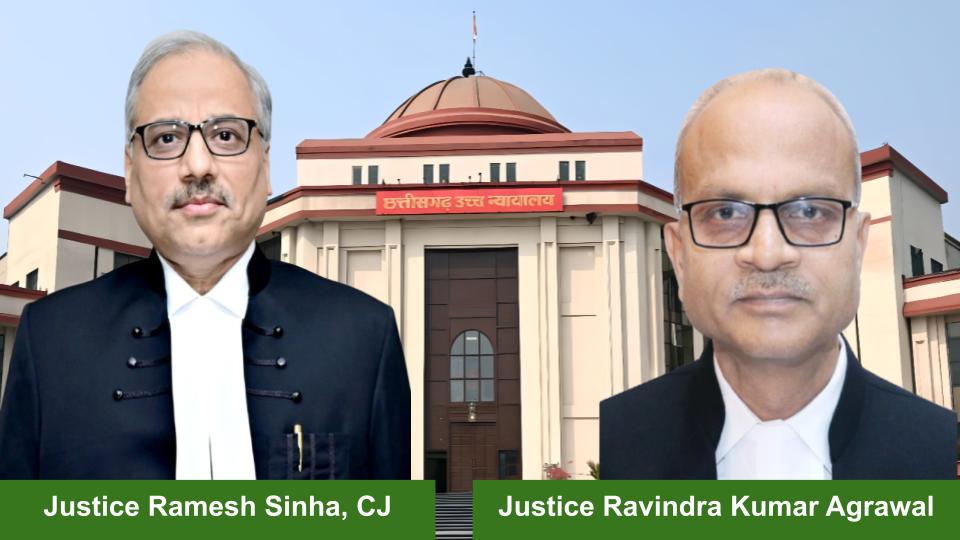
The ruling was delivered by a Division Bench comprising Chief Justice Ramesh Sinha and Justice Ravindra Kumar Agrawal in The Accountant General (A&E) and Others v. Sita Ram Sahu and Others (WA No. 418 of 2026). The Bench refused to condone the delay and consequently dismissed the writ appeal challenging an earlier order passed by a Single Judge in WPS No. 9330 of 2022.
The appeal arose from an order dated December 10, 2025, through which a Single Judge had disposed of a writ petition filed by Sita Ram Sahu. Aggrieved by that decision, the Accountant General’s Office and other authorities approached the Division Bench. However, the appeal itself was filed beyond the prescribed limitation period, prompting the appellants to move an interlocutory application seeking condonation of a 65-day delay.
After examining the application, the High Court found that the appellants had failed to provide a day-to-day explanation for the delay. The Bench observed that no satisfactory cause had been shown to justify the belated filing of the appeal. In the absence of an adequate explanation, the court concluded that the matter suffered from delay and laches and could not be entertained.
While rejecting the application, the court relied extensively on the Supreme Court’s landmark judgment in Union of India v. Tarsem Singh (2008) 8 SCC 652. The apex court had clarified that delayed service-related claims are generally liable to be rejected on grounds of limitation or laches, except in cases involving a continuing wrong that creates a recurring source of injury. The Supreme Court had also noted that claims relating to pension or pay fixation may, in appropriate circumstances, survive despite delay because they do not ordinarily affect third-party rights. However, stale claims involving seniority, promotion, or matters affecting others are usually not entertained.
The Division Bench also referred to the Supreme Court’s decision in C. Jacob v. Director of Geology and Mining (2008) 10 SCC 115, which emphasized that stale or time-barred claims can be rejected solely on the ground of limitation without examining their merits. The apex court had further held that repeated representations or subsequent departmental replies do not revive a dead claim or create a fresh cause of action.
Quoting the Supreme Court’s reasoning, the High Court reiterated that “representations relating to matters which have become stale or barred by limitation can be rejected on that ground alone, without examining the merits of the claim.” The Bench also highlighted the principle that judicial directions to consider a representation do not automatically revive a time-barred dispute.
The court underscored the importance of limitation laws in maintaining certainty and finality in legal proceedings. Limitation statutes are designed to ensure that litigants pursue remedies diligently and that disputes are not reopened after unreasonable delays. Courts have consistently held that condonation of delay is an exception rather than a rule and requires a convincing explanation demonstrating sufficient cause.
Applying these settled principles, the Division Bench concluded that the grounds cited by the Accountant General’s Office were insufficient to justify condonation of the 65-day delay. The court stated, “We do not find any sufficient cause to condone the delay of 65 days in preferring the present writ appeal.” Consequently, the interlocutory application seeking condonation of delay was rejected.
As a result, the writ appeal itself was dismissed as time-barred without the court examining the substantive merits of the challenge. The judgment serves as another reminder that government departments and public authorities are equally bound by limitation requirements and must provide a detailed and credible explanation when approaching courts after the expiry of the statutory period.
The decision is likely to have wider significance in service and pension-related litigation, where delayed appeals and representations frequently arise. By reiterating the principles laid down in Tarsem Singh and C. Jacob, the Chhattisgarh High Court has reinforced the doctrine that stale claims cannot ordinarily be revived through delayed litigation and that procedural timelines remain an essential component of the justice delivery system.
Case Reference: The Accountant General (A&E) & Others v. Sita Ram Sahu & Others, WA No. 418 of 2026