News Citation : 2026 LN (HC) 377
June 15, 2026 : In a significant ruling on the distinction between murder and culpable homicide under the Indian Penal Code (IPC), the Chhattisgarh High Court has altered the conviction of a man sentenced to life imprisonment for the death of Umesh Rathiya, holding that the incident arose out of a sudden quarrel and lacked the intention necessary to sustain a conviction for murder under Section 302 IPC. The Court converted the conviction to Section 304 Part II IPC and substantially reduced the sentence.
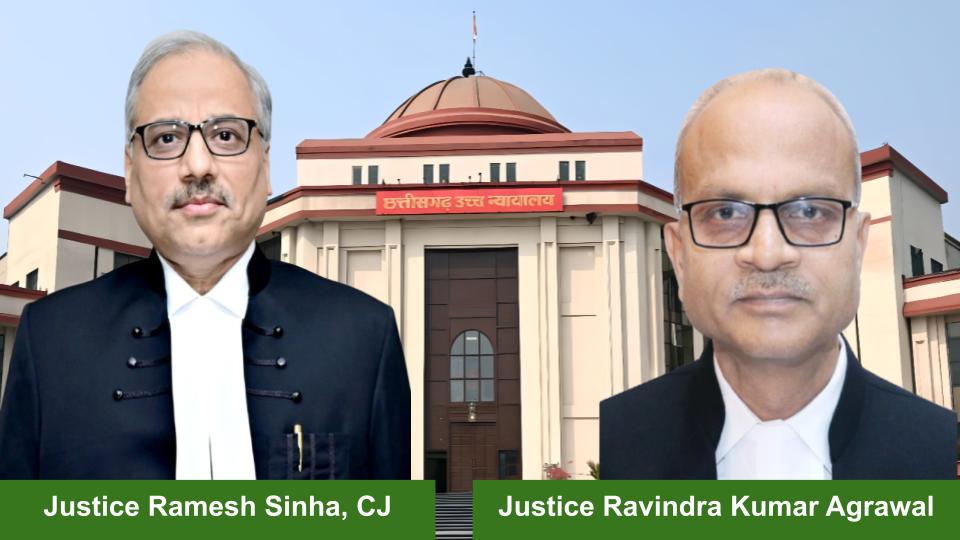
The Division Bench comprising Chief Justice Ramesh Sinha and Justice Ravindra Kumar Agrawal delivered the judgment in Sanjay Mishra v. State of Chhattisgarh, allowing the criminal appeal in part and holding that although the accused was responsible for the fatal assault, the circumstances of the case did not establish the requisite intention to commit murder.
According to the prosecution, the incident occurred on January 21, 2022, in Chotiguda village of Raigarh district. A dispute reportedly broke out between Sanjay Mishra and Umesh Rathiya near a roadside snack stall over a motorcycle and its keys. Witnesses stated that after an initial altercation, the accused returned carrying a sharp iron rod and attacked Rathiya, inflicting a serious injury in the abdominal region. The victim collapsed and suffered severe bleeding. He later died due to hemorrhagic shock caused by excessive blood loss.
Following the incident, an FIR was registered at Gharghoda Police Station under Section 302 IPC. After investigation, a charge sheet was filed and the case proceeded to trial before the Additional Sessions Judge, Gharghoda. The trial court convicted Mishra of murder and sentenced him to life imprisonment along with a fine of ₹1,000.
Before the High Court, the appellant did not dispute the occurrence of the incident but argued that the conviction for murder was legally unsustainable. His counsel contended that the assault was the result of a sudden quarrel, there was no prior enmity or premeditated plan to kill the deceased, and only a single blow had been inflicted. It was argued that the case fell within Exception 4 to Section 300 IPC, which deals with acts committed without premeditation during a sudden fight in the heat of passion. The defence therefore sought conversion of the conviction from Section 302 IPC to Section 304 IPC.
The State opposed the appeal and maintained that the trial court had correctly convicted the accused for murder. It argued that the fatal injury was intentionally inflicted with a sharp iron rod and was sufficient to attract the offence of murder punishable under Section 302 IPC.
Examining the evidence on record, the High Court first affirmed the finding that the death of Umesh Rathiya was homicidal. The Bench relied on the post-mortem findings and medical testimony showing that the victim died due to hemorrhagic shock resulting from a sharp-force injury. The Court observed that the nature and location of the wound ruled out accidental or self-inflicted causes and clearly pointed to an intentional assault.
The Court also upheld the prosecution’s case regarding the identity of the assailant. It relied on eyewitness accounts, particularly the testimony of the deceased’s wife Jagmoti Rathiya, whose version was found credible and corroborated by other witnesses as well as medical evidence. The Bench concluded that the prosecution had successfully proved beyond reasonable doubt that Sanjay Mishra had inflicted the fatal injury that led to Rathiya’s death.
The central issue before the Court was whether the act amounted to murder under Section 302 IPC or culpable homicide not amounting to murder under Section 304 IPC. While analysing this question, the Bench undertook a detailed examination of the distinction between “intention” and “knowledge” under Sections 299 and 300 IPC. The Court referred extensively to recent Supreme Court decisions, including Anbazhagan v. State and Velthepu Srinivas v. State of Andhra Pradesh, which discuss situations where a conviction for murder can be altered to culpable homicide when intention to cause death is not established.
The High Court noted that there was no evidence of prior planning or motive. It observed that the incident erupted suddenly during a quarrel and that only a single blow was inflicted. The Bench emphasized that while the injury was undoubtedly serious and capable of causing death, the surrounding circumstances did not conclusively demonstrate an intention to kill. Instead, the accused could reasonably be attributed with knowledge that his act was likely to cause death.
Explaining the legal distinction, the Court observed that intention involves a conscious objective to bring about a particular consequence, whereas knowledge denotes awareness that a consequence is likely to occur. Applying this principle, the Bench held that the prosecution had failed to prove beyond reasonable doubt that the accused intended to cause death or intended to inflict a specific injury sufficient in the ordinary course of nature to cause death. However, it was clear that he knew the consequences that could follow from striking the victim with a sharp iron rod.
The Court specifically held that the case satisfied the requirements of Exception 4 to Section 300 IPC. It found the presence of a sudden quarrel, absence of premeditation, occurrence in the heat of passion, and lack of undue advantage or cruel conduct. The Bench observed: “The occurrence arose due to the deceased’s objection… in the heat of passion. In such a setting, it would not be proper to ascribe to him the intention of causing death.” It further noted that “knowledge is clearly attributable, and the case squarely falls within the ambit of Section 304 Part II IPC.”
The judgment is legally significant because it reiterates that not every homicide resulting in death amounts to murder. Indian criminal law recognizes varying degrees of culpability depending on the accused’s mental state at the time of the act. The ruling reinforces the principle that courts must carefully distinguish between intention and knowledge before imposing the severe punishment prescribed under Section 302 IPC.
While maintaining that the accused was criminally responsible for the death, the Court concluded that the offence was culpable homicide not amounting to murder. Accordingly, it set aside the conviction under Section 302 IPC and convicted the appellant under Section 304 Part II IPC. The Bench observed that sentencing must balance deterrence with proportionality, particularly where a death results from a spontaneous altercation rather than a calculated act.
Consequently, the High Court modified the sentence and directed that the appellant undergo rigorous imprisonment for five years under Section 304 Part II IPC. The criminal appeal was partly allowed, and the jail authorities were directed to inform the appellant of his right to challenge the judgment before the Supreme Court with the assistance of legal services authorities.
The ruling is expected to be cited in future cases involving single-blow incidents and sudden fights, particularly where courts are required to assess whether the evidence establishes intention to commit murder or merely knowledge of the likely consequences of the act. By applying Exception 4 to Section 300 IPC, the High Court has once again emphasized that criminal liability must be determined not only by the result of an act but also by the state of mind accompanying it.
Case Reference: Sanjay Mishra v. State of Chhattisgarh, Criminal Appeal (CRA) No. 1526 of 2025