News Citation : 2026 LN (HC) 404
July 22, 2026 : The Chhattisgarh High Court has upheld the acquittal of a man accused of rape and wrongful confinement in a 2016 case from Janjgir-Champa district, holding that the prosecution failed to establish the charges beyond reasonable doubt. The Division Bench observed that while the testimony of a prosecutrix can, in appropriate cases, be sufficient to sustain a conviction, it must inspire complete confidence and remain consistent with the surrounding evidence. Finding material contradictions, lack of corroborative medical and forensic evidence, and no perversity in the trial court’s appreciation of the evidence, the High Court dismissed the State’s appeal against acquittal.
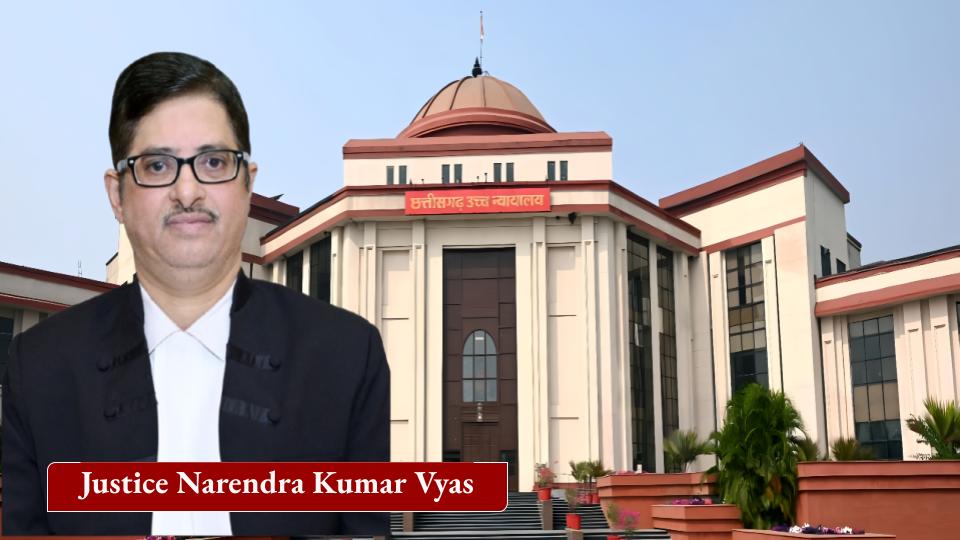
The judgment was delivered on 22 July 2026 by a Division Bench comprising Justice Sanjay S. Agrawal and Justice Narendra Kumar Vyas, affirming the judgment dated 14 June 2016 passed by the Additional Sessions Judge (Fast Track Court), Janjgir, in Sessions Trial No. 88 of 2016. The respondent had been acquitted of offences punishable under Sections 342 (wrongful confinement) and 376 (rape) of the Indian Penal Code.
According to the prosecution, the complainant alleged that on 8 February 2016 she had visited the accused’s house to collect rice and money distributed during the tenth-day death ceremony of the accused’s father. It was alleged that the accused took advantage of her being alone, forcibly carried her into a room, locked the door from inside, and sexually assaulted her. The FIR further stated that the accused allegedly offered her money and threatened her with consequences if she disclosed the incident. Following registration of the FIR, the police conducted the investigation, prepared the site map, obtained medical examination reports, seized clothing of both parties, secured forensic examination, and filed a charge sheet under Sections 342 and 376 IPC.
The trial court, after evaluating the oral, medical and documentary evidence, concluded that the prosecution had failed to prove the allegations beyond reasonable doubt and acquitted the accused. Challenging that verdict, the State argued before the High Court that the trial court had improperly appreciated the evidence, particularly the testimony of the prosecutrix, and that the prompt lodging of the FIR supported the prosecution case. The defence, however, contended that the prosecutrix’s evidence contained material inconsistencies, lacked the quality required for conviction without corroboration, and that the acquittal was based on a plausible appreciation of the evidence.
After examining the record, the High Court found significant inconsistencies regarding the alleged place of occurrence. While the prosecutrix deposed that she had been forcibly taken into a room where the assault allegedly took place, the site plan prepared on the basis of her own information identified the place of occurrence as an open veranda. The Bench observed that although a site plan is not substantive evidence, it is an important corroborative circumstance for assessing whether the prosecution version is probable. The Court held that this contradiction struck at the very foundation of the prosecution case and affected the credibility of the prosecution’s narrative.
The Court also noted that the medical evidence did not support the prosecution version. The examining doctor found no external or genital injuries on the prosecutrix and recorded that she was habituated to sexual intercourse. The forensic report detected human sperm on the prosecutrix’s clothing, but the quantity was insufficient for serological examination, while no human sperm was detected on the accused’s undergarments. The Bench further took note of evidence suggesting prior disputes between the parties, including allegations that the accused had earlier assaulted the complainant’s husband and that there had been a monetary dispute connected with work performed during the death ceremony. These surrounding circumstances, according to the Court, created additional doubt regarding the prosecution case.
Relying on the Supreme Court’s decisions in Santosh Prasad v. State of Bihar (2020) 3 SCC 443, Nirmal Premkumar v. State represented by Inspector of Police (2024) 20 SCC 293, State of Haryana v. Bhagirath (1995) 5 SCC 96, and Constable 907 Surendra Singh v. State of Uttarakhand (2025 INSC 114), the High Court reiterated that a conviction can rest solely on the testimony of the prosecutrix if she qualifies as a “sterling witness” whose evidence is consistent, reliable and inspires complete confidence. However, where material inconsistencies and circumstances create reasonable doubt, the benefit must go to the accused. The Court observed that “the statement of the victim ought to be consistent without creating any doubt qua the prosecution’s case” and that appellate courts should interfere with an acquittal only when the trial court’s findings are patently perverse or based on a clear misreading of material evidence.
Holding that the trial court’s view was a reasonable and possible view based on the evidence on record, the Division Bench concluded that the findings were neither arbitrary nor perverse. Since the prosecution had failed to prove the charges beyond reasonable doubt, no interference with the acquittal was warranted. The State’s acquittal appeal was accordingly dismissed, reaffirming the settled criminal law principle that suspicion, however strong, cannot replace proof beyond reasonable doubt.
The ruling reinforces the legal principle governing appeals against acquittal by emphasizing that appellate courts will not substitute their own view merely because another conclusion is possible. The judgment also reiterates that while courts remain sensitive to allegations of sexual offences, convictions must still satisfy the rigorous standard of proof required under criminal law, ensuring fairness to both the complainant and the accused.
Case Reference: State of Chhattisgarh v. Leelakram Kurmi, ACQA No. 290 of 2018 (Division Bench: Justice Sanjay S. Agrawal and Justice Narendra Kumar Vyas). Citation: 2026:CGHC:31092-DB.