News Citation : 2026 LN (HC) 432
The Chhattisgarh High Court at Bilaspur has dismissed a criminal appeal filed by three Odisha residents convicted in a ganja smuggling case, holding that the prosecution had sufficiently established the recovery, seizure and chain of custody of the narcotic substance. The Court found no material illegality or perversity in the trial court’s judgment and affirmed the four-year rigorous imprisonment and fine imposed on each accused under Section 20(b)(ii)(B) of the Narcotic Drugs and Psychotropic Substances Act, 1985.
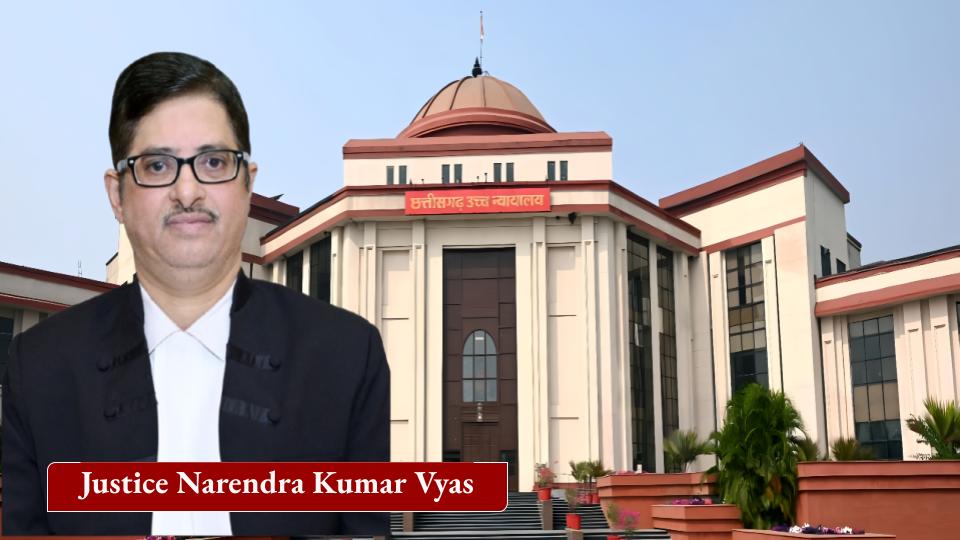
Justice Narendra Kumar Vyas delivered the judgment on August 24, 2026, in Criminal Appeal No. 1788 of 2019. The appeal challenged the November 20, 2019 judgment of the Special Judge (NDPS Act), Mahasamund, which had convicted Bhagwan Nayak, Upendra Kanta and Vaishnav Vishal. The High Court had reserved its judgment on July 10, 2026.
According to the prosecution case, police personnel along with Railway Protection Force staff were conducting checks near the old goods godown and Jay Ambey Dharamkanta area of Mahasamund on April 5, 2018. The three accused were allegedly found carrying backpacks and were intercepted on suspicion. During questioning, they allegedly disclosed that the bags contained ganja purchased in Junagarh, Odisha, which they had brought to Mahasamund for illegal sale.
The police recovered packets wrapped in brown adhesive tape from the bags. The prosecution initially recorded the total recovery as 40 kilograms, with 15 kilograms allegedly recovered from Bhagwan Nayak, 10 kilograms from Upendra Kanta and 15 kilograms from Vaishnav Vishal. The High Court, while considering the final quantity for sentencing, recorded the recoveries as 15 kilograms, 9.9 kilograms and 15 kilograms, respectively, totaling 39.9 kilograms.
The seized substance was subjected to physical identification, including examination by rubbing, smelling and tasting, and was identified as ganja. Samples were prepared and subsequently sent to the Forensic Science Laboratory at Raipur. The FSL report dated April 19, 2018 confirmed that the seized substance was ganja. An FIR, Crime No. 154/2018, was thereafter registered at Mahasamund police station and the accused were prosecuted under the NDPS Act.
During the appeal, the accused challenged the conviction on several grounds. Their counsel argued that independent witnesses had turned hostile and that the investigating officer had also not fully supported the prosecution case. The defence further alleged irregularities concerning the sealing and numbering of samples, non-compliance with Sections 52 and 52A of the NDPS Act, deficiencies in the malkhana records and non-production of the bulk contraband before the trial court.
A major argument before the High Court concerned an alleged discrepancy in the seals placed on the samples. The defence pointed out that the malkhana records referred to an “M.S.D.” seal, while the samples received by the forensic laboratory carried the Police Station Mahasamund seal. According to the appellants, this discrepancy raised a possibility of tampering and created reasonable doubt about whether the samples analysed by the FSL were the same samples seized from them.
The High Court, however, rejected this contention after examining the malkhana register and other evidence. The Court found that the seized articles and six samples had been deposited in the malkhana on April 5, 2018, while three samples were sent for forensic examination on April 7, 2018 and were received by the FSL on the same day. The Court therefore concluded that there was no break in the chain of custody.
The Court observed that the change or discrepancy in sample numbering did not by itself establish that the samples tested by the laboratory were different from those seized. Referring to the Supreme Court’s decision in Rizwan Khan v. State of Chhattisgarh, the Court noted that a clerical discrepancy in sample numbering would not be sufficient to undermine the prosecution case where the evidence otherwise establishes that the seized and sealed samples were sent to the FSL.
The defence also argued that the prosecution had failed to comply with the statutory safeguards under Section 52A of the NDPS Act and that the samples sent for chemical analysis were not the samples prepared during the proceedings before the Executive Magistrate. The High Court rejected this argument after examining the testimony of the Executive Magistrate and investigating officer.
The Court found that the Executive Magistrate had carried out the physical verification, inventory and sampling proceedings. The relevant panchnama was prepared in the presence of witnesses, photographs were taken during the weighing process and the Magistrate had affixed her seal and signature. The Court therefore held that the defence had failed to demonstrate any procedural defect serious enough to invalidate the prosecution case.
While discussing Section 52A of the NDPS Act, the High Court relied on the Supreme Court’s decision in Bharat Aambale v. State of Chhattisgarh. The Court reiterated the principle that even where there is some procedural non-compliance, it does not automatically result in acquittal. The prosecution can still establish recovery and seizure through credible evidence, including the testimony of the seizing officer, independent witnesses and other material demonstrating the chain of custody.
The judgment explained that “procedural lapses must be viewed in the context of the overall evidence” and that the court must examine whether the prosecution has ultimately proved its case beyond reasonable doubt. This approach places emphasis on the evidentiary value of the entire record rather than treating every procedural irregularity as automatically fatal to an NDPS prosecution.
The appellants had also argued that the bulk quantity of seized ganja was not produced before the court and that the investigating officer could not state during cross-examination where the remaining contraband was kept or what its condition was. According to the defence, this circumstance created further doubt about the alleged recovery.
The High Court again rejected the argument. It found that the prosecution had produced the samples along with the FSL report and had sufficiently correlated those samples with the seized contraband. The Court also noted that the accused had signed or affixed their thumb impressions on relevant sampling documents. Although some independent witnesses had turned hostile, they had admitted their signatures on the documents, while the prosecution case was also supported by the evidence of the investigating officer.
The Court therefore distinguished the Supreme Court’s ruling in Vijay Pandey v. State of Uttar Pradesh, relied upon by the defence, observing that the factual circumstances in the present case were different. In particular, the High Court found that the prosecution had established the relationship between the seized substance and the samples subjected to forensic analysis.
The High Court also considered the accused’s plea that their sentence should be reduced to the period already undergone. The record showed that they had remained in custody for approximately two years and four months. The defence argued that, considering the period already spent in custody, the sentence should be reduced accordingly.
The Court declined to grant that relief. It noted that the recovered quantity was greater than the small quantity but below the commercial quantity prescribed under the NDPS Act. Section 20(b)(ii)(B) provides for rigorous imprisonment that may extend to 10 years, along with a fine, for possession of cannabis involving a quantity greater than the small quantity but less than the commercial quantity.
In the present case, the trial court had imposed four years of rigorous imprisonment on each accused along with a fine of Rs. 10,000. The High Court considered this sentence to be appropriate and already lenient in the circumstances. Referring to the Supreme Court’s decision in Rizwan Khan, the Court emphasized the seriousness of offences involving narcotic drugs and declined to substitute the sentence with the period already undergone.
The Court made a broader observation about the social consequences of drug trafficking and the legislative purpose of the NDPS Act. It stated that the statute must be interpreted keeping in view its object and purpose and the impact of narcotic drugs on society. The Court observed that “the problem of drug addicts and mafia are working throughout the world and it is a crime against the society”, emphasizing the need for strict enforcement of the anti-narcotics law.
Ultimately, the High Court held that the trial court had properly appreciated both oral and documentary evidence and that its findings were not affected by illegality, perversity or material irregularity. The criminal appeal was therefore dismissed and the conviction and sentence were affirmed.
The Court has also cancelled the bail bonds of the three appellants and directed them to surrender before the concerned trial court on October 8, 2026, to serve the remaining portion of their sentences. The judgment further provides that they will receive the benefit of set-off in accordance with Section 428 of the Code of Criminal Procedure or the corresponding provision referred to by the Court under the Bharatiya Nagarik Suraksha Sanhita, 2023. If they fail to surrender on the specified date, the trial court has been directed to take necessary steps and submit a compliance report to the High Court.
The ruling is significant for NDPS prosecutions because it reiterates that alleged procedural irregularities concerning sampling, sealing, malkhana records or Section 52A compliance must be assessed against the complete evidentiary record. A discrepancy will not necessarily result in acquittal where the prosecution can otherwise establish the identity of the seized substance, maintain the chain of custody and prove the recovery beyond reasonable doubt. At the same time, the judgment underscores the importance of strict procedural compliance in narcotics cases, particularly because the consequences of conviction under the NDPS Act are severe.
The case also illustrates the distinction between a minor procedural discrepancy and a defect that actually creates reasonable doubt about the identity or custody of the seized narcotic substance. In this matter, the High Court concluded that the evidence, taken as a whole, sufficiently established the recovery and forensic identity of the ganja. On that basis, the Court found no reason to interfere with the conviction recorded by the Special NDPS Court at Mahasamund.