News Citation : 2026 LN (HC) 379
June 15, 2026 : The Chhattisgarh High Court has upheld the conviction and 14-year prison sentence awarded to a man found in possession of 40 kilograms of ganja, ruling that the recovery from a vehicle parked in a public place attracted the provisions of Section 43 of the Narcotic Drugs and Psychotropic Substances (NDPS) Act rather than the stricter requirements under Section 42. The court also reaffirmed that safeguards under Section 50 of the NDPS Act apply only to personal searches and not to searches of vehicles or containers.
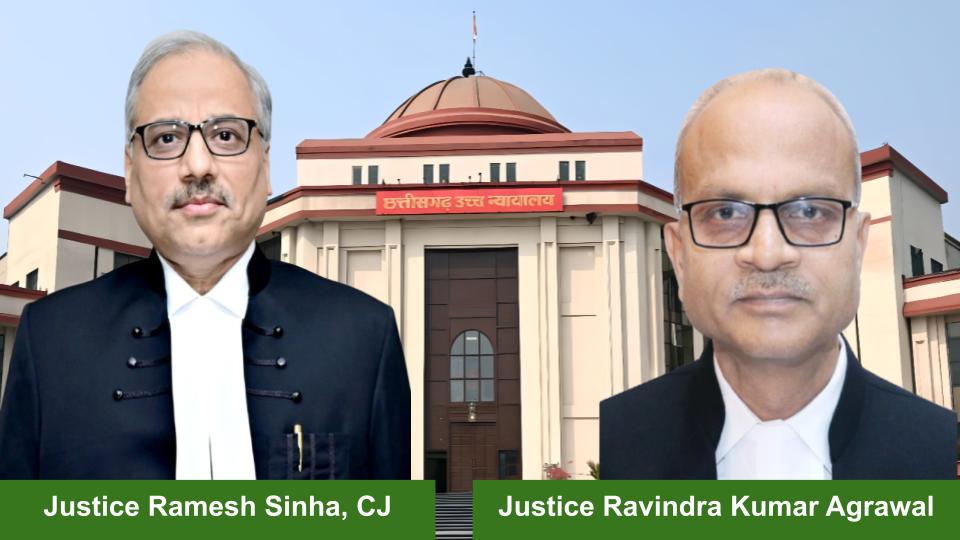
A Division Bench comprising Chief Justice Ramesh Sinha and Justice Ravindra Kumar Agrawal dismissed the criminal appeal filed by Mukesh Ram Yadav, challenging his conviction under Section 20(b)(ii)(c) of the NDPS Act. The court affirmed the judgment of the Special Judge (NDPS Act), Surguja, Ambikapur, which had sentenced him to 14 years of rigorous imprisonment and imposed a fine of ₹1 lakh for possessing a commercial quantity of cannabis.
According to the prosecution, officials of the Excise Flying Squad, Ambikapur, received confidential information on April 7, 2024, that a person was waiting near Smriti Vatika at Sandbar in Surguja district with a large quantity of ganja stored in a Ford EcoSport vehicle for sale. Acting on the tip-off, the excise team reached the spot and found the vehicle parked as described. Mukesh Ram Yadav was allegedly standing near the vehicle when officers approached him.
During the search of the vehicle’s luggage compartment, officials recovered two sacks containing suspected ganja. After weighing the substance, the authorities found that it amounted to 40 kilograms. The contraband was seized, sealed, and later subjected to sampling proceedings before a magistrate under Section 52-A of the NDPS Act. Forensic Science Laboratory analysis subsequently confirmed that the seized substance was ganja.
Before the High Court, the appellant argued that the prosecution had failed to prove conscious possession of the contraband. He contended that merely standing near the vehicle could not establish possession and that the prosecution had not produced reliable evidence linking him to the seized substance. The defence also alleged non-compliance with mandatory procedural safeguards under Sections 42 and 50 of the NDPS Act and argued that independent witnesses had not supported the prosecution case.
The State opposed the appeal, maintaining that the recovery was duly proved through official witnesses, documentary evidence, and forensic reports. It argued that the search and seizure were conducted lawfully and that the chain of custody of the seized contraband remained intact throughout the investigation.
After examining the evidence, the High Court framed the central issue as whether the prosecution had proved beyond reasonable doubt that the appellant was in conscious and exclusive possession of 40 kilograms of ganja, a commercial quantity under the NDPS Act.
A significant aspect of the judgment concerns the distinction between Sections 42 and 43 of the NDPS Act. The appellant claimed that the investigating agency had failed to comply with Section 42, which governs searches of buildings, enclosed places, and conveyances based on prior information. However, the court held that the vehicle was searched at a public location accessible to the general public, making Section 43 applicable.
Referring to several Supreme Court decisions, including Firdoskhan Khurshidkhan v. State of Gujarat, State of Haryana v. Jarnail Singh, and Kallu Khan v. State of Rajasthan, the High Court observed that searches conducted in public places fall within the ambit of Section 43. The Bench stated, “The search and seizure in the present case were not conducted in any private building, house or enclosed premises, but at a public place. In such circumstances, the provisions of Section 43 of the NDPS Act would be attracted and not the provisions contained under Section 42 of the Act.”
The court also rejected the appellant’s argument regarding non-compliance with Section 50 of the NDPS Act. Section 50 provides an accused person the right to be searched before a Gazetted Officer or Magistrate when a personal search is conducted. The High Court noted that no narcotic substance was recovered from the appellant’s body. Instead, the recovery was made from the luggage compartment of the vehicle.
Relying on Supreme Court precedents such as Madan Lal v. State of Himachal Pradesh, State of Himachal Pradesh v. Pawan Kumar, Ajmer Singh v. State of Haryana, Arif Khan v. State of Uttarakhand, and Baljinder Singh v. State of Punjab, the Bench reiterated that Section 50 applies only to personal searches. The court observed, “The recovery in the present case was from a conveyance and not from the body or person of the appellant.” It further held that “the provisions contained in Section 50 of the NDPS Act are not attracted to the facts of the present case.”
The judgment also addressed the evidentiary value of official witnesses. Although the independent witnesses turned hostile during trial, the High Court held that conviction can be sustained on the basis of trustworthy official testimony. The Bench found the evidence of the investigating officer and other excise officials to be consistent, reliable, and supported by contemporaneous records.
The court further noted that the prosecution had successfully established the entire chain of custody, beginning with receipt of secret information, followed by search and seizure, sealing of contraband, magistrate-supervised sampling under Section 52-A, forensic examination, and confirmation of the seized material as ganja. No material discrepancy or break in the chain of evidence was found.
Another important legal aspect of the ruling relates to the statutory presumptions under Sections 35 and 54 of the NDPS Act. The court held that once possession of contraband is established, the burden shifts to the accused to explain the circumstances of such possession. Since the prosecution proved recovery of commercial quantity ganja from a vehicle under the appellant’s control and the appellant failed to rebut the statutory presumptions, the finding of conscious possession was justified.
The High Court concluded that the prosecution had proved beyond reasonable doubt that Mukesh Ram Yadav was in conscious possession of 40 kilograms of ganja in violation of the NDPS Act. Upholding the trial court’s findings, the Bench ruled that there was no illegality, perversity, or material irregularity warranting appellate interference.
“The prosecution has proved beyond all reasonable doubt that the appellant was in conscious possession of 40 kilograms of ganja in contravention of the provisions of the NDPS Act and has rightly been held guilty for the offence punishable under Section 20(b)(ii)(c) of the NDPS Act,” the court observed while dismissing the appeal.
The ruling reinforces established Supreme Court jurisprudence on the distinction between searches conducted in public places and those carried out in private premises. It also provides clarity on the limited applicability of Section 50 protections and underscores the importance of statutory presumptions under the NDPS framework in cases involving commercial quantities of narcotic substances. The judgment is likely to serve as a significant precedent in future NDPS prosecutions involving recoveries from vehicles and public locations.
Case Reference: Mukesh Ram Yadav v. State of Chhattisgarh, Criminal Appeal (CRA) No. 793 of 2025