News Citation : 2026 LN (HC) 424
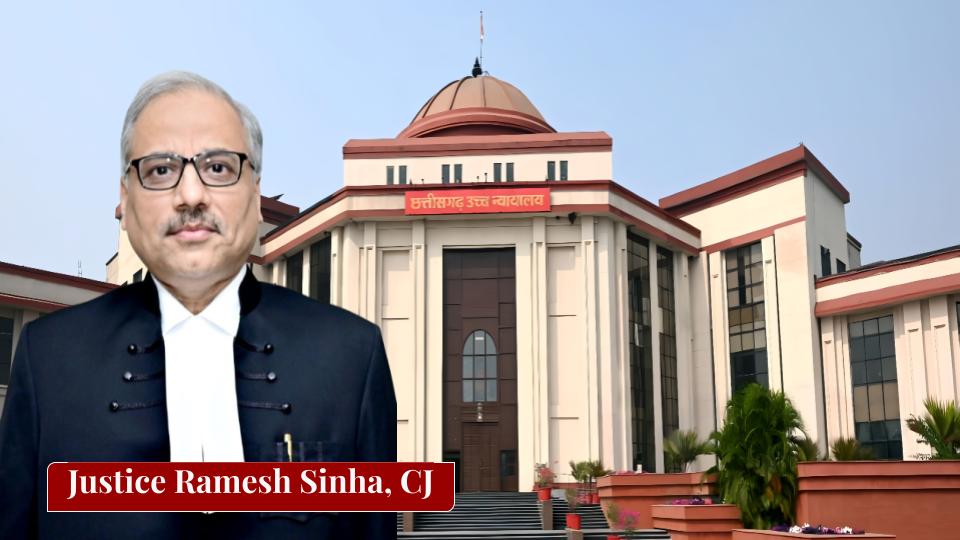
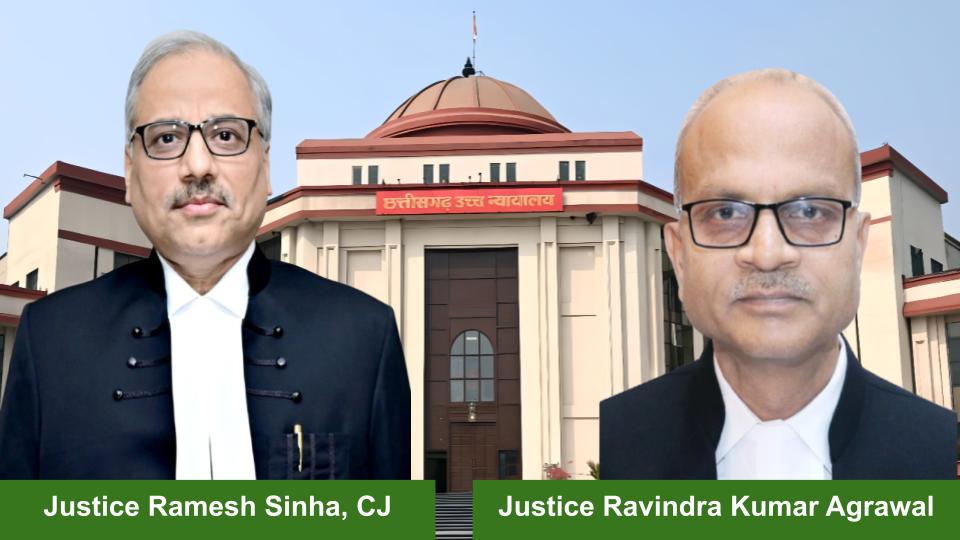
August 5, 2026 : The Chhattisgarh High Court at Bilaspur has acquitted Kaushal @ Deepak Nirmalkar and Lokesh Shori @ Loku in a 2019 murder case, holding that the prosecution failed to establish a complete and unbroken chain of circumstantial evidence connecting them with the killing. A Division Bench comprising Chief Justice Ramesh Sinha and Justice Ravindra Kumar Agrawal set aside their conviction and life sentences, observing that suspicion, however strong, cannot substitute legally admissible proof.
The appeals arose from the common judgment dated September 7, 2021, passed by the Additional Sessions Judge, Bhanupratappur, District North Bastar Kanker, in Sessions Case No. 30/2019. The trial court had convicted both appellants under Sections 302/34 and 201 of the Indian Penal Code and sentenced them to life imprisonment with a fine of Rs. 2,000 under Section 302/34 IPC, along with one year rigorous imprisonment and a fine of Rs. 500 under Section 201 IPC. The High Court found that the evidence relied upon by the prosecution did not meet the standard required for sustaining a conviction based entirely on circumstantial evidence.
According to the prosecution case, on June 26, 2019, a dead body was found near the Ranwahi Canal Culvert with injuries on the head. The deceased was subsequently identified as Paleshwar Nirmalkar. The post-mortem examination found multiple injuries, including a fracture of the head bone, and the doctor opined that the death was homicidal and caused by throttling. An FIR was initially registered under Section 302 IPC against an unknown person. During the investigation, the police arrested the two appellants and alleged that their memorandum statements led to the recovery of articles including a motorcycle, clothes, a wooden club and other materials.
The prosecution relied principally on circumstantial evidence because there was no eyewitness to the alleged murder. It also relied upon the alleged motive that the deceased, who was the brother of accused Kaushal, frequently consumed liquor and Ganja and allegedly quarrelled with Kaushal and their mother. The State argued before the High Court that the prosecution had established a complete chain of circumstances through the alleged disclosures, recovery of articles and the presence of blood on some seized materials.
The defence, however, argued that the prosecution case suffered from material contradictions and omissions. It pointed out that there was no last-seen evidence placing the deceased with the accused within a relevant time period, no eyewitness account and no reliable evidence establishing the alleged recoveries. The defence further contended that the alleged memorandum statements made before the police could not themselves be treated as substantive evidence of guilt.
The High Court agreed that the prosecution had failed to establish the necessary chain of circumstances. The Bench noted that “there is no last seen evidence” showing that the deceased was last seen with the appellants within a reasonable time before the body was recovered. Several prosecution witnesses had either turned hostile or admitted that their knowledge about the alleged involvement of the accused was based on information received from others. The Court also found inconsistencies concerning the manner and place in which the alleged weapon and other articles were recovered.
A significant aspect of the judgment concerned the evidentiary value of the alleged memorandum statements of the accused. The High Court examined Section 27 of the Indian Evidence Act, 1872, which permits limited use of information supplied by an accused in police custody when it distinctly relates to a fact discovered as a consequence of that information. Relying on the Supreme Court’s decisions in Asar Mohammad and Others v. State of U.P. and Pulukuri Kotayya v. King Emperor, the Court explained that the admissible portion is confined to the fact actually discovered, including the place of discovery and the accused’s knowledge concerning it. A confession regarding the commission of the offence does not become admissible merely because it is contained in a memorandum statement.
The Court further relied on the Supreme Court’s decision in Aghnoo Nagesia v. State of Bihar, concerning Section 25 of the Evidence Act. The High Court held that a confession made by an accused to a police officer is barred by Section 25, subject to the limited statutory exception relating to discovery under Section 27. In the present case, the Bench concluded that the alleged confessional portions of Exhibits P-9 and P-10 were hit by Section 25 and that the prosecution could not rely upon them as substantive evidence of the appellants’ guilt.
The Bench also examined the blood allegedly found on some of the seized articles. Although blood was detected on certain materials, the Court held that this circumstance by itself could not connect the appellants to the murder when the remaining evidence was unreliable or incomplete. The witnesses were inconsistent about the seizure of the wooden club and clothes, further weakening the prosecution’s recovery evidence. The Court therefore found that the presence of blood did not constitute conclusive evidence of the appellants’ involvement.
While assessing the circumstantial evidence, the High Court relied upon several leading Supreme Court decisions, including Madhu v. State of Kerala, (2012) 2 SCC 399, Nagendra Sah v. State of Bihar, (2021) 10 SCC 725, Surendra Kumar and Another v. State of Uttar Pradesh, (2021) 20 SCC 430, and Ravindra Singh v. State of Punjab, (2022) 7 SCC 581. These decisions reiterate that every incriminating circumstance must be firmly established and that the circumstances, taken cumulatively, must form a complete chain pointing only towards the guilt of the accused.
The High Court also referred to the Supreme Court’s judgment in Digambar Vaishnav and Another v. State of Chhattisgarh, (2019) 4 SCC 522, emphasizing the fundamental criminal law principle that the burden of proving guilt beyond reasonable doubt rests upon the prosecution. The Court reiterated that “suspicion is not the substitute for proof” and that even strong suspicion or grave doubt cannot take the place of legally admissible evidence.
Another important issue was the reliance placed by the trial court on the alleged false explanation or non-explanation given by the accused in their statements under Section 313 of the Code of Criminal Procedure, 1973. The High Court held that such conduct cannot independently complete a broken chain of circumstantial evidence. Relying on Shivaji Chintappa Patil v. State of Maharashtra, (2021) 5 SCC 626, the Court observed that a false explanation or failure to explain an incriminating circumstance may be considered only as an additional circumstance after the prosecution has already established a complete chain leading unmistakably to guilt. It cannot itself supply a missing link.
The judgment is significant because it reinforces the heightened evidentiary standard applicable to cases based exclusively on circumstantial evidence. The prosecution is not required merely to show that the accused may have committed the offence. The circumstances must exclude reasonable alternative explanations and must be consistent with guilt alone. In the present case, the High Court found that important links, including reliable last-seen evidence and credible recovery evidence, were missing.
The Bench ultimately held that the conviction could not be sustained because there was a “lack of sufficient cogent and clinching evidence” and the chain of circumstances remained incomplete. Giving the appellants the benefit of doubt, the High Court allowed both criminal appeals, set aside the conviction and sentences imposed by the trial court, and acquitted Kaushal @ Deepak Nirmalkar and Lokesh Shori @ Loku.
The Court noted that Kaushal had remained in custody since June 29, 2019, while Lokesh had been in custody since September 7, 2021, the date of the trial court judgment. It directed that both be released forthwith if they were not required in any other case. The Court further directed them, in view of Section 481 of the Bharatiya Nagarik Suraksha Sanhita, 2023, to furnish a personal bond of Rs. 25,000 each with one surety in the like amount, effective for six months, along with an undertaking to appear before the Supreme Court if notice is issued in the event of a Special Leave Petition or an application for leave.
The ruling does not determine that no murder occurred. Rather, it holds that the prosecution failed to legally establish beyond reasonable doubt that these two appellants were responsible for that murder. The decision therefore underscores a central principle of criminal jurisprudence: a conviction, particularly one based solely on circumstantial evidence, must rest on a complete and reliable evidentiary chain, and the gaps in that chain cannot be filled merely through suspicion, disputed recoveries or an accused’s alleged failure to provide an explanation.
Case Reference: Kaushal @ Deepak Nirmalkar v. State of Chhattisgarh and connected appeal, CRA Nos. 1063 & 1066 of 2021, 2026:CGHC:34094-DB