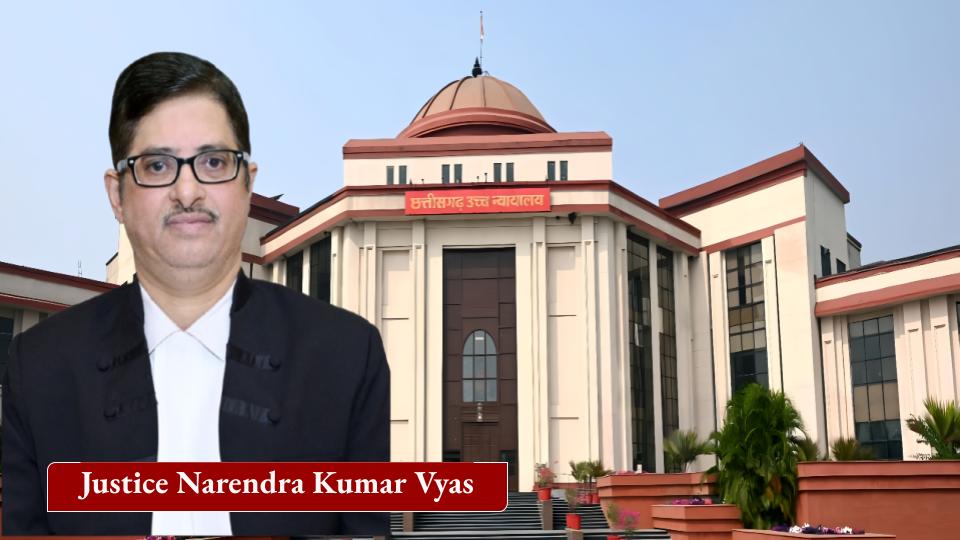
Bilaspur : The Chhattisgarh High Court at Bilaspur has acquitted Pratap Singh in a long-pending criminal case arising from the death of Umraj Gond, holding that a trial court cannot use its powers under Section 165 of the Indian Evidence Act, 1872 to fill gaps in the prosecution case or put questions that effectively prompt a witness to implicate the accused. Justice Narendra Kumar Vyas allowed Criminal Appeal No. 764 of 2011 and set aside the conviction and five-year sentence imposed on Singh under Section 304 Part-I of the Indian Penal Code (IPC).
The judgment was reserved on July 28, 2026 and pronounced on September 24, 2026. The appeal arose from the judgment of the Additional Sessions Judge, Pendra Road, District Bilaspur, dated September 28, 2011, by which Pratap Singh had been convicted under Section 304 Part-I IPC and sentenced to five years’ rigorous imprisonment along with a fine of Rs. 1 lakh. In default of payment of the fine, he was directed to undergo an additional three months’ rigorous imprisonment.
According to the prosecution case, a quarrel took place in the early morning of November 19, 2011, involving deceased Umraj Gond, Shivnadh and his son Pratap Singh. The prosecution alleged that during the altercation, the deceased was assaulted with bamboo sticks and suffered injuries to his neck and chest, resulting in his death. An FIR was registered invoking Sections 302 and 34 IPC against Pratap Singh and his father Shivnadh. The case was subsequently investigated and a charge-sheet was filed before the jurisdictional Magistrate, after which it was committed to the Sessions Court for trial.
During the trial, the prosecution examined eight witnesses and produced documentary evidence. The accused denied the allegations in his statement under Section 313 of the Code of Criminal Procedure, 1973 and claimed false implication. The Sessions Court, however, did not find the charge of murder under Section 302/34 IPC proved, but convicted Pratap Singh under Section 304 Part-I IPC. His father Shivnadh was acquitted. Singh thereafter challenged his conviction before the High Court under Section 374(2) CrPC.
Before the High Court, advocate Somnath Verma, appearing for the appellant, argued that the prosecution had failed to establish the case beyond reasonable doubt. He pointed out that several prosecution witnesses had turned hostile and that the alleged recovery of the weapon was not reliably proved. The defence also relied on the medical evidence, submitting that the seized lathi did not contain human blood and that the doctor had not identified any injury on the deceased as having been caused by the seized weapon.
The defence further argued that there was no reliable eyewitness evidence establishing that Pratap Singh had assaulted the deceased. It was also contended that the trial court had acquitted the co-accused Shivnadh on the same evidence, making the conviction of Pratap Singh on that evidence legally questionable. The appellant’s counsel particularly challenged the manner in which the trial court had questioned the principal witness by exercising its powers under Section 165 of the Evidence Act.
The State opposed the appeal and maintained that the prosecution had proved the case and that the trial court had correctly appreciated the oral and documentary evidence. The State also argued that the different outcomes for the two accused were justified because their individual roles had been separately assessed by the trial court.
The High Court, however, found serious weaknesses in the prosecution evidence. The Court closely examined the testimony of Surajwati Gond, the wife of the deceased and an important prosecution witness. According to her initial testimony, she was inside the house when she heard the sound of lathi blows and came outside, after which she found her husband lying on the ground. The High Court noted that her evidence did not independently establish that Pratap Singh had assaulted the deceased.
The Court also considered the evidence of other prosecution witnesses. Several witnesses did not support the prosecution’s version, while the seizure witnesses disputed the alleged recovery proceedings. The investigating officer stated that Pratap Singh had assaulted the deceased three or four times with a lathi, but the medical witness admitted that he had not matched the injuries with the lathi and had not seen an injury that could specifically be attributed to that weapon.
A major issue before the High Court concerned Section 165 of the Indian Evidence Act, 1872. The provision gives judges broad powers to ask questions and seek evidence for discovering or properly proving relevant facts. However, the High Court emphasized that these powers do not permit a judge to assume the role of the prosecution or introduce material facts that the prosecution itself has failed to establish.
The Court observed that the trial judge had put questions to PW-1 concerning the appellant’s alleged assault on the deceased. According to the High Court, the witness had not independently stated in her examination-in-chief that Pratap Singh had assaulted her husband, and the answer obtained through the trial court’s questioning was not supported by other prosecution evidence. The High Court held that such questioning could not become the foundation of a criminal conviction.
Referring to the Supreme Court’s decision in Ram Chander v. State of Haryana, the High Court emphasized that although a judge has wide powers to discover the truth, the judge must remain impartial and must not frighten, coerce or confuse witnesses. The judgment stated, “The Court, the prosecution and the defence must work as a team whose goal is justice, a team whose captain is the judge.”
The High Court further relied upon the Supreme Court’s observations in State of Rajasthan v. ANI, holding that judicial intervention should not be used to fill lacunae in the prosecution case. The Court made it clear that a judge may seek clarification from a witness, but cannot suggest answers, introduce essential facts that the witness has not stated, or repair weaknesses in the prosecution evidence. Such intervention, the Court noted, may create an apprehension of bias and affect the fairness of the trial, which forms an integral part of Article 21 of the Constitution.
The Court explained the principle in simple terms: Section 165 gives the trial judge considerable authority to discover the truth, but that authority must be exercised within the framework of a fair and impartial trial. The judge cannot effectively become the prosecutor by extracting from a witness the very facts required to establish the accused’s guilt.
The High Court also considered the principle of parity between co-accused. Referring to the Supreme Court judgment in Javed Shaukat Ali Qureshi v. State of Gujarat, the Court noted that where substantially similar evidence and allegations exist against two accused persons, a criminal court cannot arbitrarily convict one while acquitting the other. The judgment observed that “the cases of both the accused will be governed by the principle of parity” where identical or similar evidence attributes similar roles to them.
Applying these principles, Justice Narendra Kumar Vyas concluded that the prosecution had failed to place sufficient cogent evidence establishing Pratap Singh’s involvement beyond reasonable doubt. The Court found that the conviction substantially depended upon answers obtained through questions put by the trial court under Section 165 of the Evidence Act, while independent prosecution evidence did not sufficiently establish the appellant’s guilt.
The High Court therefore extended the benefit of doubt to the appellant and held that the conviction under Section 304 Part-I IPC could not be sustained. The appeal was allowed, the 2011 judgment of conviction and sentence was set aside, and Pratap Singh was acquitted of the offence. As he was already on bail, the Court directed that his bail bonds would continue in view of Section 481 of the Bharatiya Nagarik Suraksha Sanhita, 2023 (BNSS).
The ruling has wider significance for criminal trials because it reinforces the distinction between a judge’s duty to discover the truth and the prosecution’s responsibility to prove the accused’s guilt. The judgment does not restrict a court from questioning witnesses. Instead, it emphasizes that judicial questioning must remain neutral and must not be used to supply missing links in the prosecution case. This safeguards the accused’s right to a fair trial under Article 21 and preserves the impartial role of the judiciary.
The decision also serves as an important reminder that a criminal conviction must rest on legally admissible and properly proved evidence. Where prosecution witnesses fail to establish a material fact, the deficiency cannot ordinarily be cured merely by judicial questioning that effectively introduces the missing fact into the record.
Case Reference : Mr. Somnath Verma, Advocate, appeared for the appellant, while Ms. Sonia Kuldeep, Panel Lawyer, appeared for the State. The case is Pratap Singh v. State of Chhattisgarh, Criminal Appeal No. 764 of 2011