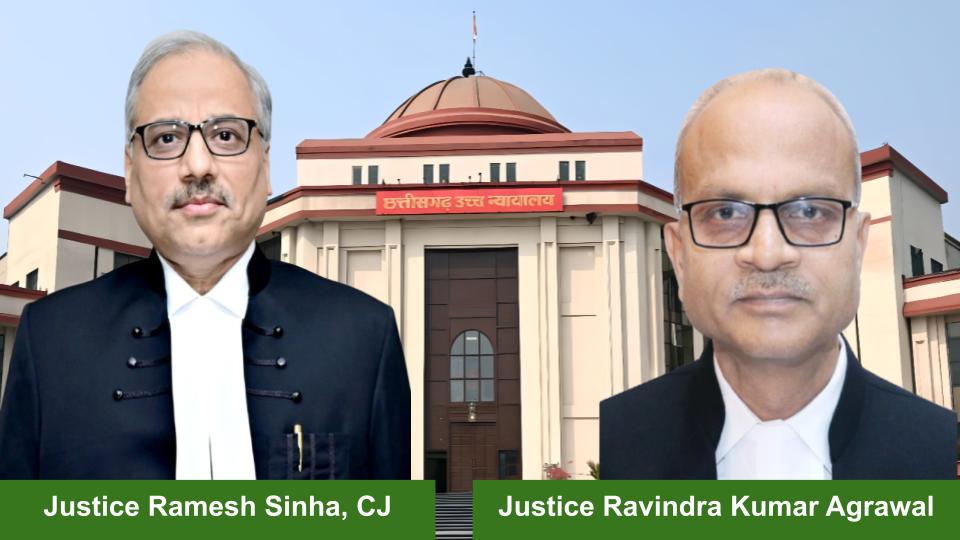
Bilaspur : The Chhattisgarh High Court at Bilaspur has refused to quash domestic violence proceedings against six petitioners, holding that questions relating to an aggrieved person’s domestic relationship, shared household and allegations of domestic violence are matters that generally require examination of evidence at trial.
The case arose from a complaint filed under Section 12 of the Protection of Women from Domestic Violence Act, 2005 by the mother-in-law and sister-in-law of petitioner No. 6. The petitioners challenged the cognizance taken by the Judicial Magistrate First Class, Raipur, as well as the subsequent dismissal of their criminal appeal by the 9th Additional Sessions Judge, Raipur. The High Court heard the matter finally with the consent of the parties.
According to the complaint, petitioner No. 6, Smt. Anisha Agnivanshi, married the son of respondent No. 1 in February 2011 and initially lived in a joint family. The complaint alleged that disputes subsequently developed within the family, including allegations of rude behaviour, mental harassment, abuse, threats and pressure relating to the matrimonial relationship. The complainants sought compensation of Rs. 15 lakh each along with other reliefs under the Domestic Violence Act.
The petitioners argued that the complaint was not legally maintainable because they had never lived with the complainants in a shared household. They also contended that the complainants did not satisfy the definition of an “aggrieved person” under Section 2(a) of the 2005 Act and that the allegations did not constitute domestic violence under Section 3. Their counsel relied upon Supreme Court decisions including Prabha Tyagi v. Kamlesh Devi and Shaurabh Kumar Tripathi v. Vidhi Rawal, besides a Delhi High Court decision.
Opposing the petition, counsel for the respondents argued that the complaint specifically stated that the parties had lived together as members of a joint family. It was therefore submitted that the complainants were entitled to invoke the Domestic Violence Act and that the allegations of mental torture and harassment fell within the statutory definition of domestic violence. Reliance was also placed on the Supreme Court judgment in Hiral P. Harsora v. Kusum Narottamdas Harsora.
The High Court examined the statutory scheme of the Protection of Women from Domestic Violence Act, particularly Sections 2(a), 2(f), 2(s) and 3. Section 2(a) defines an aggrieved person as a woman who is or has been in a domestic relationship with the respondent and alleges that she has been subjected to domestic violence. Section 2(f) deals with a domestic relationship involving persons who live or have lived together in a shared household, while Section 2(s) defines the expression “shared household.” Section 3 covers physical, sexual, verbal, emotional and economic abuse, among other forms of conduct.
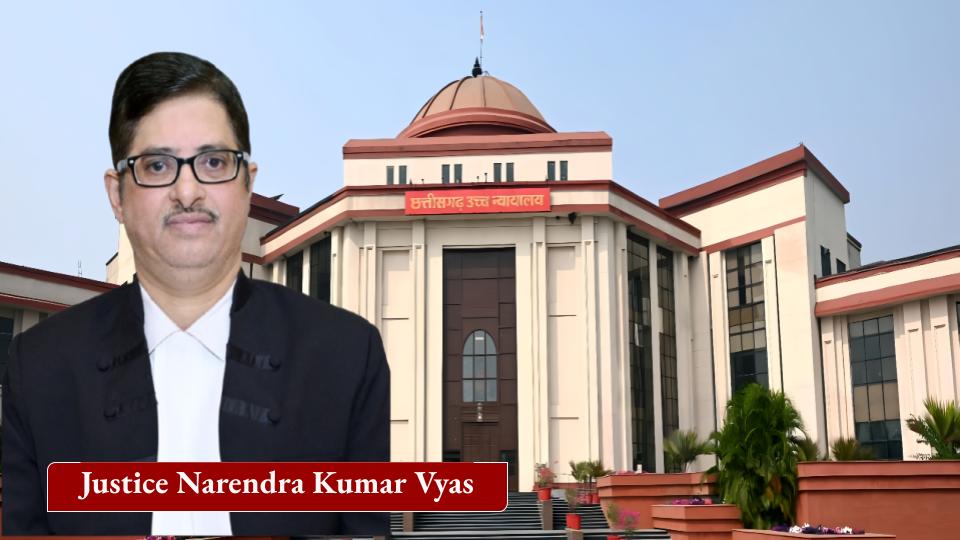
Justice Vyas noted that the complaint contained specific allegations that the parties had lived together in a shared household at Raipur and Mumbai. On that basis, the Court found that the complainants had prima facie established the necessary relationship to invoke the provisions of the Act. The Court observed, “the respondents No. 1 and 2 have alleged domestic violence by the petitioners and also stated that the petitioner No. 6 was residing with the respondent No. 1 in shared household at Raipur and Mumbai.”
The Court further held that the trial court was justified in taking cognizance of the complaint because the objections raised by the petitioners involved factual questions that could not appropriately be conclusively determined at the preliminary stage. “The submissions raised by the petitioners required evidence which can be appreciated during the trial,” the High Court noted while upholding the approach adopted by the Magistrate.
The High Court also relied upon the Supreme Court’s interpretation of the expression “shared household” in Prabha Tyagi v. Kamlesh Devi. The Supreme Court has held that the concept of shared household is inclusive and that the statutory protection can extend to different categories of women in a domestic relationship, including daughters, sisters, wives, mothers, mothers-in-law and daughters-in-law. The Chhattisgarh High Court considered this interpretation while assessing the maintainability of the complaint.
An important aspect of the ruling concerns the High Court’s power to interfere in proceedings under the Domestic Violence Act. The petitioners had invoked Section 528 of the Bharatiya Nagarik Suraksha Sanhita, 2023 (BNSS), which preserves the High Court’s inherent jurisdiction corresponding to the former Section 482 of the Code of Criminal Procedure. The High Court accepted that such power can be exercised to prevent abuse of process or secure the ends of justice, but stressed that it must be exercised cautiously in domestic violence proceedings.
Referring to the Supreme Court’s ruling in Shaurabh Kumar Tripathi v. Vidhi Rawal, the Court reiterated that proceedings arising from an application under Section 12 of the Domestic Violence Act can, in an appropriate case, be quashed under the High Court’s inherent jurisdiction. However, such intervention is ordinarily justified only where there is gross illegality or injustice.
The High Court ultimately found that the petitioners had failed to demonstrate an exceptional circumstance warranting interference at this stage. It held that issues concerning whether the complainants were aggrieved persons, whether the parties had a domestic relationship and whether there was a shared household were matters requiring appreciation of evidence. The Court described these issues as essentially matters of defence that could be examined by the trial court.
Accordingly, the High Court dismissed CRMP No. 3610 of 2025. However, the Court clarified that the petitioners would remain free to raise all their defences before the Judicial Magistrate First Class. The trial court was directed to decide those issues independently on the basis of the evidence and material placed before it and not to be influenced merely by the dismissal of the High Court petition.
The ruling is significant because it reinforces the distinction between examining the prima facie maintainability of a domestic violence complaint and finally determining disputed factual issues. A respondent cannot ordinarily secure quashing merely by asserting at the preliminary stage that there was no shared household or domestic relationship when the complaint contains allegations requiring evidence. At the same time, the judgment does not decide the allegations finally. The petitioners retain the right to establish their defence during the trial.
Case Reference: Sushila Singh & Others v. Nirmala Agnivanshi & Another & State of Chhattisgarh, CRMP No. 3610 of 2025, The petitioners were represented by Ms. Akanksha Singh, Advocate; respondents No. 1 and 2 were represented by Mr. Hemant Gupta, Advocate, while the State was represented by Mr. Vivek Sharma, Panel Lawyer.