News Citation : 2026 LN (HC) 446
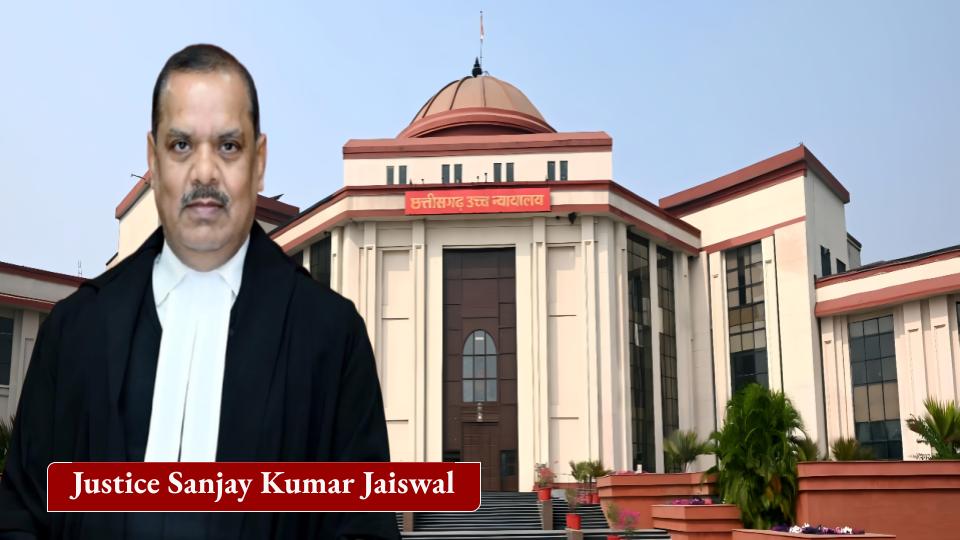
September 15, 2026 : The Chhattisgarh High Court at Bilaspur has reduced compensation awarded in a motor accident death case from Rs 67.03 lakh to Rs 62.14 lakh after finding that the Motor Accident Claims Tribunal had not correctly calculated the income tax payable on the deceased’s income. Justice Sanjay Kumar Jaiswal, while partly allowing an appeal filed by The New India Assurance Company Limited, held that the deceased’s annual income had to be assessed after applying the applicable income tax slab for the financial year 2017-18.
The case arose from the death of Vinod Kumar Tiwari, aged 59, following a road accident on July 13, 2017. He remained under treatment until July 22, 2017. The 7th Additional Motor Accident Claims Tribunal, Raipur, had awarded Rs 67,03,977 to his family in Claim Case No. 356/2018 and fastened liability for payment on the insurance company. The insurer challenged the award before the High Court.
The insurance company first argued that the vehicle involved in the accident had been falsely implicated. According to the insurer, although the accident occurred on July 13, 2017, the FIR was lodged only on July 31, 2017. It was further pointed out that the statement of eyewitness Rajesh Kumar Dubey, an auto-rickshaw driver, was recorded under Section 161 of the CrPC nearly three months after the accident, on October 13, 2017, while the alleged offending vehicle was seized on November 25, 2017. On this basis, the insurer contended that the vehicle had subsequently been introduced into a case that initially involved an unknown vehicle.
The High Court rejected this argument. It noted that Rajesh Kumar Dubey had been examined as an eyewitness and had specifically stated that the offending vehicle was responsible for the accident. His evidence remained unrebutted, and he was also named as a witness in the police final report. The Court further observed that the police charge-sheet was specifically directed against the vehicle in question. The death summary also established that Vinod Kumar Tiwari had been admitted and treated at VY Hospital, Raipur, from July 14 to July 22, 2017.
Importantly, the Court relied on the Supreme Court’s decision in Geeta Dubey v. United India Insurance Co. Ltd., which had referred to the principles laid down in Bimla Devi v. Himachal Road Transport Corporation. The High Court reiterated that in motor accident claim proceedings, claimants are not required to establish the accident with the same strict standard applicable to criminal trials. As the Supreme Court observed, “The standard of proof beyond reasonable doubt could not have been applied.”
The second issue concerned the calculation of the deceased’s income. The salary slip produced before the Tribunal showed that Tiwari was earning Rs 85,735 per month, or Rs 10,28,820 annually. The High Court accepted the Tribunal’s addition of 15 per cent towards future prospects, taking the annual income to Rs 11,83,143. The Court applied the principles laid down by the Supreme Court in National Insurance Company Ltd. v. Pranay Sethi, particularly in relation to future prospects for a salaried deceased person.
However, the High Court found that the Tribunal had deducted only 10 per cent towards income tax. The Court held that the deduction should instead be calculated according to the income tax slabs applicable during the financial year 2017-18. On the annual income of Rs 11,83,143, the Court calculated total income tax and education cess at Rs 1,72,466. After this deduction, the annual income for the purpose of compensation calculation came to Rs 10,10,677.
The Court thereafter recalculated the compensation by applying the established principles governing motor accident compensation, including the deductions towards personal expenses and the appropriate multiplier. After the revised income tax deduction, the annual income was reduced to Rs 10,10,677. One-third was deducted towards the deceased’s personal expenses and the multiplier of nine was applied. The amount under conventional heads was also recalculated.
According to the calculation table on page five of the judgment, the Tribunal had awarded Rs 65,38,977 under the income and multiplier component and Rs 1,65,000 under conventional heads, taking the total compensation to Rs 67,03,977. The High Court recalculated these components at Rs 60,64,065 and Rs 1,50,000 respectively, resulting in a final compensation of Rs 62,14,065.
The ruling is significant for motor accident compensation cases because it reinforces that the deceased’s actual taxable income must be considered while determining the loss of dependency. At the same time, the Court made clear that a delayed FIR or delay in recording an eyewitness statement does not, by itself, establish that a vehicle was falsely implicated when the eyewitness evidence, police investigation and other material on record support the claim. The standard applicable to a motor accident claim is based on the preponderance of probabilities rather than proof beyond reasonable doubt.
The proceedings arose under the law governing compensation for motor vehicle accidents. The judgment also refers to Section 161 of the Code of Criminal Procedure in discussing the recording of the eyewitness statement, while the compensation calculation was guided by Supreme Court precedents including Pranay Sethi, Sarla Verma v. Delhi Transport Corporation and Magma General Insurance Co. Ltd. v. Nanu Ram. The order does not identify a specific provision of the Motor Vehicles Act in its operative discussion, so no additional statutory provision is attributed to the Court beyond what appears in the judgment.
In the final order, the High Court modified the Tribunal’s award and held that the claimants were entitled to Rs 62,14,065 instead of Rs 67,03,977. All other conditions of the Tribunal’s award were left intact. The insurance company’s appeal was therefore partly allowed.
Case Reference: The New India Assurance Company Limited v. Smt. Aarti Tiwari & Ors., MAC No. 371 of 2023, For the appellant: Mr. B.N. Nande, Advocate, with Ms. Suchi Ramteke, Advocate. For Respondent No. 4: Mr. S.P. Sahu, Advocate.