News Citation : 2026 LN (HC) 447
September 17, 2026 : The Chhattisgarh High Court at Bilaspur has held that an executing court cannot convert proceedings for enforcement of an arbitral money award into proceedings against individual government officers who were not personally liable under the award. The Court ruled that execution of an arbitral award must remain within the statutory framework of Section 36 of the Arbitration and Conciliation Act, 1996, read with Order XXI of the Code of Civil Procedure, 1908 (CPC).
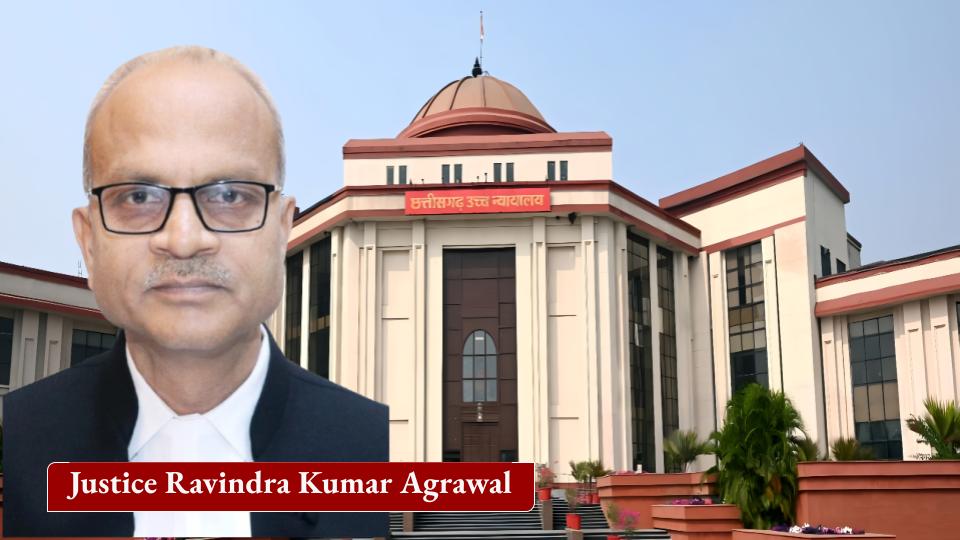
Justice Ravindra Kumar Agrawal delivered the order on September 17, 2026, in WP227 No. 768 of 2026, filed by the State of Chhattisgarh through the Public Works Department and the Superintending Engineer, National Highway Circle, Raipur, against ECI-Keystone (JV). The petition challenged a series of orders passed by the Commercial Court at Nava Raipur in Execution Case No. 06 of 2023.
The dispute arose from a road construction project on various stretches of NH-63 in Bastar district under the Left Wing Extremism Scheme. The project was sanctioned by the Ministry of Road Transport and Highways (MoRTH), initially for Rs. 169.23 crore and later revised to Rs. 211.53 crore. The project was funded by the Government of India, while the Chhattisgarh Public Works Department acted as the executing agency. ECI-Keystone (JV) was awarded the contract, with the letter of acceptance issued on October 31, 2012, followed by the work order on December 1, 2012. The contractor completed the work on June 30, 2019.
After completion of the work, the contractor raised an additional claim of Rs. 190.33 crore on January 27, 2020. The claim was rejected by the department, following which the contractor invoked the arbitration clause in the contract. A sole arbitrator was appointed on August 10, 2020, and arbitration proceedings commenced on August 20, 2020.
According to the State, its authorities repeatedly requested MoRTH to provide an authorised representative and legal assistance for conducting the arbitration and preparing the statement of defence. The State contended that MoRTH had advised that the dispute should be resolved through conciliation or before a three-member arbitral panel and that approval of the competent authority was required before accepting a sole arbitrator. The contractor, however, declined conciliation and insisted on proceeding before the sole arbitrator. In the absence of an authorised representation and statement of defence from the State side, the arbitrator proceeded ex parte and passed an award on September 2, 2022, directing payment of Rs. 160,30,11,411 along with applicable interest.
The State subsequently challenged the arbitral award under Section 34 of the Arbitration and Conciliation Act, 1996. That challenge was dismissed on November 1, 2023, as being barred by limitation. The challenge under Section 37 was also dismissed by the Chhattisgarh High Court on June 10, 2024. The Special Leave Petition filed before the Supreme Court was dismissed on January 19, 2026, on the ground of a delay of 484 days. The High Court order records that review petitions against the Supreme Court orders were pending.
During the execution proceedings, the Commercial Court passed several directions requiring senior PWD officials to appear personally and file affidavits concerning the steps being taken to make payment. The court also sought details of departmental bank accounts, funds received, balances and receivables. Subsequently, the Commercial Court indicated that personal financial responsibility could be fixed upon officials for interest accruing on the award and contemplated referring the matter for contempt proceedings.
The State challenged these directions before the High Court, arguing that the Commercial Court had exceeded its jurisdiction. It submitted that the award was a money award and therefore its enforcement had to be carried out through the mechanisms available under Order XXI CPC. The State further argued that the individual officers were not judgment-debtors in their personal capacity and could not be compelled to satisfy the award from their personal resources. It also maintained that payment involved governmental sanctions, budgetary procedures and approvals because the project had been funded under the MoRTH scheme.
The award-holder, on the other hand, argued that the award had attained finality for execution purposes and that the State could not indefinitely postpone payment by relying on internal administrative approvals. It submitted that the awarded amount had increased substantially because of continuing interest. According to the award-holder, the amount had risen from Rs. 160,30,11,411 to Rs. 222,06,54,058 as of June 16, 2026, with interest accruing at approximately Rs. 4.5 lakh per day.
The High Court agreed that the arbitral award had attained finality for the purpose of execution. However, it drew a clear distinction between the enforceability of the award and the jurisdiction of the executing court.
The Court observed that “the finality of the award does not enlarge the jurisdiction of the Executing Court beyond the statutory framework governing execution.” Under Section 36 of the Arbitration and Conciliation Act, an arbitral award is enforceable in accordance with the CPC in the same manner as if it were a decree of the court. Consequently, the executing court must follow the procedure prescribed under Order XXI CPC.
Justice Agrawal specifically rejected the attempt to transform the departmental liability into personal financial liability of individual officers. The Court held that the award was against the award-debtor and not against the officers in their individual capacities.
The Court stated: “The liability created by the award cannot, in execution, be converted into a personal monetary liability of an officer merely because such officer happens to be responsible for processing or arranging payment on behalf of the department.”
The Court clarified that an executing court is not powerless when the judgment-debtor is a government department. It can require the competent authority to disclose information concerning assets, funds, sanctions and the steps being taken to satisfy the award. It can also adopt the modes of execution permitted under Order XXI CPC. However, it cannot create a new personal monetary liability against an officer when no such liability exists under the award or any separate adjudication.
A significant aspect of the judgment concerns the distinction between execution proceedings and contempt jurisdiction. The High Court referred to Section 2(b) of the Contempt of Courts Act, 1971, which deals with civil contempt involving wilful disobedience of a judgment, decree, direction, order or other process of a court.
Relying upon the Supreme Court’s decision in R.N. Dey and Others v. Bhagyabati Pramanik and Others, the High Court reiterated that contempt proceedings cannot ordinarily be used as a substitute for execution where an effective execution remedy is available. The Supreme Court had cautioned that the power of contempt should not be used as an alternative mechanism for enforcing a money decree.
The High Court also relied upon Food Corporation of India v. Sukh Deo Prasad and Kanwar Singh Saini v. High Court of Delhi, which emphasised that the appropriate remedy for enforcement of a money decree or final civil order is execution and not contempt. The Court noted that execution and contempt are legally distinct proceedings and should not be conflated.
The Court further referred to State of Uttar Pradesh and Others v. Dr Manoj Kumar Sharma, where the Supreme Court had expressed concern about the practice of frequently summoning government officials and exerting pressure on executive officers. The High Court observed that government officials perform their duties as custodians of public funds and that judicial proceedings must respect the separation between judicial and executive functions.
At the same time, the High Court did not approve of indefinite delay by the State. It recognised the Commercial Court’s concern regarding the continuing accumulation of interest and observed that government authorities cannot indefinitely postpone payment merely by referring to internal correspondence or administrative difficulties.
The Court held that the executing court could require the competent authority to provide financial information and take lawful steps for satisfaction of the award. However, “the Court cannot substitute such statutory modes by compelling individual officers to furnish personal undertakings or affidavits promising payment, or by threatening to make them personally liable for the interest accruing on the award amount.”
The High Court also interfered with the observations made by the Commercial Court regarding the review petitions pending before the Supreme Court. The Commercial Court had described the State’s pursuit of the review proceedings as “hoping against hope.” The High Court held that the prospects of a pending review petition were exclusively within the jurisdiction of the Supreme Court and should not have been prejudged by the executing court.
However, the High Court clarified that the mere pendency of review petitions does not automatically stay enforcement of the arbitral award. Unless a competent court grants a stay, the award-holder remains entitled to pursue execution.
The Court therefore struck a balance between the rights of the award-holder and the statutory limits on execution jurisdiction. It observed that the award-holder had been deprived of the awarded amount for a considerable period and that interest continued to increase. The State authorities were consequently required to take all lawful and expeditious steps to satisfy the final award.
In its final decision, the High Court partly allowed the writ petition. It set aside the directions requiring personal affidavits and undertakings from individual officers, the threatened fixing of personal financial liability for interest accruing on the award, and the proposed initiation of contempt proceedings merely for non-payment of the money award.
The execution proceedings, however, were not terminated. The Commercial Court was directed to continue Execution Case No. 06 of 2023 strictly in accordance with Section 36 of the Arbitration and Conciliation Act and Order XXI CPC and to adopt only those modes of execution permissible under law.
The ruling is significant for government departments as well as contractors and other award-holders. It reinforces that a final arbitral award remains enforceable against the judgment-debtor, including a government department, but the execution process must follow the statutory mechanism. At the same time, individual public officials cannot automatically be made personally liable merely because they are responsible for processing or arranging payment.
The decision also reiterates an important procedural safeguard: contempt jurisdiction cannot ordinarily be employed as a substitute for execution of a money award. The executing court may take effective steps permitted by the CPC, but it cannot create a personal liability against officers that was never imposed by the award itself.
Case Reference : State of Chhattisgarh through Secretary, PWD & Anr. v. ECI-Keystone (JV), WP227 No. 768 of 2026, 2026:CGHC:40702. The petitioners were represented by Rahul Tamaskar, Government Advocate, and Ghanshyam Kashyap, Deputy Government Advocate, while the respondent was represented by Parvesh Buttan and Pushkar Bhandarkar, Advocates.