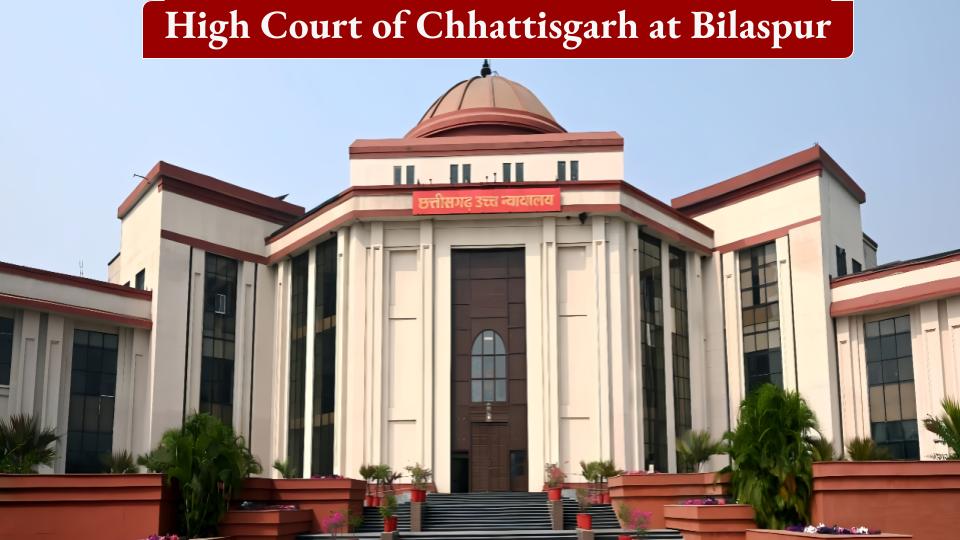
Bilaspur : The Chhattisgarh High Court at Bilaspur has dismissed an appeal filed by the Income Tax Department against Jindal Power Limited, holding that the reassessment proceedings initiated for the assessment year 2009-10 were based on a mere change of opinion rather than any fresh tangible material. The Division Bench held that a successor Assessing Officer cannot reopen a concluded assessment simply by taking a different view on material that had already been examined during the original scrutiny assessment.
The judgment, delivered on September 24, 2026, arose from an appeal under Section 260A of the Income Tax Act, 1961, filed by the Joint Commissioner of Income Tax, Range-1, Bilaspur, against an order of the Income Tax Appellate Tribunal, Raipur Bench. The Tribunal had earlier allowed Jindal Power Limited’s appeal and quashed the reassessment order dated February 13, 2015. The High Court has now upheld that decision and dismissed the Revenue’s appeal.
Dispute over reassessment of Jindal Power’s 2009-10 income
Jindal Power Limited had filed its return for the assessment year 2009-10 declaring income of approximately Rs.95.29 crore. The assessment was selected for scrutiny and the Assessing Officer issued notice under Section 143(2) of the Income Tax Act. During the scrutiny proceedings, the company furnished information and documents sought by the department.
The original assessment was completed on December 28, 2011. Subsequently, the Assessing Officer initiated reassessment proceedings under Section 147 of the Income Tax Act after obtaining sanction under Section 151. A notice under Section 148 was issued on July 5, 2013 on the ground that taxable income had allegedly escaped assessment.
The reassessment ultimately resulted in a substantial increase in the company’s taxable income. By order dated February 13, 2015, the Assessing Officer assessed the taxable income at approximately Rs.238.90 crore and raised a demand of about Rs.193.13 crore. Jindal Power challenged the order before the appellate authorities.
Income Tax Department argued that income had escaped assessment
Before the High Court, the Revenue argued that the Tribunal had wrongly treated the reassessment as a mere change of opinion. According to the department, an Assessing Officer could discover an omission or an incorrect allowance even from the original assessment record, and such discovery could provide a basis for reopening the assessment.
The department particularly relied upon the company’s claim of 100 per cent depreciation on a dam amounting to approximately Rs.8.50 crore. It also pointed to alleged issues concerning disallowance under Section 14A, additional depreciation of approximately Rs.377.81 crore under Section 32(1)(iia), and interest and other income of about Rs.3.47 crore earned during the pre-production period.
The Revenue contended that these items had resulted in taxable income escaping assessment and that the assessee had failed to disclose all material facts fully and truly. It relied, among other authorities, upon the Supreme Court’s decision in Phool Chand Bajrang Lal v. ITO.
Jindal Power said all relevant issues were already examined
Jindal Power, however, argued that there was no failure on its part to disclose material facts. According to the company, the original Assessing Officer had specifically raised queries regarding depreciation on the dam, additional depreciation, Section 14A disallowance and interest and other income earned during the pre-production period.
The company submitted that it had responded to those queries and supplied the relevant documents before the original assessment was completed. Therefore, the subsequent Assessing Officer had not discovered any new material but had merely reached a different conclusion on the same material that was already available on the assessment record.
The Tribunal accepted this argument and concluded that reopening the concluded assessment amounted to a change of opinion. It therefore quashed the reassessment proceedings for want of valid jurisdiction under Section 147.
High Court examines the limits of Section 147
The Division Bench carefully examined the statutory requirements governing reassessment under Section 147 of the Income Tax Act. The provision permits an Assessing Officer to assess or reassess income that has escaped assessment where the officer has a legally sustainable “reason to believe” that such income has escaped assessment.
The Court noted that where an earlier assessment has been completed under Section 143(3), reopening after the prescribed period also requires satisfaction of the statutory condition relating to the assessee’s failure to disclose fully and truly all material facts necessary for the assessment.
The Court emphasized that these requirements are jurisdictional safeguards. In other words, they are not merely procedural formalities. They must exist before the Assessing Officer can lawfully exercise the power of reassessment.
Supreme Court precedents on “reason to believe”
The High Court referred to a series of Supreme Court decisions explaining the meaning of “reason to believe” and the distinction between reassessment and review.
Referring to Income Tax Officer v. Lakhmani Mewal Das, the Court reiterated that there must be a rational connection or live link between the material available to the Assessing Officer and the belief that income has escaped assessment. The belief cannot be founded on vague, remote or irrelevant material and must be formed in good faith.
The Bench also considered the Supreme Court’s landmark ruling in CIT v. Kelvinator of India Ltd., which explains that an Assessing Officer has the power to reassess but not to review his earlier assessment. The Court quoted the principle that the concept of “change of opinion” acts as an important safeguard against an improper exercise of reassessment powers and that reopening requires tangible material having a live link with the alleged escapement of income.
The High Court further relied on Income Tax Officer v. Tech Span India (P.) Ltd., where the Supreme Court held that Section 147 cannot be used merely because an Assessing Officer later adopts a different interpretation of law on facts that were already within his knowledge during the original assessment.
2026 Supreme Court ruling also considered
The Bench also took note of the Supreme Court’s recent decision in Sanand Properties Pvt. Ltd. v. Joint Commissioner of Income Tax, reported as 2026 SCC OnLine SC 851.
The High Court noted the Supreme Court’s distinction between material that had already been considered during the original assessment and genuinely new or previously unconsidered material. If the same material was already relied upon by the Assessing Officer while making the original assessment, using it again to reopen the assessment would amount to a review rather than reassessment. On the other hand, material extraneous to the original assessment record, or material that was available but not considered earlier, may in an appropriate case provide a jurisdictional basis for reopening.
Court finds no fresh tangible material in Jindal Power case
Applying these principles, the High Court found that the issues relied upon by the successor Assessing Officer had already been examined during the original scrutiny assessment.
The Court noted that the Assessing Officer had specifically sought information from Jindal Power concerning its 100 per cent depreciation claim on the dam, additional depreciation, Section 14A disallowance and interest and other income during the pre-production period. The company had furnished responses to those queries, following which the original Assessing Officer completed the scrutiny assessment.
The Court therefore found that the reassessment reasons were based on information already available in the original assessment records. There was no indication that fresh tangible material had subsequently come to the Assessing Officer’s notice.
Importantly, the Bench also observed that the reasons recorded for reopening did not establish that the assessee had failed to make a full and true disclosure of material facts. Nor did the Assessing Officer record that any fresh facts had emerged after completion of the original assessment.
“A successor Assessing Officer cannot reopen merely because he takes a different view”
The High Court ultimately held that reassessment proceedings could not be initiated merely because the successor Assessing Officer believed that the earlier Assessing Officer had made an error while computing taxable income.
The Court observed that once the original Assessing Officer had examined the relevant material and consciously allowed the deductions or depreciation, a subsequent officer could not reopen the assessment simply by forming a different opinion on the same material.
The Bench made the legal position clear: “Proceedings for reassessment cannot be initiated merely because income liable to tax has escaped assessment due to mistake committed by the Assessment Officer.” It further held that reopening the assessment on the basis of a later opinion that the original assessment contained an error would fall within the prohibited doctrine of “change of opinion”.
Reassessment proceedings declared without jurisdiction
In its concluding findings, the High Court held that the “reasons to believe” recorded by the Assessing Officer were unfounded and not bona fide. Since the statutory jurisdictional requirements under Section 147 had not been satisfied, the reassessment proceedings were held to be invalid.
The Court accordingly upheld the Tribunal’s decision to quash the reassessment order dated February 13, 2015. The Income Tax Department’s appeal was dismissed, with the Court making no order as to costs.
Significance of the ruling
The ruling reinforces an important limitation on the reassessment powers of the Income Tax Department. Section 147 is intended to enable the Revenue to bring escaped income to tax, but it does not give an Assessing Officer an unrestricted power to revisit a concluded assessment.
For taxpayers, the decision underscores the importance of the distinction between reassessment and review. Where an issue was specifically examined during the original scrutiny proceedings and the assessee supplied the information sought by the Assessing Officer, a later officer cannot ordinarily reopen the assessment merely because he reaches a different conclusion on the same material.
At the same time, the judgment does not mean that every reassessment based on material appearing in an earlier assessment record is automatically invalid. The decisive question is whether there is legally sufficient tangible material and whether the statutory conditions for reassessment are satisfied. Where genuinely new information emerges, or where the assessee failed to make a full and true disclosure of material facts in circumstances covered by the law, the Revenue’s reassessment powers may still be invoked.
The decision therefore serves as a significant reminder that the power to reassess is subject to jurisdictional safeguards and cannot be converted into a general power of review.
Case Reference: The Joint Commissioner of Income Tax, Range-1, Bilaspur v. M/s Jindal Power Limited, TAXC No. 15 of 2025, For the appellant-Revenue: Mr. Ajay Kumarani, Advocate. For the respondent: Mr. Salil Kapoor, Advocate, with Ms. Katyayani Vishnupriya, Advocate.