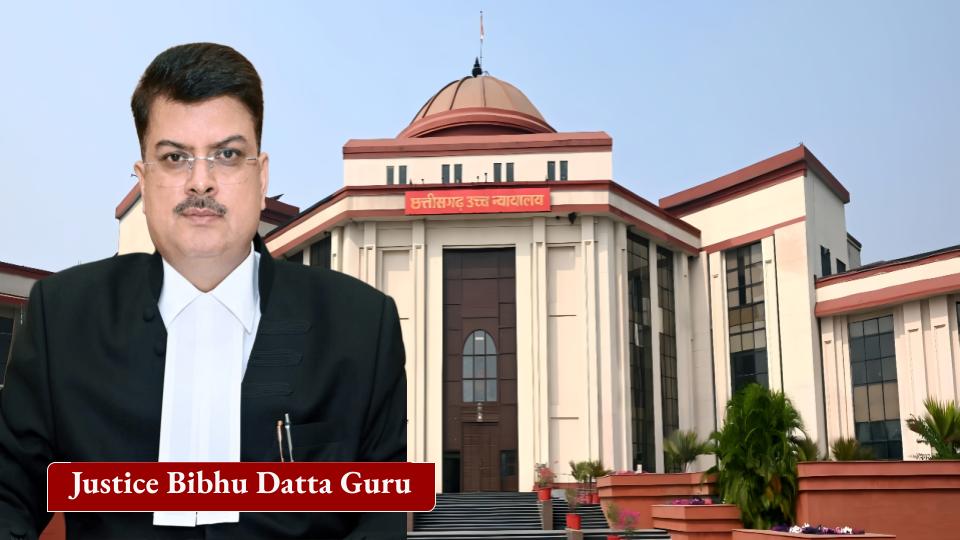
Bilaspur: The Chhattisgarh High Court has set aside a departmental penalty imposed on an Assistant Draftsman of the Rural Engineering Services, Korba, holding that a government employee cannot be punished even with a minor penalty without first being informed in writing of the proposed disciplinary action and given a reasonable opportunity to respond. Justice Bibhu Datta Guru delivered the order on September 23, 2026, in WPS No. 6103 of 2026.
The petitioner, Prabhawati Patel, an Assistant Draftsman posted in the Rural Engineering Services, Korba Division, had challenged an order dated June 11, 2026, by which one annual increment was withheld without cumulative effect. Her principal grievance was that the penalty had been imposed without following the procedure prescribed under Rule 16(1)(a) of the Chhattisgarh Civil Services (Classification, Control and Appeal) Rules, 1966, commonly referred to as the CCA Rules.
According to the petitioner, the disciplinary action arose from information presented during a review meeting concerning the progress of certain construction works. She maintained that the information had been compiled from material supplied by field officials and was presented by her in the course of her official duties. The review meeting was held on June 10, 2026, while the penalty order followed on June 11, giving her virtually no opportunity to explain the alleged discrepancy before the punishment was imposed.
The petitioner argued that she had never been served with a written proposal informing her that disciplinary action was proposed against her, nor had she been given a reasonable opportunity to submit her explanation. Relying upon the Supreme Court’s decision in O.K. Bhardwaj v. Union of India & Others, she contended that the requirement of giving an employee an opportunity to respond applies even where the proposed punishment is a minor penalty. The petitioner described this opportunity as a basic requirement of natural justice.
The State and the Chief Executive Officer, Zila Panchayat, Korba, opposed the petition. Their case was that the petitioner was responsible for presenting the information before the competent authority and that the information was found to be incorrect. According to the respondents, the lapse amounted to negligence in the discharge of official duties and the minor penalty was therefore justified. They also relied on the fact that the petitioner subsequently submitted a representation, which was considered by the competent authority.
The High Court framed the central issue as whether the penalty of withholding one annual increment without cumulative effect could legally be imposed without following the procedure prescribed under Rule 16 of the CCA Rules. Rule 16(1)(a) specifically requires the government servant to be informed in writing of the proposal to take disciplinary action and of the imputations of misconduct or misbehaviour, while also giving the employee a reasonable opportunity to make a representation against the proposed action.
Justice Bibhu Datta Guru emphasized that this procedural protection is not an empty formality. The Court observed, “The safeguard contained in Rule 16(1)(a) is not a mere procedural formality.” According to the Court, the provision incorporates a fundamental requirement of fairness because an employee must have an effective opportunity to answer the allegations and place an explanation before the disciplinary authority before any penalty is imposed.
The Court found that the record did not establish that any written proposal for disciplinary action, accompanied by the imputations of misconduct, had been served on the petitioner before the penalty order. The Court also noted the exceptionally short sequence of events: the review meeting took place on June 10 and the penalty order was issued on June 11.
A significant aspect of the ruling was the Court’s treatment of the representation submitted by the petitioner after the penalty had already been imposed. The record showed that the penalty order was issued on June 11, while the petitioner’s representation was submitted on June 15. The High Court made it clear that such a subsequent representation could not satisfy the statutory requirement of a prior opportunity to defend oneself.
The Court explained that the opportunity must come before the proposed penalty is imposed because the employee’s explanation must be available to the disciplinary authority while deciding whether disciplinary action is warranted and, if so, what punishment should be imposed. The Court further held that the fact that the punishment was classified as a minor penalty did not remove the mandatory requirement of Rule 16.
The High Court also considered the underlying factual dispute. The petitioner claimed that the information placed before the authorities had been compiled from information supplied by field officials, whereas the respondents attributed responsibility for the correctness of the information to the petitioner. The Court held that these disputed factual aspects should have been considered only after giving the employee an effective opportunity to explain her position under the procedure laid down by the CCA Rules.
The ruling reinforces the application of the principles of natural justice in government disciplinary proceedings. In practical terms, it means that a departmental authority cannot bypass the prescribed procedure merely because the proposed punishment is relatively limited. The employee must be informed of the proposed action and the allegations and must be given a meaningful opportunity to respond before the disciplinary authority reaches its decision.
The Court ultimately held that the June 11 penalty order suffered from a violation of the mandatory procedural requirement under Rule 16(1)(a) of the CCA Rules. It observed that the absence of a prior opportunity to respond had vitiated the disciplinary action and that the later representation could not cure the fundamental defect.
Accordingly, the Chhattisgarh High Court quashed and set aside the June 11, 2026 order withholding one annual increment without cumulative effect. At the same time, the Court clarified that the competent disciplinary authority would remain free to initiate proceedings afresh, if it considered such action appropriate and legally permissible, but any fresh action would have to strictly comply with the CCA Rules. The writ petition was allowed to that extent.
The decision is significant for government employees and disciplinary authorities across Chhattisgarh because it reiterates that procedural fairness is not dependent on the severity of the proposed punishment. Even where the alleged misconduct may result only in a minor penalty, the statutory safeguards under Rule 16 must be followed. The ruling therefore places renewed emphasis on notice, disclosure of the allegations and a genuine opportunity of representation before disciplinary consequences are imposed. The Court’s headnote similarly records that an opportunity to meet the allegations and submit an explanation is both a requirement of natural justice and a statutory safeguard that cannot be dispensed with.
Case Reference: Prabhawati Patel v. State of Chhattisgarh & Others, WPS No. 6103 of 2026, or the petitioner: Ms. Zainab Mustafa Vanak, Advocate. For the State: Mr. Shaleen Singh Baghel, Government Advocate. For Respondent No. 6: Mr. Rahul Sahu, Advocate.