News Citation : 2026 LN (HC) 429
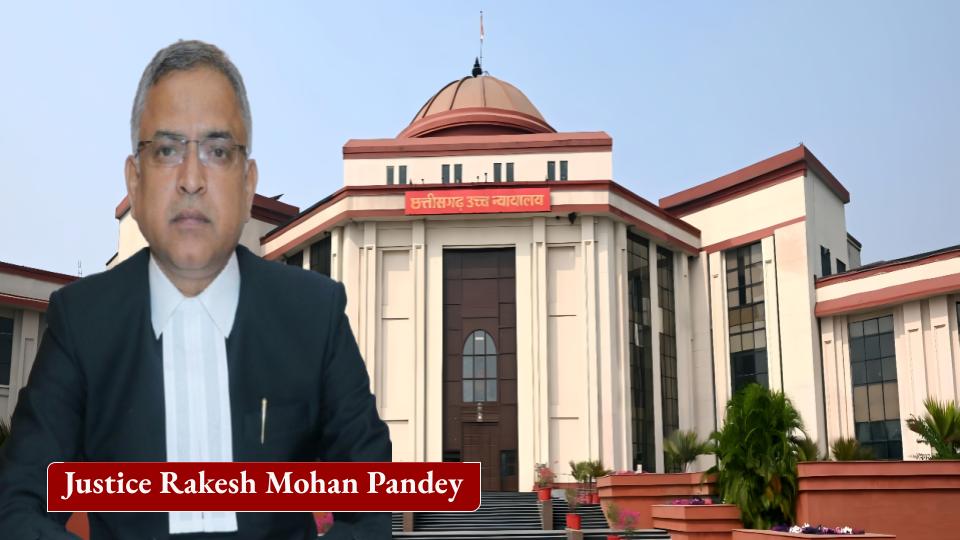
The Chhattisgarh High Court at Bilaspur has directed South Eastern Coalfields Limited (SECL) to reconsider the disciplinary penalty imposed on an accountant after finding that he was subjected to a harsher form of punishment than a co-employee facing substantially similar allegations. Justice Rakesh Mohan Pandey, while hearing WPS No. 1132 of 2021, held that the doctrine of equality can apply even among employees found guilty of misconduct when they are similarly placed.
The order was passed on August 21, 2026, in a petition filed by Sunil Sharma, an accountant working at SECL’s Manikpur Colliery in Korba. Sharma had challenged the departmental proceedings and the penalty imposed on him in connection with irregularities concerning the clearance of bills raised by Dhruv Guard Private Limited.
According to the High Court order, Sharma and another accountant, K.S. Thakur, were proceeded against departmentally in connection with bill-clearance irregularities. Sharma had cleared bills relating to the period from June 1, 2012, to May 31, 2013, while Thakur had dealt with bills for the period from December 31, 2010, to May 31, 2012. Both employees were charged under Clauses 26.1, 26.5 and 26.22 of the applicable SECL Standing Orders.
A charge-sheet was issued to Sharma on November 21, 2014, and he submitted his reply four days later. Following the departmental enquiry, the disciplinary authority imposed the penalty of stoppage of one increment with cumulative effect on February 4, 2016. In comparison, Thakur was awarded stoppage of one increment without cumulative effect by an order dated February 9, 2016.
Sharma subsequently challenged the penalty through departmental remedies. His first appeal was dismissed on March 15, 2016, on technical grounds, while his second appeal was rejected on June 15, 2018. His review petition was also dismissed by SECL’s competent authority on July 14, 2020, prompting him to approach the High Court.
Appearing for Sharma, advocate Vikram Sharma argued that the allegations against the petitioner and the co-delinquent employee were substantially the same and that they should therefore have received equivalent punishment. Reliance was placed on several Supreme Court judgments, including Rajendra Yadav v. State of Madhya Pradesh, State of Uttar Pradesh v. Raj Pal Singh and Naresh Chandra Bharadwaj v. Bank of India.
SECL opposed the petition. Its counsel, Dr. Sudeep Agrawal, argued that although the allegations were almost similar, the two employees had been subjected to separate departmental enquiries by different disciplinary authorities and under different sets of rules. The respondents also contended that the penalty imposed on Sharma had been upheld by the departmental authorities and that stoppage of one increment with cumulative effect constituted a minor penalty under the applicable Standing Orders.
The High Court, however, focused on the principle of parity in disciplinary punishment. Referring to the Supreme Court’s decision in Raj Pal Singh, the Court noted that where employees face substantially similar allegations and there is no demonstrated difference in the gravity of their misconduct, the disciplinary authority should not ordinarily impose different punishments.
The Court also relied on the Supreme Court’s ruling in Rajendra Yadav, which recognised that the doctrine of equality under Article 14 of the Constitution can extend to persons who have themselves been found guilty of misconduct. The Supreme Court has held that “persons who have been found guilty can also claim equality of treatment” where they establish discriminatory treatment in punishment despite being involved in the same incident or transaction.
At the same time, the High Court recognised the limits of judicial intervention in disciplinary matters. Referring to the principles summarised by the Supreme Court in Naresh Chandra Bharadwaj and the earlier Lucknow K. Gramin Bank case, the Court noted that determination of the appropriate penalty ordinarily falls within the jurisdiction of departmental authorities. Judicial review of punishment is limited and generally arises where the penalty is shockingly disproportionate.
The Court also highlighted an important exception to that general rule. Where a co-delinquent receives a lesser punishment despite identical charges, the principle of equality may justify judicial intervention, provided there is complete parity between the employees not only regarding the nature of the charges but also their subsequent conduct after the charge-sheet.
Applying these principles to Sharma’s case, the High Court found that both employees were working as accountants and that departmental proceedings arose from alleged irregularities in bill clearance following a complaint by Dhruv Guard Private Limited. Although separate enquiries had been conducted, the Court found the allegations against the two employees to be “almost similar”.
The Court further observed that Sharma was not primarily challenging the quantum of punishment on the ground that it was excessive. His central claim was that he should receive the same treatment as the co-delinquent employee, who had been awarded stoppage of one increment without cumulative effect.
After considering the Supreme Court precedents and the circumstances of the case, Justice Rakesh Mohan Pandey held that the authorities should have imposed the same form of penalty on Sharma as was imposed on K.S. Thakur. The Court accordingly remitted the matter to the disciplinary authority for an appropriate decision in accordance with the observations contained in the judgment.
The High Court directed the competent authority to complete the exercise within 60 days from the date of receipt of a copy of the order. The writ petition was consequently disposed of with these directions.
The ruling is significant for disciplinary proceedings in public-sector organisations because it reinforces the principle that punishment cannot be arbitrarily differentiated between similarly placed employees. The judgment does not mean that every employee facing similar charges must automatically receive identical punishment. The Supreme Court principles relied upon by the High Court require substantial or complete parity, including consideration of the nature of the charges and subsequent conduct. However, where such parity exists, unequal punishment can raise concerns under Article 14 of the Constitution.
For employees facing departmental proceedings, the order also highlights the importance of examining how co-delinquents involved in the same transaction have been treated. For disciplinary authorities, the decision underscores the need to record objective reasons whenever different penalties are imposed on employees facing materially similar allegations. The High Court’s direction in the present case requires SECL’s disciplinary authority to reconsider Sharma’s penalty in light of these principles rather than treating the earlier departmental decisions as conclusive.
The case is Sunil Sharma v. South Eastern Coalfield Limited & Others, WPS No. 1132 of 2021