News Citation : 2026 LN (HC) 430
The Chhattisgarh High Court at Bilaspur has declined to pass a direct demolition order in a dispute concerning alleged encroachment of government land and construction of a temple in Bemetara. The Court held that since proceedings under Section 248 of the Chhattisgarh Land Revenue Code are already pending before the Tehsildar, the statutory revenue authority should first examine the allegations and determine the matter in accordance with law.
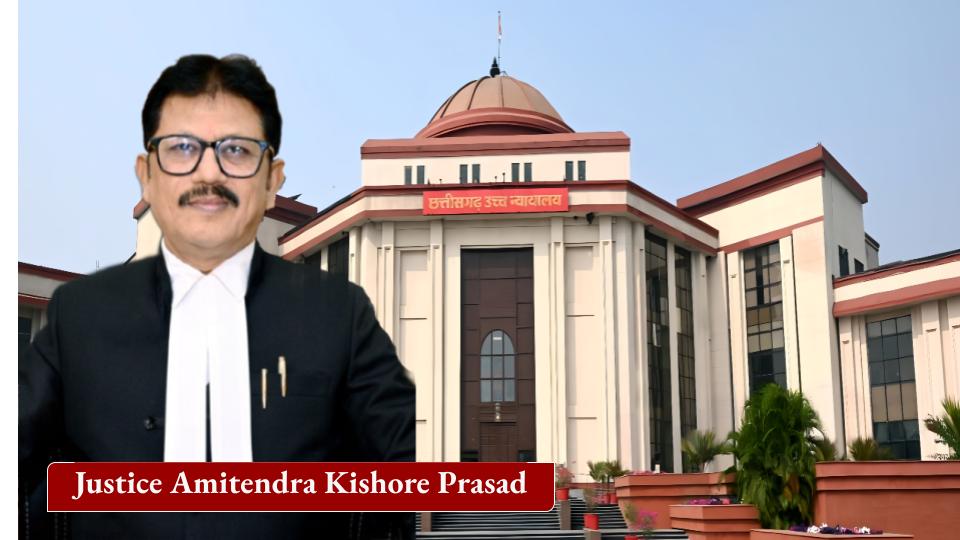
The order was passed by Justice Amitendra Kishore Prasad on August 21, 2026, in Writ Petition (Civil) No. 4681 of 2024, filed by Sukhnandan Das Jangde against the Chief Municipal Officer, Municipal Corporation Bemetara, Rajesh Nishad and other authorities.
The petitioner claimed that his family is the recorded owner or holder of land bearing Khasra No. 649/3, measuring 0.019 hectare, in Ward No. 21, Kurmipara, Bemetara. According to the petition, government land lies between the main road and the petitioner’s property, and respondent No. 2 allegedly occupied a portion of this government land and constructed a temple there without obtaining permission or sanction from the competent authority.
The petitioner had approached the Tehsildar, Bemetara, on May 28, 2024, seeking removal of the alleged encroachment and action against the respondent. According to the case record, after considering the application and hearing the concerned parties, the Tehsildar passed an order on July 16, 2024, directing immediate stoppage or closure of the alleged unauthorized construction.
The petitioner alleged that construction nevertheless continued. He subsequently approached the Tehsildar, police authorities and other competent officials, seeking removal of the alleged encroachment and demolition of the unauthorized structure. He also informed the High Court that an earlier order dated September 26, 2024, had directed the parties to maintain status quo regarding the construction as it existed at that time. According to the petitioner, construction was subsequently carried out despite that direction, leading him to file a contempt petition, which was stated to be pending before the High Court.
The respondents, however, submitted before the High Court that proceedings under Section 248 of the Chhattisgarh Land Revenue Code had already been initiated by the Tehsildar. On that basis, they argued that the petitioner should pursue his grievance before the competent revenue authority rather than seeking an independent determination from the High Court.
While considering the matter, the High Court referred to the Supreme Court’s decision in Union of India vs. State of Gujarat and Others, reported in (2011) 14 SCC 62. The Supreme Court had directed that unauthorized religious constructions should not be permitted on public streets, public parks or other public places and that existing unauthorized religious structures should be reviewed by the concerned governments on a case-by-case basis.
The High Court also referred to its earlier judgment in Vinod Soni and Others vs. Rajesh Kumar Sahu and Others, decided on September 22, 2016. In that case, the Court had emphasized that public property cannot be occupied for construction of a temple merely by invoking religious or spiritual considerations.
The Court observed in the earlier decision that “No person can be permitted to set up a temple on public land.” It further emphasized that the rule of law applies irrespective of the religious character claimed for a structure.
The present Bench also considered the Supreme Court’s detailed procedural safeguards laid down in In Re: Directions in the Matter of Demolition of Structures, reported in (2025) 5 SCC 1. Those directions require authorities to follow due process before carrying out demolition, including service of a show-cause notice, adequate time to respond, an opportunity of personal hearing and a reasoned final order.
The Supreme Court’s directions also require the competent authority to specify the nature of the alleged unauthorized construction, the violations relied upon and the grounds for proposed demolition. Where demolition is ultimately considered necessary, the authority must explain why other options, such as compounding or partial demolition, are unavailable.
Against this legal background, the Chhattisgarh High Court held that it would not be appropriate at this stage to independently adjudicate whether the respondent had actually encroached upon government land or to order demolition directly. The Court noted that the proceedings under Section 248 of the Chhattisgarh Land Revenue Code already pending before the Tehsildar provide the appropriate statutory mechanism for determining the allegation.
The High Court accordingly relegated the petitioner to the pending proceedings before the Tehsildar, Bemetara. The Tehsildar has been directed to consider the petitioner’s grievance and all relevant material and determine whether respondent No. 2 has illegally occupied government land and constructed an unauthorized structure thereon.
The Court further directed that if the Tehsildar finds that government land has been encroached upon and an unauthorized construction has been raised, appropriate action must be taken and a reasoned and speaking order must be passed in accordance with law.
Importantly, the High Court made it clear that any adverse order or coercive action must follow the principles of natural justice. The respondent and other stakeholders whose rights may be affected must receive an opportunity of hearing, and the authority must comply with the procedural safeguards prescribed by law, including the Supreme Court’s directions governing demolition of structures.
The Court also directed that the proceedings before the Tehsildar should be considered and decided expeditiously, preferably within a reasonable period, subject to there being no legal impediment.
The order does not, however, establish that the alleged encroachment or temple construction is illegal. The High Court expressly clarified that it has “not expressed any opinion on the merits of the allegations of encroachment or unauthorized construction.” The final determination will therefore have to be made independently by the Tehsildar on the basis of the evidence and material available before him.
The ruling is significant because it underlines two principles that often arise in disputes involving alleged encroachment on public or government land. First, government authorities have to act in accordance with the applicable land and revenue laws when allegations of unauthorized occupation arise. Second, even where an unauthorized structure is alleged, demolition cannot be carried out arbitrarily and the affected parties must receive the procedural protections required by law.
For citizens, the order also makes clear that a dispute involving government land must ordinarily be examined through the competent statutory mechanism when such proceedings are already pending. At the same time, the authorities cannot bypass due process while taking coercive action. The case will now proceed before the Tehsildar, who is required to determine the underlying encroachment dispute independently and pass an appropriate reasoned order.
Case Reference: Sukhnandan Das Jangde vs. Chief Municipal Officer, Municipal Corporation Bemetara & Others, WPC No. 4681 of 2024