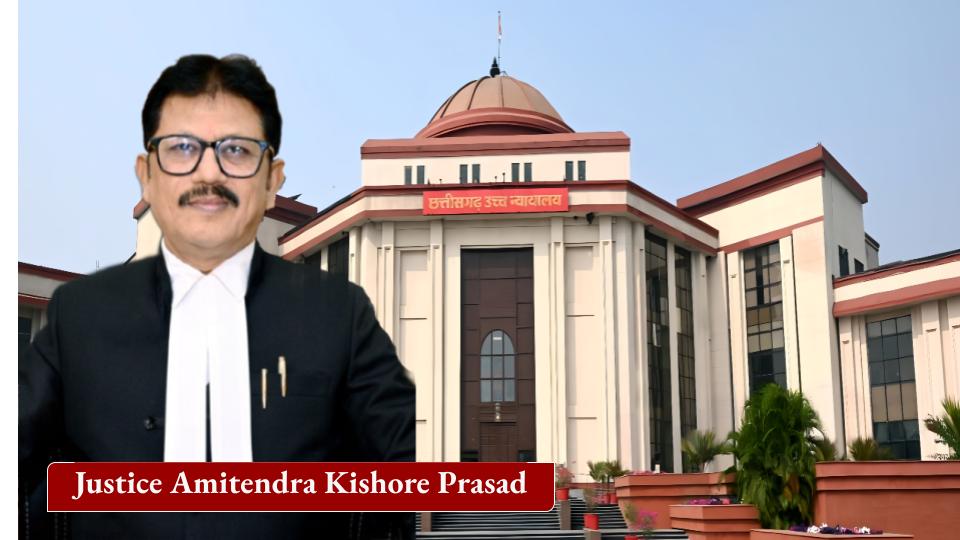
Bilaspur : In a significant ruling that reinforces the constitutional promise of equal educational opportunity, the High Court of Chhattisgarh at Bilaspur has directed the State Government to forthwith commence Lower Kindergarten (LKG) classes across all districts, specifically including District Bemetara, in the Swami Atmanand Excellent English Medium Schools. The order, delivered on September 22, 2026, by Justice Amitendra Kishore Prasad, came in response to a writ petition filed by twelve residents of Village Saja, Tahsil Saja, District Bemetara, who alleged arbitrary and discriminatory denial of pre-primary admissions in their region.
The petitioners, represented by Advocate Mr. N. Naha Roy, approached the court under Article 226 of the Constitution of India after the respondent authorities—including the Secretary of the School Education Department, the Collector of Bemetara, and the District Education Officer—failed to initiate the LKG admission process for the 2026 academic session. According to the petition, while eligible children in a majority of districts across Chhattisgarh were being duly admitted to LKG sections of Swami Atmanand Excellent English Medium Schools, the authorities in Bemetara had arbitrarily neglected to conduct admissions, thereby depriving young children of their Right to Education. The petitioners, who belong to economically weaker and marginalized sections of society and work in the unorganized sector, argued that this selective non-conduction of admissions violated their fundamental rights under Article 14 (Right to Equality) and Article 21-A (Right to Education) of the Constitution, read with Section 11 of the Right of Children to Free and Compulsory Education Act, 2009.
The genesis of the dispute lies in a welfare policy formulated by the State Government to establish Swami Atmanand Excellent English Medium Schools across all districts, with the objective of providing high-quality English medium education to students from all socio-economic backgrounds. Under this uniform scheme, admissions are systematically conducted from LKG to Class XII in almost all districts. However, in Bemetara, the process was stalled. The petitioners submitted that upon inquiry, the Principal of the Atmanand Excellent English Medium School in Rajamohgaon, Block Saja, informed them that LKG classes could not be started due to non-allocation of the required sanction and budget by the State Government, as well as the lack of necessary staffing and infrastructure. This was corroborated by two communications—one dated February 27, 2026, from the District Education Officer, Bemetara, and another dated February 28, 2026, from the Headmaster of the subject school—which categorically admitted that the lack of sanctioned posts and financial allocation was the sole impediment preventing the commencement of LKG classes.
Advocate N. Naha Roy argued that this administrative inaction amounted to clear discrimination, as the State had selectively deprived Bemetara of benefits that were fully operational elsewhere. He contended that the Right to Education is a cherished fundamental right, and its denial warranted strictures from the court accompanied by a writ of mandamus directing the State to commence LKG classes. The petitioners sought a direction to permit admissions at the LKG level through the web portal in the Swami Atmanand Excellent English Medium Schools in Bemetara.
On the other side, Dr. Saurabh Kumar Pande, Deputy Advocate General, representing the State, opposed the petition, arguing that it was devoid of merits. He submitted that the State, as a Welfare State, remains conscious of its constitutional mandate, and the policy decision to establish model schools was taken in the larger public interest. He further contended that foundational pre-school education (LKG) does not automatically attract the mandatory statutory obligations under Article 21-A or the RTE framework, which applies to elementary education for children aged 6 to 14 years. According to him, the State Government determines the opening of LKG classes based on local necessity and feasibility, and a policy decision cannot be interfered with unless it suffers from manifest arbitrariness. He asserted that in the absence of a corresponding statutory duty cast upon the State, the authorities cannot be compelled to grant a relief they are under no legal obligation to provide.
After hearing both parties and perusing the documents, the court found that the letters from the District Education Officer and the Headmaster clearly revealed that LKG classes could not commence only due to non-availability of infrastructure and lack of budgetary allocation, despite demands raised. The court noted that no other reason was assigned to justify the denial. Justice Prasad observed that being a Welfare State, the State is expected to frame and execute its policies uniformly across all districts so that benefits reach every section of society rather than being confined to a select few. “Territorial discrimination in matters pertaining to foundational education cannot be permitted under the constitutional scheme,” the court stated. It further emphasized that once the State took a policy decision to impart quality English-medium education through Swami Atmanand Excellent English Medium Schools throughout all districts, the said policy ought to have been implemented in its true letter and spirit universally. “The benefit of such a Welfare Scheme cannot be denied to students of parents of a particular district or social class nor can access to basic education be restricted in a discriminatory manner,” the court added.
The court also relied on the Supreme Court’s judgment in Dinesh Biwaji Ashtikar vs. State of Maharashtra and others, reported in (2026) 7 SCC 267, which underscored that ensuring admission of students must be a national mission and an obligation of the appropriate Government and local authority. The Supreme Court had highlighted the five duty bearers under the RTE Act—the appropriate Government, the local authority, neighbourhood schools, parents/guardians, and primary school teachers—and emphasized that the legislative choice to implement the right through neighbourhood schools is a deliberate constitutional strategy to operationalise equality of status, dignity, and social integration among children in their formative years. The High Court noted that equality of educational opportunity is a constitutional guarantee under Articles 14 and 21, and since education falls under Entry 25 of the Concurrent List, both the State and the Union share a solemn responsibility to ensure non-discrimination in access to public education.
Accordingly, the Writ Petition was allowed with specific directions. The State Government and its respondent authorities are directed to forthwith commence LKG classes throughout all districts in Chhattisgarh and specifically in District Bemetara, including Swami Atmanand Excellent English Medium School, Rajamohgaon, Block Saja. The concerned authorities must ensure that necessary arrangements, infrastructure, and admissions for LKG classes are finalized within four weeks from the date of receipt of a copy of the order, ensuring that the academic future of young children is not jeopardized in the current academic session. The court also directed that students of District Bemetara shall be placed at par with students of other districts in accessing state-sponsored pre-primary English medium education without discrimination.
This judgment carries significant implications for the implementation of welfare schemes in Chhattisgarh and beyond. It reinforces the principle that once a state formulates a policy for the benefit of its citizens, it cannot selectively deny those benefits to a particular region without reasonable justification. The ruling affirms that while Article 21-A specifically guarantees free and compulsory education to children aged 6 to 14, the State cannot act arbitrarily in matters of pre-primary education when it has already committed to providing such education through its own policy. The decision also serves as a reminder to authorities that administrative excuses such as lack of funds or staffing cannot justify discriminatory denial of constitutional benefits, especially when the affected parties are from economically weaker sections. For the petitioners and other parents in Bemetara, the order brings immediate relief, ensuring that their children will no longer be deprived of foundational English medium education available to their counterparts in other districts. The State Government is now under a legal obligation to allocate the necessary resources and expedite the admission process, failing which contempt proceedings could follow. The judgment is expected to set a precedent for similar cases where welfare schemes are implemented unevenly across regions, reinforcing the judiciary’s role as a guardian of constitutional equality and the right to education.