News Citation : 2026 LN (HC) 364 | 2026:CGHC:23516-DB
June 2, 2026 : The Chhattisgarh High Court has set aside a Single Judge’s order that had upheld a ₹153.55 crore recovery demand against Jindal Steel Limited, holding that the company could not be saddled with such a massive financial liability without being given an opportunity to be heard in the regulatory proceedings that formed the basis of the demand.
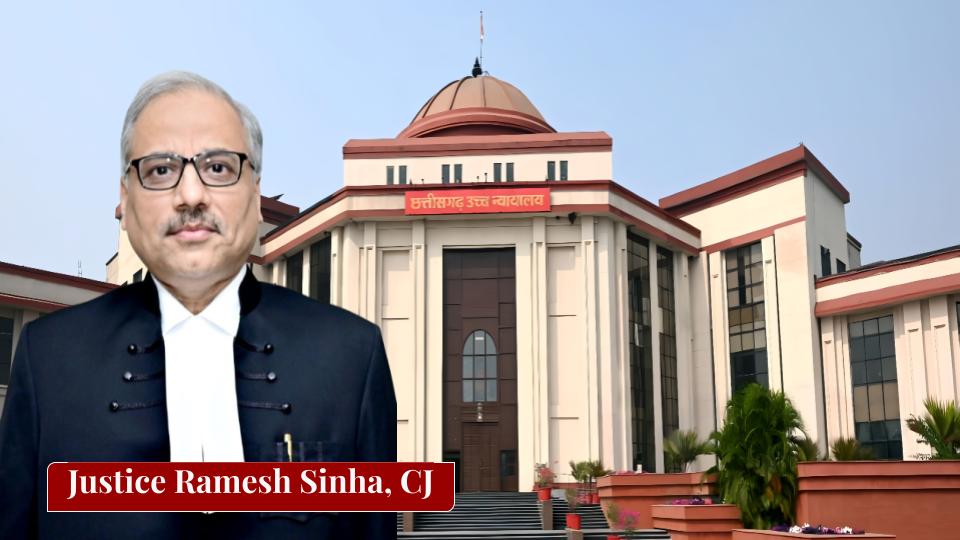
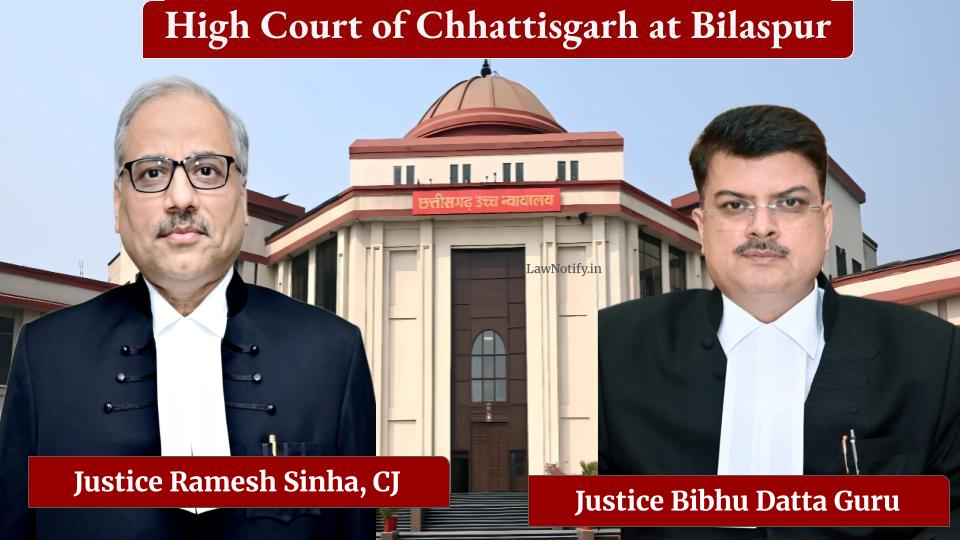
In a significant ruling concerning electricity regulation, contractual rights, and the principles of natural justice, a Division Bench comprising Chief Justice Ramesh Sinha and Justice Bibhu Datta Guru allowed an appeal filed by Jindal Steel Limited and its shareholder Pinaki Bhattacharjee against orders arising from tariff proceedings before the Chhattisgarh State Electricity Regulatory Commission (CSERC) and subsequent proceedings before the Appellate Tribunal for Electricity (APTEL).
The dispute stemmed from power purchase agreements (PPAs) executed between Jindal Steel and the Chhattisgarh State Power Distribution Company Limited (CSPDCL) for the supply of electricity during the financial years 2011-12 and 2012-13. Under the agreements, Jindal supplied electricity from its captive power plant in Raigarh, while CSPDCL accepted the power and made payments in accordance with invoices raised under the contractual framework.
Years later, during tariff true-up proceedings, CSPDCL sought regulatory approval for its power purchase costs. The State Electricity Regulatory Commission examined the procurement and treated certain power purchases as non-firm power. The matter eventually reached APTEL, which upheld the Commission’s findings. Following those proceedings, CSPDCL issued a demand notice in July 2016 seeking recovery of ₹153.55 crore from Jindal Steel, alleging that excess payments had been made for power supplied during the relevant financial years.
The demand triggered further consequences. CSPDCL refused to issue a No Objection Certificate required for short-term open access transactions, and the Chhattisgarh State Power Transmission Company Limited subsequently rejected Jindal’s application for open access on the ground of the alleged outstanding dues.
Jindal challenged the demand, the denial of open access, and the underlying regulatory findings, contending that it had never been impleaded or heard in either the tariff proceedings before CSERC or the appellate proceedings before APTEL, despite the fact that the eventual outcome directly affected its financial interests.
Before the High Court, the company argued that the PPAs were fully performed contracts, all invoices had been accepted and paid without protest, and neither the Commission nor APTEL had specifically directed recovery from the generator. It further contended that contractual rights could not be retrospectively altered and that recovery proceedings based on findings recorded in proceedings where it was not a party violated Articles 14, 19(1)(g), and 21 of the Constitution.
The Division Bench found substantial merit in those submissions. The Court observed that although tariff determination generally carries a regulatory character, proceedings assume a quasi-judicial nature when they culminate in findings that impose adverse financial consequences on a specific entity.
In one of its key observations, the Court held: “While tariff determination may ordinarily possess a regulatory or legislative flavour, the moment proceedings culminate in specific findings fastening adverse financial consequences upon a distinct Generating Company under identified PPAs, the proceedings assume a quasi-judicial character qua such entity.”
The Bench further noted that neither the tariff orders nor the judgment of APTEL expressly directed recovery from Jindal Steel. According to the Court, the Commission’s primary exercise was to determine the extent to which CSPDCL could pass on power purchase costs to consumers through tariff mechanisms. Such regulatory disallowance against a distribution licensee could not automatically be converted into a recovery claim against a generator without a separate adjudication of liability.
Addressing Section 62(6) of the Electricity Act, 2003, the Court clarified that while the provision permits recovery where tariff in excess of the approved tariff has been collected, it does not eliminate the requirement of a proper adjudicatory process. The Bench emphasized that a generator facing a substantial recovery claim must be afforded an effective opportunity to defend itself before liability can be imposed.
The Court strongly criticized the manner in which the demand was raised against Jindal. It noted that the company was never heard during the tariff petition, review proceedings, or the appeals before APTEL, despite the fact that the outcome was later used to demand repayment of ₹153.55 crore.
Highlighting the importance of procedural fairness, the Bench observed: “The appellant-Company was neither heard during tariff petition, review petition or the appeal before the Appellate Tribunal which in no manner can be justified especially when an order is passed on the basis of those proceedings which results into payment of Rs.153.55 crores back to the respondent.”
The Court concluded that the demand notice and consequential actions were vitiated by a clear violation of the principles of natural justice, particularly the rule of audi alteram partem, which guarantees that no person should be condemned unheard.
The High Court also invalidated the denial of open access and the refusal to grant a No Objection Certificate. It held that the rejection was based entirely on disputed dues arising from the impugned demand notice and that such contested claims could not be treated as crystallized outstanding dues for the purpose of restricting access to the electricity market.
The Bench further disagreed with the approach adopted by the Single Judge, holding that once a violation of natural justice had been recognized, the writ petition ought not to have been dismissed on grounds such as alternative remedies or the finality of earlier proceedings. The Court reiterated that the doctrine of alternative remedy is a rule of discretion and cannot override a clear breach of procedural fairness.
The ruling is expected to have significant implications for electricity regulation and contractual disputes in the power sector. It reinforces the principle that regulatory findings affecting private contractual rights cannot be enforced against a party that was never afforded a hearing. The judgment also underscores that distribution licensees cannot automatically transform regulatory disallowances into recovery claims against generating companies without independent adjudication.
For power producers, distribution companies, and regulatory authorities across India, the decision serves as an important reminder that contractual certainty and procedural safeguards remain central to the functioning of the electricity sector. The judgment is likely to be cited in future disputes involving tariff true-up exercises, recovery proceedings, open access rights, and the scope of Section 62(6) of the Electricity Act, 2003.
Case Reference : Jindal Steel Limited (formerly Jindal Steel and Power Limited) & Another v. Chhattisgarh State Electricity Regulatory Commission & Others, WA No. 379 of 2026, decided on June 2, 2026 ; appearance for the appellants: Mr. Gopal Jain, Mr. Abhimanyu Bhandari and Mr. Ashish Shrivastava, Senior Advocates, assisted by Ms. Divya Chaturvedi, Mr. Bhaskar Payashi, Mr. Saransh Shaw, Mr. Jai Dhanani, Mr. Pranav Sood, Ms. Pankhuri Gupta, Ms. Kriti Sharma and Mr. Rahul Ambast, Advocates; for Respondent No. 1: Mr. Adhiraj Surana, Advocate; and for Respondents No. 2 and 3: Mr. Raj Kumar Mehta, Ms. Himanshi Andley and Mr. Varun Sharma, Advocates.