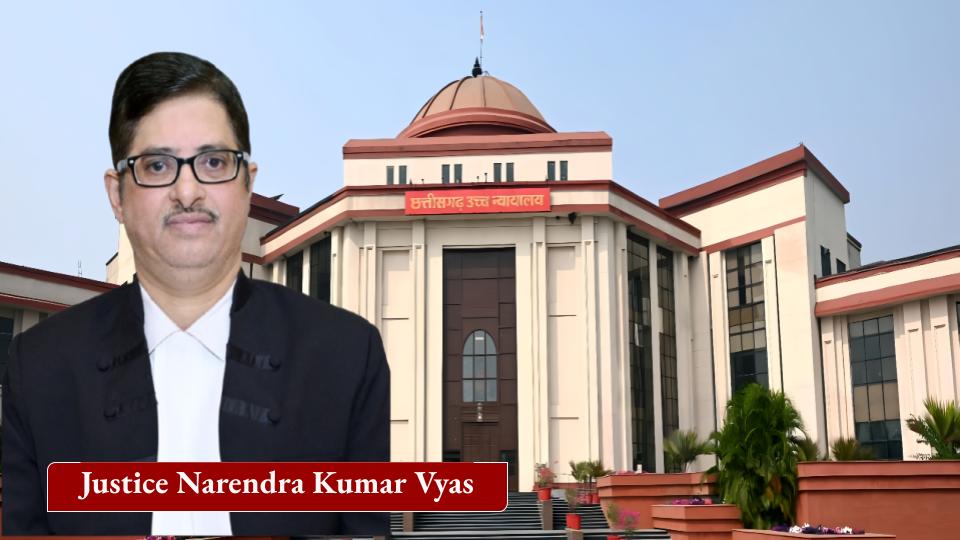
Bilaspur : The Chhattisgarh High Court at Bilaspur has partly allowed the State’s acquittal appeal and reversed the acquittal of three accused in a case concerning alleged illegal abortions and preservation of foetuses at LifeCare Hospital in Deepka, Korba. Justice Narendra Kumar Vyas held that the prosecution had established the offences punishable under Section 5 of the Medical Termination of Pregnancy Act, 1971 and Section 315 of the Indian Penal Code, while the acquittal under Section 22(3) of the PC & PNDT Act was upheld because the case had been initiated through a police FIR and charge-sheet in violation of the special statutory procedure.
The case arose from an inspection of LifeCare Hospital following information received by the authorities in August 2011. During the inspection, medical authorities allegedly found foetuses of different gestational ages, objectionable medical instruments and medicines at the hospital. An FIR was subsequently registered at Deepka Police Station against the hospital operator and doctors under the Medical Termination of Pregnancy Act, the PC & PNDT Act and Section 315 of the IPC. The matter ultimately proceeded to trial before the Additional Sessions Judge, Katghora.
The trial court had acquitted the accused on August 31, 2016, holding that the prosecution had failed to prove the allegations beyond reasonable doubt. The State challenged that decision before the High Court, arguing that the trial court had failed to properly appreciate the evidence of several medical witnesses and had attached undue importance to minor contradictions and omissions. The accused, represented by advocate Sumit Verma, opposed the appeal and maintained that the trial court had correctly assessed the evidence and that the prosecution witnesses suffered from material inconsistencies.
A significant part of the High Court’s ruling concerned the legal procedure prescribed under the PC & PNDT Act, 1994. The Court noted that Section 28 creates a specific statutory mechanism for taking cognizance of offences under the Act. Cognizance can be taken only on a complaint by the Appropriate Authority or other persons specifically authorised under the Act. The Court also noted that the State Government had designated the District Magistrate and Block Medical Officer as Appropriate Authorities within their respective jurisdictions.
The High Court found that, in the present case, the police had registered an FIR and subsequently filed a charge-sheet for the PC & PNDT offence. According to the Court, this procedure was legally impermissible. Relying on the Supreme Court’s decision in State of Uttar Pradesh and Another v. Brij Pal Singh and Another, reported as 2026 INSC 901, the Court observed that the police cannot act as the principal investigating authority for offences under the PC & PNDT Act. The Supreme Court had held that the Appropriate Authority is responsible for investigating complaints under the special legislation and that a Magistrate cannot take cognizance of such an offence merely on the basis of a police charge-sheet.
The High Court therefore affirmed the acquittal of the respondents in respect of Section 22(3) of the PC & PNDT Act, but on a different legal ground. The Court held that because the mandatory complaint procedure under Section 28 had not been followed, the trial court could not have taken cognizance of the PC & PNDT offence on the basis of the FIR and police charge-sheet.
The position was different, however, with respect to the charges under the Medical Termination of Pregnancy Act, 1971 and Section 315 IPC. The Court examined the evidence concerning foetuses allegedly found at the hospital and noted that witnesses had spoken about several preserved foetuses of different gestational ages. Medical witnesses also described the presence of instruments allegedly capable of being used for abortions and the storage of expired medicines.
The Court particularly relied upon evidence showing that five foetuses between approximately 16 and 32 weeks were found at the hospital and observed that the accused had failed to provide a satisfactory explanation for their presence. The judgment records that the defence was unable to rebut the fact that the foetuses had been found at the hospital.
The Court examined the statutory framework of the MTP Act as it stood before the 2021 amendment. Section 3 permitted termination of pregnancy only in specified circumstances and subject to prescribed gestational limits and medical opinions. Section 5 provided limited exceptions, particularly where termination was immediately necessary to save the life of the pregnant woman. The Court found that the accused had failed to establish that the foetuses found at the hospital resulted from abortions carried out in good faith or under circumstances permitted by the Act.
The judgment also considered Section 315 of the IPC, which deals with acts intended to prevent a child from being born alive or to cause the child to die after birth. The provision contains an exception where the act is done in good faith for the purpose of saving the life of the mother. The High Court concluded that the accused had failed to establish such good faith or that the relevant statutory conditions had been satisfied.
Importantly, the High Court explained the significance of the burden relating to good faith. Referring to Section 111 of the Evidence Act and Supreme Court precedents, the Court held that where the circumstances were particularly within the knowledge of the accused, they were required to establish that the termination was carried out in good faith and within the statutory exceptions. The Court concluded that the respondents had “miserably failed to discharge their burden” regarding the circumstances in which the foetuses came to be kept at the hospital.
The Court also addressed the limited scope of interference in an appeal against acquittal. Ordinarily, an appellate court exercises caution before reversing an acquittal because the accused enjoys the benefit of the presumption of innocence. However, relying on the Supreme Court’s decision in Constable 907 Surendra Singh and Another v. State of Uttarakhand, reported as 2025 INSC 114, the High Court held that interference is justified where the trial court’s findings are patently perverse, material evidence has been overlooked or misread, and the evidence permits only a conclusion consistent with guilt.
Applying that principle, Justice Narendra Kumar Vyas held that the trial court had committed an illegality in acquitting the accused under Section 5 of the MTP Act and Section 315 IPC. The High Court found that the trial court had relied on the absence of a woman complaining about an abortion and the fact that no abortion was detected during the inspection, but those considerations did not adequately address the evidence concerning the foetuses found at the hospital.
The High Court consequently allowed the State’s appeal in part. The acquittal of the three respondents under Section 5 of the Medical Termination of Pregnancy Act, 1971 and Section 315 of the IPC was reversed, while their acquittal under Section 22(3) of the PC & PNDT Act was maintained on the ground of the statutory bar concerning cognizance and investigation.
The Court has not yet pronounced the sentence. In compliance with Section 235(2) of the CrPC and Section 254(2) of the Bharatiya Nagarik Suraksha Sanhita, 2023, the accused or their counsel are required to be heard on the question of sentence. The matter has been directed to be listed on October 12, 2026, when the respondents or their counsel are required to remain present.
The ruling has significance beyond the individual prosecution because it clarifies two separate aspects of medical-regulation offences. First, proceedings under the PC & PNDT Act must strictly follow the special complaint and investigation mechanism prescribed by Parliament. Second, where prosecution under the MTP Act and Section 315 IPC is otherwise maintainable, the accused may be required to establish the statutory good-faith exception when the relevant circumstances are within their special knowledge. The decision therefore underscores the importance of maintaining lawful medical records, complying with statutory abortion requirements and following the prescribed enforcement mechanism under special health legislation.
Case Reference: State of Chhattisgarh v. Dr. Rajendra Prasad Ravidas & Others, ACQA No. 115 of 2022.