Author: Dr. Kundan Shri Mishra
Abstract- Library and Information Science (LIS) is an important field that supports education, research, knowledge management and public access to information. The role of a librarian is no longer limited to issuing books and maintaining shelves. Today, librarians manage digital resources, organise information, support researchers, use library automation systems and help users find reliable information.
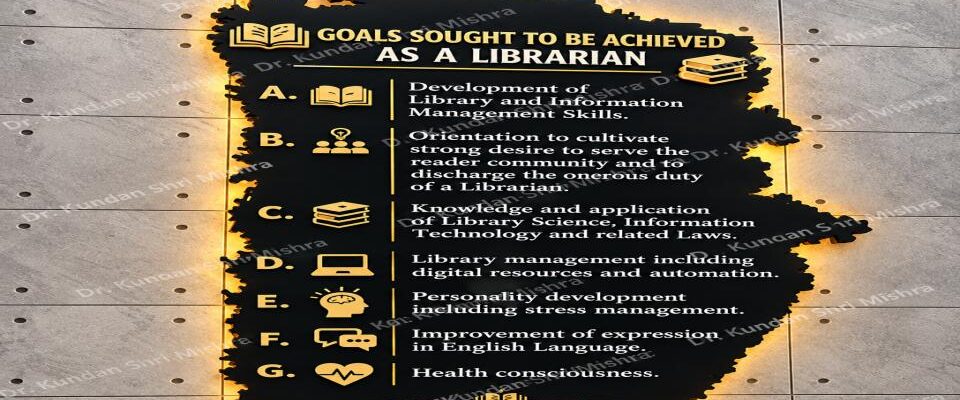
This article presents the Seven Professional Goals for Librarians, a proposed framework developed by Dr. Kundan Shri Mishra. It covers professional skills, user services, knowledge of library science and law, digital library management, personality development, communication skills, and health awareness. These goals provide a simple and practical way for LIS students, library professionals and institutions to understand the major areas of professional development.
The framework connects the traditional principles of librarianship with the needs of modern libraries, including academic libraries, public libraries, special libraries, digital libraries and court libraries.
Keywords: Seven Professional Goals for Librarians, Library and Information Science, Librarian Duties, Library Management, Professional Ethics, Digital Library, Library Automation, LIS Students, Information Technology, Dr. Kundan Shri Mishra.
1. Introduction
A librarian plays an important role in collecting, organising, preserving and providing access to information. Libraries help students learn, researchers discover knowledge, professionals conduct research and citizens access useful information.
The development of information technology has changed the working environment of libraries. Printed books now exist alongside e-books, electronic journals, online databases, digital repositories and other electronic resources. As a result, librarians need professional knowledge, technical skills, legal awareness, communication abilities and a commitment to continuous learning.
Dr. S. R. Ranganathan’s Five Laws of Library Science remain a foundation of library philosophy. First formulated in 1928 and published in his landmark book in 1931, these laws explain the importance of using books, serving readers, connecting resources with users, saving readers’ time and developing libraries continuously.
Building on the broader professional needs of modern librarianship, this article presents a separate framework of seven professional goals. These goals focus on what librarians should learn, practise and improve throughout their careers.
2. Goal One: Development of Library and Information Management Skills
Core principle: A librarian must continuously improve professional knowledge and skills.
Library and information management is the foundation of librarianship. A librarian must understand how to select, acquire, organise, classify, catalogue, preserve and retrieve information resources.
Important professional skills include classification, cataloguing, indexing, reference services, collection development, circulation management, bibliographic control and information retrieval.
For example, a student searching for a book on Indian constitutional law should be able to locate the correct book through the library catalogue, classification number or subject index. Similarly, a researcher should be able to identify relevant journals, reports and electronic resources with the librarian’s assistance.
Modern librarians should also learn digital repository management, metadata standards, research support services and information literacy.
Practical application: LIS students should study classification schemes such as Dewey Decimal Classification and Colon Classification, understand cataloguing principles and gain practical experience with library management software.
The professional objective is to develop librarians who can organise information accurately and help users find the resources they need.
3. Goal Two: Commitment to Reader and User Services
Core principle: Every library service should focus on the legitimate information needs of its users.
A library exists to serve its users. A librarian should therefore develop a strong commitment to helping readers, students, researchers, teachers, legal professionals and other authorised users.
Good library service includes answering enquiries, helping users locate books, guiding them in the use of digital resources and making library services accessible to different sections of society.
A public library may need to support children, senior citizens, rural readers and people with disabilities. A university library may focus on students, teachers and researchers. A court library may provide legal research materials and reference services to judicial officers, advocates and authorised staff.
The services may differ, but the basic objective remains the same: to provide appropriate information in a helpful, fair and professional manner.
Practical application: Librarians should maintain a user-friendly catalogue, provide clear instructions, offer reference assistance and regularly review the needs of their readers.
The professional objective is to make library services inclusive, responsive and useful.
4. Goal Three: Knowledge and Application of Library Science, Information Technology and Law
Core principle: A librarian must understand the rules and technologies that govern professional work.
A modern librarian needs knowledge of Library and Information Science as well as the legal and administrative requirements relevant to the institution.
Library legislation, copyright, information access, data protection, records management and institutional service rules can all affect library operations.
For example, the Right to Information Act, 2005 includes requirements concerning the proper maintenance and organisation of records by covered public authorities. The Copyright Act, 1957 governs copyright protection and contains specific exceptions subject to their conditions. The Digital Personal Data Protection Act, 2023 is relevant to digital personal data processing according to its applicable provisions and implementation status.
Librarians must understand the limits of their authority and follow the applicable laws, licences and institutional policies. They should not assume that every book may be copied, every digital document may be distributed or every library record may be disclosed without restriction.
Technology is equally important. Knowledge of databases, search systems, digital catalogues, metadata and information retrieval helps librarians provide accurate and efficient services.
Practical application: LIS courses and professional training should include library legislation, copyright awareness, information ethics, digital security and the practical use of library technologies.
The professional objective is to develop librarians who can apply professional knowledge responsibly and work within the applicable legal framework.
5. Goal Four: Effective Library Management, Digitisation and Automation
Core principle: A librarian must manage resources efficiently and adapt to technological change.
Library management includes collection development, budgeting, inventory control, preservation, staff coordination, maintenance of records and evaluation of services.
Library automation makes many of these activities faster and more systematic. Library management software can support cataloguing, circulation, serials control, stock verification and report generation.
Digitisation and digital repositories provide additional ways to preserve and access information. Electronic journals, e-books, institutional research publications and digitised historical materials can help users obtain information beyond the physical library.
For example, a court library may organise judgments, legal commentaries, statutes and research materials in searchable electronic systems. A university library may develop an institutional repository to preserve and provide access to eligible research publications.
However, digitisation must respect copyright, licensing terms, confidentiality, data protection and applicable institutional policies.
Practical application: Librarians should develop skills in library automation, digital preservation, electronic resource management, cybersecurity and the maintenance of accurate digital records.
The professional objective is to create libraries that are organised, efficient, secure and prepared for future information needs.
6. Goal Five: Personality Development and Stress Management
Core principle: Professional competence must be supported by responsible behaviour and emotional balance.
Librarians work with users, colleagues, administrators, publishers and other professionals. Good communication, patience, discipline, teamwork and problem-solving are important for maintaining effective library services.
Time management and stress management are also valuable because library work may involve deadlines, detailed records, research requests and multiple administrative responsibilities.
Personality development should not be limited to appearance or speaking style. It should include professional integrity, respectful behaviour, leadership, confidence, accountability and the ability to make thoughtful decisions.
Practical application: Librarians should participate in professional development programmes, improve their teamwork and communication, plan their work effectively and use appropriate methods to manage occupational stress.
The professional objective is to develop confident, responsible and cooperative library professionals.
7. Goal Six: Improvement of English and Other Communication Skills
Core principle: A librarian must communicate information clearly and accurately.
Communication is an essential skill in Library and Information Science. Librarians explain how to use catalogues, help users search databases, prepare bibliographies, write reports and communicate with publishers and researchers.
English is particularly useful for accessing international research literature, technical documentation, scholarly databases and many professional standards. However, effective librarianship also requires communication in the languages used by the library’s community.
In India, Hindi and regional languages can play an important role in helping readers understand library services and access information.
For example, a librarian who can explain a digital search in simple language may help a student find relevant research more quickly than a librarian who provides only technical instructions.
Practical application: LIS students should practise professional writing, reference interviews, presentation skills, report writing, email communication and the preparation of bibliographies.
The professional objective is to make information easier to understand and use.
8. Goal Seven: Health Awareness and Personal Well-Being
Core principle: A healthy working environment supports sustainable professional performance.
Library work may involve long periods of reading, computer use, cataloguing, handling books and working at a desk. Attention to physical and mental well-being can help librarians maintain concentration and work comfortably.
Useful practices include maintaining suitable workstation arrangements, taking appropriate breaks, using adequate lighting and following safe methods for handling collections.
Mental well-being is also important. Reasonable workloads, professional support, respectful working relationships and effective time management can help reduce avoidable workplace stress.
Health awareness should be supported by appropriate institutional arrangements and should not be used to discriminate against employees.
Practical application:Librarians should adopt suitable ergonomic practices, maintain healthy working routines and encourage institutions to provide safe and supportive working environments.
The professional objective is to promote a healthy, balanced and sustainable professional life.
9. The Seven Professional Goals in the Digital Age
The seven goals can be applied to traditional libraries, digital libraries and specialised information centres.
In a traditional library, they support collection management, reader services and professional development. In a digital library, they support information retrieval, metadata quality, accessibility, electronic resource management and data security. In a court or law library, they support legal research, accurate record organisation, authorised access to information and compliance with institutional requirements.
These goals also connect with Dr. Ranganathan’s Five Laws of Library Science. The emphasis on user service reflects the importance of readers. Digital discovery supports the connection between resources and users. Efficient catalogues and search systems help save readers’ time. Continuous training and technology adoption support the idea of a growing organism.
The two frameworks serve different purposes. Ranganathan’s Five Laws express the foundational philosophy of librarianship, while the Seven Professional Goals proposed here focus on the skills, responsibilities and development needs of the modern librarian.
10. A Proposed Professional Framework for LIS Students and Librarians
The Seven Professional Goals for Librarians can be used as a practical guide for education, training and professional reflection.
LIS students can use them to identify the knowledge and skills they need to develop before entering the profession. Working librarians can use them to review their professional strengths and identify areas for further training. Library institutions can use them as a starting point for developing training programmes, subject to their own policies and applicable rules.
The framework can also help educators connect classroom concepts with practical library work. For example, classification and cataloguing relate to professional competence; reference services relate to user service; copyright and library legislation relate to legal awareness; and automation relates to digital library management.
The framework is a proposed professional model, not a statutory code already binding on every librarian. Any institution wishing to make its provisions mandatory would need to adopt them through the appropriate rules, regulations or policies.
11. Conclusion
The role of the librarian continues to expand with changes in education, research, information technology and society. Modern librarians must combine professional knowledge with user service, legal awareness, digital competence, communication skills and personal well-being.
The Seven Professional Goals for Librarians provide a simple framework for understanding these responsibilities. They encourage librarians to improve their knowledge, serve users effectively, apply the law responsibly, manage digital and physical resources, develop professional behaviour, communicate clearly and maintain healthy working practices.
For LIS students, these goals offer a practical way to connect theory with professional responsibilities. For working librarians, they provide a foundation for continuous learning and improvement. For institutions, they offer a starting point for designing professional development programmes and service standards.
The future of librarianship depends not only on the number of books or digital resources a library holds, but also on the ability of its professionals to connect people with reliable information. A skilled, ethical and user-focused librarian remains essential to every effective library.
References
1. Ranganathan, S. R. (1931). The Five Laws of Library Science. Madras Library Association; Edward Goldston.
2. Government of India. The Right to Information Act, 2005.
3. Government of India. The Copyright Act, 1957, as amended.
4. Government of India. The Digital Personal Data Protection Act, 2023, subject to applicable commencement and implementation provisions.
5. Ministry of Culture, Government of India. National Mission on Libraries.
6. University Grants Commission. Applicable regulations concerning qualifications and service conditions for librarians in higher education.