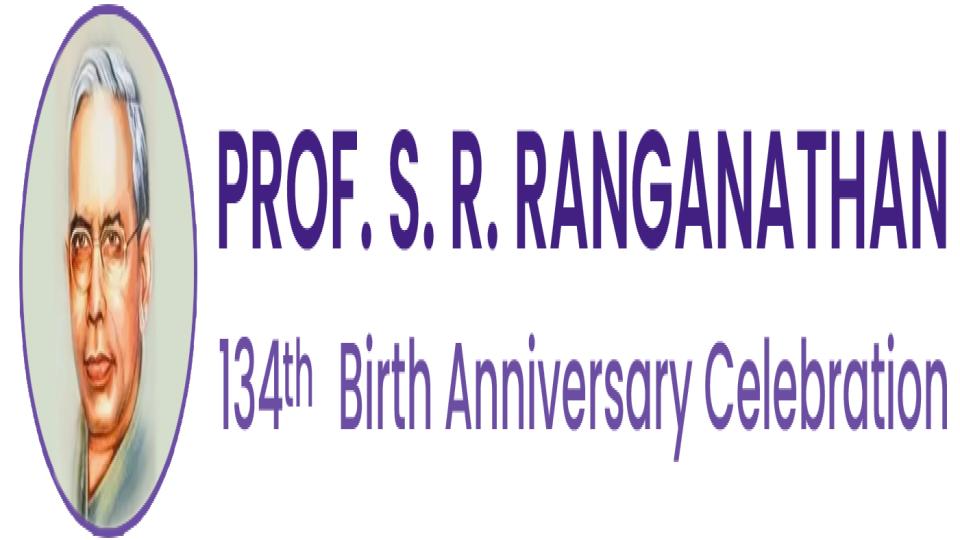
August 11, 2026 : The intellectual progress of a society cannot be measured merely by the number of schools, universities or research institutions it possesses. It must also be measured by how easily, equally and effectively people can access knowledge. In this context, the life and work of Dr. S. R. Ranganathan occupy a distinguished place in the history of librarianship in India.
Born on 12 August 1892, Shiyali Ramamrita Ranganathan began his professional career as a teacher of mathematics. His professional journey, however, eventually led him towards librarianship, a field to which he devoted his life. He is widely regarded as the father of library science in India. His contribution went far beyond the management of books. He established a scientific and systematic approach to librarianship and placed the user, access to knowledge and efficient organisation of information at the centre of library services.
Ranganathan’s most enduring contribution is his Five Laws of Library Science, first published in 1931. These principles, namely, “Books are for use,” “Every reader his or her book,” “Every book its reader,” “Save the time of the reader,” and “The library is a growing organism,” transformed the way libraries and their services were understood.
The first law, “Books are for use,” challenged the idea of the library as merely a place where books were preserved. A collection has little value if its resources cannot be effectively used. The principle remains equally relevant today, when libraries are responsible not only for printed books but also for electronic journals, e-books, databases, institutional repositories and digital resources.
The second and third laws place the relationship between readers and information at the heart of librarianship. “Every reader his or her book” emphasises the responsibility of libraries to understand the diverse information needs of their users. “Every book its reader” highlights the equally important responsibility of making useful resources discoverable and accessible to those who need them.
The fourth law, “Save the time of the reader,” has perhaps acquired even greater importance in the digital age. Users today expect immediate access to reliable information. A modern library must therefore provide effective discovery systems, digital catalogues, remote access, electronic resources and efficient information services. The principle is no longer simply about locating a book quickly. It is about helping users reach relevant and trustworthy information with minimum effort.
The fifth law, “The library is a growing organism,” is particularly significant in an era of rapid technological transformation. Libraries cannot remain static institutions. Their collections, technologies, services, infrastructure and professional practices must continuously evolve. The emergence of digital libraries, artificial intelligence, data-driven research, online databases and open-access resources demonstrates how accurately Ranganathan anticipated the changing nature of libraries.
Ranganathan also made a landmark contribution to the organisation of knowledge through Colon Classification, first published in 1933. His classification system introduced a faceted approach to the organisation of subjects. The PMEST framework, representing Personality, Matter, Energy, Space and Time, provided a flexible method for analysing and representing complex subjects.
The importance of this contribution extends beyond traditional library shelves. Modern information systems continue to face the fundamental challenge of organising increasingly complex bodies of knowledge so that users can discover relevant information efficiently. Although today’s technologies are far more sophisticated, the underlying intellectual problem remains remarkably similar to the one Ranganathan addressed nearly a century ago.
His contribution was not confined to theory. Ranganathan played an important role in the development of library education and professional training in India. His association with institutions such as the University of Madras, Banaras Hindu University and the University of Delhi helped strengthen library science as an academic and professional discipline.
Ranganathan was also a strong advocate of public libraries and wider access to knowledge. His vision extended beyond universities and research institutions. He believed that library services should reach ordinary citizens and that access to knowledge was essential for education and social development. His ideas therefore became an important part of the intellectual foundation of India’s public library movement.
His legacy becomes even more significant in the present era of digital transformation. Institutions such as the INFLIBNET Centre have helped build networks and information infrastructure connecting the higher education and research community with digital scholarly resources. In this environment, Ranganathan’s philosophy provides an important guiding principle: technology should ultimately serve the user and improve access to knowledge.
The relevance of Ranganathan’s work is therefore not limited to the history of librarianship. His ideas raise a fundamental question for every modern library: Are we merely storing information, or are we making knowledge genuinely accessible and useful?
This question is particularly important in an age when information is abundant but reliable knowledge is often difficult to identify. Digital platforms have made information available at unprecedented speed, but they have also created new challenges involving information overload, discoverability, misinformation, digital preservation and information literacy. The modern librarian increasingly has to act not only as a custodian of collections but also as a guide, organiser, facilitator and mediator of knowledge.
Ranganathan’s greatest achievement was perhaps his ability to see the library as something larger than a physical institution. For him, the library was a dynamic social and intellectual system in which books, readers, librarians and knowledge interacted continuously.
Today, artificial intelligence, machine learning, digital repositories, automated discovery systems and electronic scholarly communication are redefining library and information science. Yet the fundamental objective remains unchanged: connecting people with the knowledge they need.
That is why Dr. S. R. Ranganathan continues to remain relevant more than a century after his birth. His Five Laws are not merely historical principles. They can be understood as enduring standards against which modern library services can be evaluated.
His birth anniversary on 12 August, observed in India as National Librarians’ Day, provides an opportunity not merely to remember a pioneering scholar but also to reconsider the purpose and future of libraries.
Ranganathan’s enduring message is simple yet profound: a library achieves its true purpose when knowledge does not remain locked within shelves, databases or digital repositories, but reaches the right person at the right time in a form that can be meaningfully used.
For the digital generation, this remains perhaps the most important lesson of Ranganathan’s legacy. Technology may change the form of information, but the fundamental mission of librarianship remains the same: to organise knowledge, connect people with information and keep the library a living institution in the service of society.
– Author : Dr. Kundan Shri Mishra (Father of Public Library Movement in Chhattisgarh State)