News Citation : 2026 LN (HC) 427
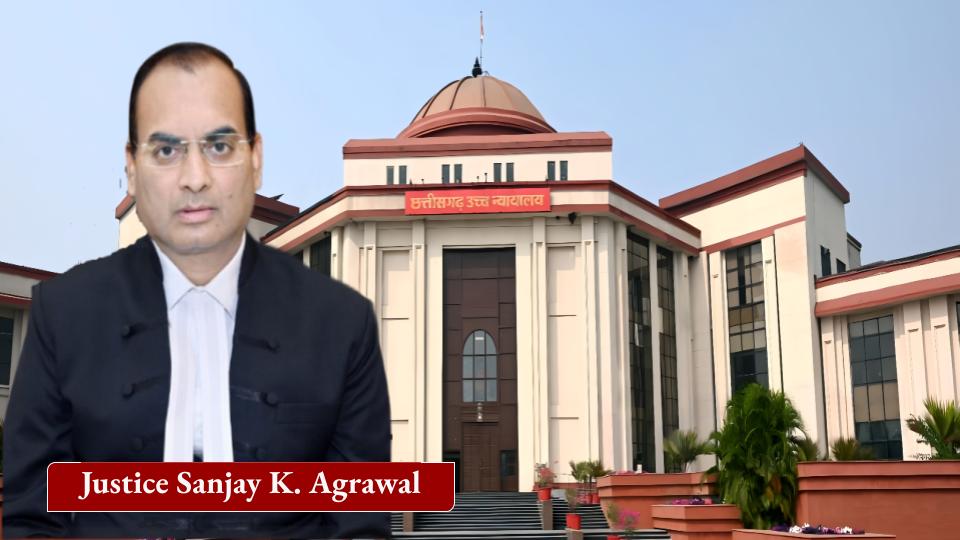
August 20, 2026 : The Chhattisgarh High Court at Bilaspur has held that the State Government cannot use the general power of relaxation under Rule 79 of the Chhattisgarh Civil Services (Pension) Rules, 1976 to bypass the mandatory four-year limitation prescribed for initiating departmental proceedings against a retired government employee. Justice Sanjay K. Agrawal, hearing WPS No. 9593 of 2019, quashed the State Government’s order directing recovery of ₹1,09,975 from retired jail superintendent Dr. Shyam Raj Singh. The order was reserved on August 14, 2026 and delivered on August 20, 2026.
The case arose from alleged irregularities in the purchase of materials at Central Jail, Raipur during 2004-05 and 2005-06, when Dr. Singh was serving as Superintendent. The allegation was that the lowest tender was not accepted, resulting in an alleged loss of ₹1,09,975 to the government. Dr. Singh retired from service on August 31, 2010, after which he received his retiral benefits, including pension and gratuity. Despite his retirement, a charge-sheet was issued on May 29, 2013 in relation to the alleged misconduct. The departmental proceedings ultimately resulted in the State ordering recovery of the alleged loss from his retiral benefits by order dated October 18, 2019.
The central issue before the High Court was whether departmental proceedings could legally be initiated after the expiry of four years from the alleged event by invoking the State Government’s relaxation power under Rule 79 of the 1976 Rules. Rule 9(2)(b)(ii) expressly provides that where departmental proceedings are initiated after retirement, they “shall not be in respect of any event which took place more than four years before such institution.” The Court emphasised that the use of the word “shall” makes the limitation mandatory rather than merely directory.
The Court also examined Rule 79, which permits the State Government to relax a rule where its operation causes undue hardship in a particular case. However, such relaxation must be supported by reasons recorded in writing and must be intended to deal with the matter in a just and equitable manner. The proviso further requires concurrence of the Finance Department. Justice Agrawal held that this provision gives the government limited administrative flexibility and cannot be treated as a blanket power to disregard mandatory statutory safeguards.
In the present case, the High Court found that although the Finance Department had given its concurrence, there was no material showing that the Administrative Department had independently recorded reasons demonstrating the existence of undue hardship or explaining why relaxation of the four-year limitation was necessary. The Court therefore concluded that the requirements of Rule 79 had not been properly satisfied.
The High Court relied on several Supreme Court decisions while reaching its conclusion. Referring to Kadirkhan Ahmedkhan Pathan v. Maharashtra State Warehousing Corporation, the Court noted that provisions restricting post-retirement departmental proceedings are benevolent in nature because they regulate the State’s discretion and protect retired employees from proceedings relating to stale allegations. It also relied on Brajendra Singh Yambem v. Union of India, where the Supreme Court held that departmental proceedings initiated beyond the prescribed limitation period cannot be sustained merely because sanction had subsequently been obtained.
The Court further referred to State of U.P. v. Shri Krishna Pandey, in which the Supreme Court had recognised the importance of the statutory time limit governing disciplinary action after retirement. The Chhattisgarh High Court observed that the limitation is designed to prevent the State from initiating disciplinary proceedings against retired employees after an unreasonable and legally prohibited delay.
On the scope of the relaxation power, the Court explained that Rule 79 is intended to mitigate genuine undue hardship and permit a just and equitable resolution of exceptional situations. It is not a mechanism for rewriting the rules or reviving an action that has already become time-barred. The judgment states, “Rule 79 of the Rules of 1976 provides a mechanism for the relaxation of rules, not for their rewriting.”
Justice Agrawal further held that the State’s power of relaxation must be exercised judiciously and cannot override an express statutory prohibition. According to the Court, allowing Rule 79 to defeat Rule 9(2)(b)(ii) would effectively permit administrative discretion to replace a mandatory statutory requirement. The judgment cautioned that such an unrestricted exercise of power could turn a provision intended to provide equitable relief into a means of oppressive or arbitrary action against public servants.
The Court noted that the alleged misconduct related to 2004-05 and 2005-06, whereas the charge-sheet was issued only on May 29, 2013. This meant that the proceedings were initiated more than seven to eight years after the alleged events. The Court held that the departmental action was therefore barred by limitation under Rule 9(2)(b)(ii), and the State could not overcome that statutory bar by invoking Rule 79.
The judgment has wider significance for disciplinary proceedings against retired government employees in Chhattisgarh. It makes clear that administrative authorities must act within the statutory framework when seeking to proceed against a retired employee for past misconduct. Finance Department concurrence by itself cannot substitute the requirement of a reasoned decision by the competent administrative authority where the rules specifically require reasons to be recorded in writing.
The ruling also reinforces the distinction between a genuine relaxation power and an attempt to extend a statutory limitation period. While the government may possess limited authority to address undue hardship under Rule 79, that authority cannot be used to revive proceedings that the pension rules expressly prohibit because of the passage of time. This principle provides an important safeguard for retired government employees against disciplinary action based on stale allegations.
Ultimately, the Chhattisgarh High Court quashed the State Government’s October 18, 2019 punishment order directing recovery of ₹1,09,975 from Dr. Shyam Raj Singh. The writ petition was allowed to that extent, and the Court made no order as to costs.