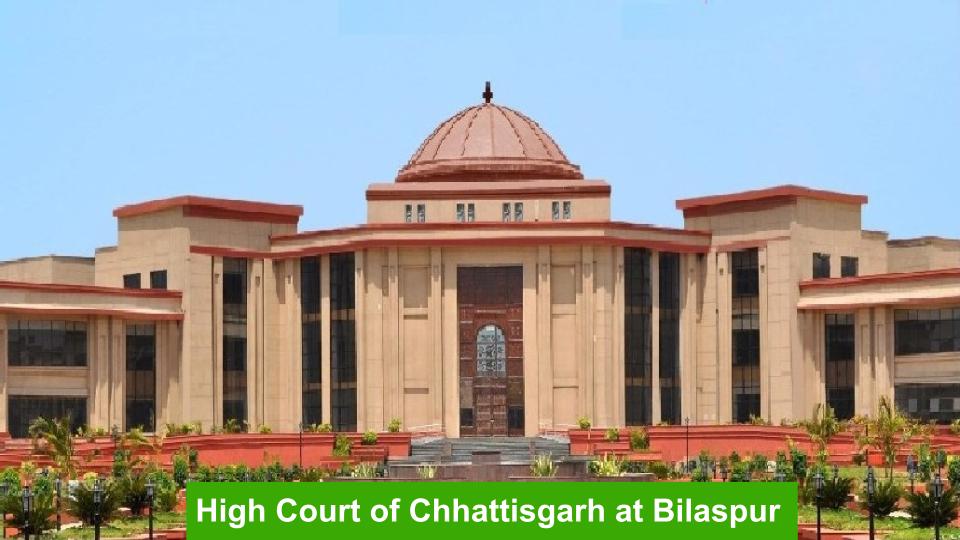
Bilaspur : The Chhattisgarh High Court has dismissed a tenant’s writ petition seeking condonation of delay in filing an appeal against an eviction order, holding that a party who has sufficient notice and opportunity to participate in judicial proceedings cannot seek the benefit of limitation condonation merely by citing negligence or apprehension of arrest.
A Division Bench comprising Chief Justice Krushna Ram Mohapatra and Justice Santosh Sharma dismissed the petition filed under Article 227 of the Constitution of India. The Court held that the tenant had been given repeated opportunities to appear before the Rent Control Authority but failed to participate diligently in the proceedings. Consequently, his explanation for the delay in filing the statutory appeal was found insufficient.

The case arose from eviction proceedings initiated by the landlord under Section 12 of the Chhattisgarh Rent Control Act, 2011, against the petitioner, Suresh Mishra, who had taken the premises on rent for commercial purposes. During the proceedings, the Rent Control Authority issued notices to the tenant on several occasions after he remained absent. The tenant subsequently appeared and participated in the proceedings through his lawyer.
According to the petitioner, he could not regularly attend the proceedings because a criminal case had been initiated against him and he was apprehending arrest. He claimed that he had instructed his advocate to take appropriate steps in the rent proceedings until he obtained bail. However, on September 8, 2025, the Rent Control Authority proceeded ex parte against him. The petitioner further alleged that no subsequent notice was served upon him before the final eviction order was passed on October 15, 2025.
The petitioner submitted that he surrendered before the trial court pursuant to directions of the Supreme Court and was released on bail in March 2026. Thereafter, he contacted his counsel and filed an appeal before the Chhattisgarh Rent Control Tribunal on April 21, 2026, along with an application seeking condonation of delay under Section 5 of the Limitation Act.
Before the High Court, the petitioner argued that he had not been provided an adequate opportunity of hearing as contemplated under Section 10 of the Chhattisgarh Rent Control Act, 2011. It was further contended that proceedings under the Act were not strictly governed by the procedure prescribed under the Code of Civil Procedure, 1908, and therefore, the Tribunal should have adopted a liberal approach while considering the application for condonation of delay.
Reliance was also placed on the earlier decision of the Chhattisgarh High Court in Deepak Sona v. Amolak Singh Bhatia, decided on April 25, 2024. In that case, the High Court had emphasised that an application for condonation of delay under Section 5 of the Limitation Act should ordinarily receive liberal consideration where sufficient cause is established and the delay is neither deliberate nor mala fide.
However, the Division Bench found that the circumstances of the present case were materially different. Examining the procedural history, the Court observed that the Rent Control Authority had repeatedly issued notices to the petitioner, providing him opportunities to participate in the proceedings. Since the petitioner had already engaged an advocate and participated in the matter, it was his responsibility to remain vigilant and defend his case.
The Bench also noted that the petitioner did not take any steps to get the ex parte order dated September 8, 2025, set aside. Instead, he allowed the proceedings to continue and the final eviction order to be passed on October 15, 2025.
Importantly, the Court observed that the petitioner had sufficient opportunity to challenge the eviction proceedings or file an appeal under Section 13(1) of the Chhattisgarh Rent Control Act, 2011, within the prescribed limitation period. His apprehension of arrest could not, by itself, justify the delay in filing the appeal.
Rejecting the petitioner’s reliance on the principles laid down in Deepak Sona, the Court clarified that although delay condonation applications should generally be considered liberally, such leniency cannot be extended to a litigant who has been consistently negligent despite having adequate notice and opportunity.
The Bench made an important observation regarding the principles of natural justice, stating that “A party not availing opportunity provided to him in a proceeding cannot complain non-compliance of principle of natural justice.”
The Court further emphasised that while the explanation for condonation of delay deserves liberal interpretation, a person who is thoroughly negligent and fails to demonstrate diligence in participating in litigation does not automatically become entitled to judicial leniency.
Finding that the Rent Control Authority had complied with Section 10 of the Chhattisgarh Rent Control Act, 2011, and that the petitioner had failed to provide a plausible explanation for the delay, the High Court concluded that there was no merit in the writ petition.
Accordingly, the Division Bench dismissed the writ petition, declining to interfere with the Tribunal’s order rejecting the application for condonation of delay.
The ruling reiterates an important principle in rent control litigation: the law of limitation may be applied with a liberal approach where sufficient cause exists, but litigants cannot rely on general excuses to overcome their own failure to pursue legal remedies despite having adequate knowledge and opportunity. It also underscores that the principles of natural justice do not require repeated opportunities where reasonable opportunities have already been provided and the litigant has failed to utilise them.
Case Details: Suresh Mishra v. Smt. Chandabai Agrawal, W.P.(227) No. 1367 of 2026, Coram: Chief Justice Krushna Ram Mohapatra and Justice Santosh Sharma; Advocate for Petitioner: Mr. Anand Mohan Tiwari.