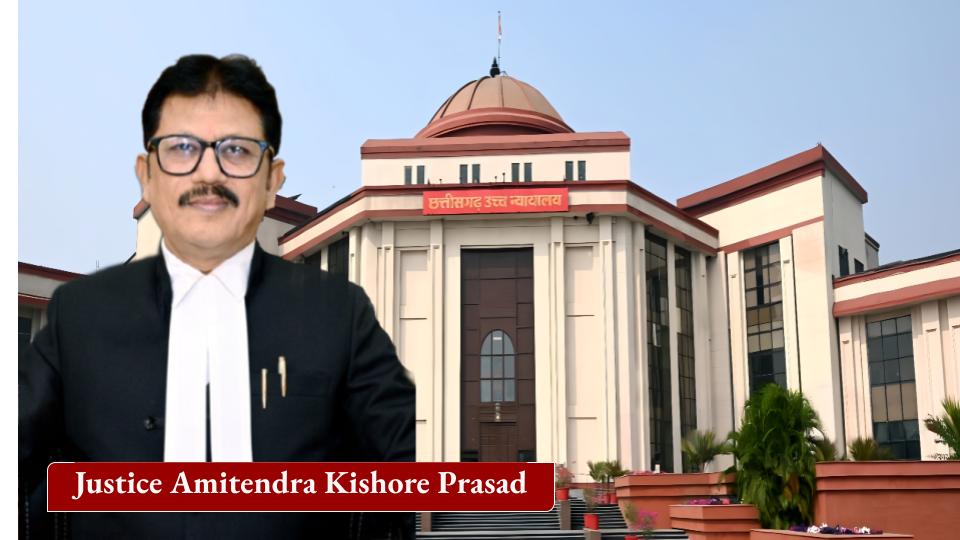
Bilaspur : The Chhattisgarh High Court at Bilaspur has dismissed a writ petition challenging the appointment of Jageshwar Das as Village Kotwar of Kusma village in Kondagaon district, holding that the petitioner failed to establish any jurisdictional error, patent illegality or perversity in the order passed by the Chhattisgarh Board of Revenue. Justice Amitendra Kishore Prasad delivered the order on October 27, 2026, affirming the Board of Revenue’s decision to uphold the appointment made by the Tahsildar, Kondagaon, on January 15, 2020.
The case arose from a dispute over the appointment to the post of Village Kotwar following the resignation of Pitamber Das, who had been serving in the position after the death of the petitioner’s father, Kalyan Das Mongri. The petitioner, Vivek Das Mongri, argued that the appointment process was procedurally defective and that the authorities had failed to properly examine objections concerning the validity of the Gram Sabha resolution and publication of the recruitment notice.
According to the petitioner, his father had originally served as the Village Kotwar, and Pitamber Das, his uncle, was appointed after his father’s death when he was still a minor. Following Pitamber Das’s resignation on health grounds, the Tahsildar appointed Jageshwar Das, Pitamber Das’s son, as the new Village Kotwar by an order dated January 15, 2020.
Vivek Das Mongri challenged the appointment before the Sub-Divisional Officer (Revenue), Kondagaon. On May 28, 2020, the SDO set aside the appointment, finding procedural irregularities in the resolution relied upon for the selection. The authority also raised concerns about the manner in which the resolution was prepared and the absence of proper publication inviting applications and objections.
The Commissioner, Bastar Division, Jagdalpur, subsequently upheld the SDO’s decision on July 13, 2021, and directed the Tahsildar to initiate fresh proceedings for appointment in accordance with the prescribed rules. However, the Chhattisgarh Board of Revenue, in its order dated November 7, 2022, reversed the Commissioner’s decision and restored the Tahsildar’s appointment order.
Before the High Court, the petitioner alleged that the Gram Sabha resolution dated October 5, 2019, had been passed before the public notice was issued on December 13, 2019, and before Jageshwar Das submitted his application on December 20, 2019. He contended that this sequence of events raised doubts about the fairness of the selection process.
The petitioner also questioned whether the Gram Sabha meeting had actually taken place and challenged the genuineness of signatures appearing on the resolution. He relied on affidavits from approximately 120 villagers who allegedly disputed their presence at the meeting and the authenticity of their signatures. The petitioner further argued that the notice inviting applications had not been properly published and that the appointment could not be justified merely because Jageshwar Das was related to a former Kotwar.
Opposing the petition, counsel for Jageshwar Das and the State maintained that the appointment had been made under Section 230 of the Chhattisgarh Land Revenue Code, 1959, and the applicable rules. They argued that the petitioner had no vested right to appointment merely because his father had previously held the post. The respondents also submitted that the Board of Revenue had considered the relevant material and found no sufficient basis to invalidate the appointment.
Justice Amitendra Kishore Prasad examined the rival submissions and the orders passed by the revenue authorities. The Court held that the principal question was whether the Board of Revenue’s decision suffered from a jurisdictional error, patent illegality, perversity or procedural impropriety warranting interference under Article 226 of the Constitution of India.
The High Court observed that the appointment of a Village Kotwar is governed by Section 230 of the Chhattisgarh Land Revenue Code, 1959, and the rules framed under it. Although the SDO and the Commissioner had earlier reached a different conclusion, that fact alone was insufficient to invalidate the subsequent decision of the Board of Revenue.
Addressing the challenge to the Gram Sabha resolution and the publication of the notice, the Court held that the disputed allegations could not, by themselves, justify interference in writ jurisdiction when the revisional authority had examined the available material and declined to invalidate the appointment.
The Court explained that judicial review under Article 226 is not equivalent to a fresh appeal on facts. It referred to the Supreme Court’s decisions in Union of India v. P. Gunasekaran, (2015) 2 SCC 610, and Rajendra Diwan v. Pradeep Kumar Ranibala, (2019) 20 SCC 143, which discuss the limited scope of High Court interference with decisions of competent authorities and tribunals. The Court also relied on Municipal Corporation of Greater Mumbai v. Vivek V. Gawde, 2024 SCC OnLine SC 3722, regarding the limits of judicial review.
The High Court reiterated that interference is warranted where a decision suffers from a fundamental legal error, arbitrariness, perversity, violation of natural justice or lack of jurisdiction. As the petitioner failed to establish such a defect in the Board of Revenue’s order, the Court found no justification to substitute its own assessment for that of the statutory revisional authority.
On the question of preference for relatives of former Kotwars, the Court clarified that such preference under the applicable rules does not create an absolute or indefeasible right to appointment. The petitioner’s relationship with his deceased father, who had previously served as Kotwar, did not automatically entitle him to the position or establish a right to appointment in preference to Jageshwar Das.
Accordingly, the High Court dismissed Writ Petition (Civil) No. 5602 of 2022 and affirmed the Board of Revenue’s order dated November 7, 2022. The appointment of Jageshwar Das as Village Kotwar pursuant to the Tahsildar’s order dated January 15, 2020, will therefore remain undisturbed. The Court also clarified that the dismissal does not confer an independent or vested right to appointment upon either party beyond what is permitted under the applicable law. No order as to costs was passed.
The ruling underscores the distinction between a claim for consideration under statutory recruitment rules and an enforceable right to appointment. It also reiterates that the High Court’s writ jurisdiction is intended to address recognised legal or procedural defects, rather than provide an unrestricted opportunity to re-examine factual disputes already considered by a competent statutory authority.
Case Reference: Vivek Das Mongri v. Jageshwar Das & Others, WPC No. 5602 of 2022.
Advocates: Sourabh Sharma for the petitioner; Pravin Kumar Tulsyan for respondent No. 1; Abhishek Gupta, Panel Lawyer, for the State and respondents No. 2 to 5.