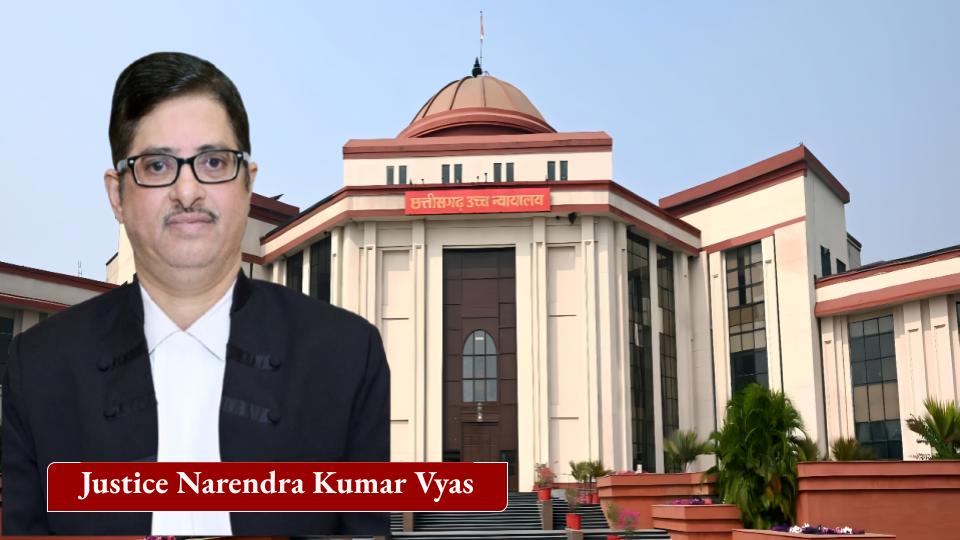
Bilaspur : The Chhattisgarh High Court has dismissed a criminal revision petition filed by Dr. Narayan Prasad Pandey, an Assistant Veterinary Surgeon, challenging the framing of charges against him in a disproportionate assets case under the Prevention of Corruption Act, 1988. Justice Narendra Kumar Vyas held that the allegations and material collected during the investigation warranted a trial and that the accused’s explanations regarding the source of his assets could be examined by the trial court on the basis of evidence.
In its judgment delivered on October 27, 2026, in Criminal Revision No. 71 of 2020, the High Court affirmed the order dated November 30, 2019, passed by the Special Judge under the Prevention of Corruption Act, Bastar at Jagdalpur, framing charges under Sections 13(1)(e) read with Section 13(2) of the Act. The Court clarified that its observations would not influence the final determination of the case during trial.
Disproportionate Assets Allegations Against Government Doctor
According to the prosecution, the State Economic Offences and Anti-Corruption Bureau (ACB), Raipur, received information that Dr. Pandey had allegedly accumulated movable and immovable assets disproportionate to his known sources of income during his service.
The investigation covered several properties, including approximately five acres of agricultural land in Hanumana, Rewa district, Madhya Pradesh; a two-storey house in Deendayal Upadhyay Nagar, Raipur; and another two-storey house in Vrindavan Colony, Jagdalpur. The alleged assets also included agricultural land, a dairy farm measuring approximately 0.46 hectares in Karkapal village, vehicles, cash, gold and silver ornaments, household articles and other investments.
The prosecution further alleged that some properties were held in the name of the accused’s adopted son and that assets belonging to family members had to be examined in the context of the alleged accumulation of wealth.
The ACB conducted a preliminary inquiry on May 2, 2005, and obtained a search warrant from the Special Judge on May 3, 2005. Searches were carried out at the accused’s residences in Jagdalpur and Raipur on May 4, 2005.
During the search at Jagdalpur, investigators recovered cash amounting to Rs. 8,97,090, gold ornaments weighing approximately 688.6 grams and silver ornaments weighing around 1,125 grams. The value of the movable and immovable assets inventoried at the Jagdalpur premises was assessed at approximately Rs. 56.44 lakh. Property found at the Raipur residence was valued at approximately Rs. 1.40 lakh, taking the combined assessed value of the assets at both locations to around Rs. 57.85 lakh.
The ACB subsequently registered Crime No. 16/2005 on May 8, 2005, under Sections 13(1)(e) and 13(2) of the Prevention of Corruption Act. After investigation, the charge-sheet was filed before the Special Judge on November 29, 2018, and charges were framed the following day.
Accused Challenges Property Valuation and Investigation
Challenging the order framing charges, Dr. Pandey argued before the High Court that the trial court had failed to properly consider the material collected during the investigation. His counsel contended that the prosecution had relied on inflated property valuations instead of the actual values prevailing when the properties were acquired.
The defence also argued that several properties belonged to the accused’s relatives and had been purchased from their independent sources of income. According to the applicant, the investigating agency had improperly included the income and expenditure of family members in its assessment of his assets.
The accused further relied on income-tax returns, documents obtained from statutory authorities and explanations regarding the acquisition of properties. He maintained that certain purchases had been made after obtaining permission or providing the requisite information to the competent authorities. He also claimed that a house had been purchased using a loan obtained against his General Provident Fund account and that the dairy farm was established in his wife’s name.
Another principal argument concerned the delay in completing the investigation. The defence submitted that the charge-sheet had been filed more than 13 years after the searches conducted in May 2005 and argued that such prolonged delay justified quashing the criminal proceedings.
Opposing the revision petition, the State submitted that the investigation had disclosed sufficient material to establish a prima facie case. The prosecution argued that the issues concerning ownership, valuation and the sources of income were disputed questions of fact that required examination during trial. It also contended that proceedings initiated by the accused during the investigation had contributed to the delay.
High Court: Defence on Source of Income Must Be Examined at Trial
After considering the rival submissions, Justice Narendra Kumar Vyas held that the accused’s explanations regarding the sources of income and ownership of the properties could not be conclusively accepted at the stage of examining the legality of the order framing charges.
The Court observed that whether the assets had been acquired from legitimate sources and whether they were disproportionate to the accused’s known income were matters that required assessment by the trial court on the basis of the evidence.
The judgment emphasised that a revisional court should not conduct a detailed inquiry into the reliability of the prosecution’s allegations or undertake a full evaluation of competing versions before the trial has taken place.
The High Court relied on the Supreme Court’s decision in State of Chhattisgarh v. Aman Kumar Singh, reported in (2023) 6 SCC 559, which cautioned against routinely interfering with investigations and prosecutions involving corruption allegations.
The Supreme Court had emphasised the need for courts to exercise restraint in corruption cases and ordinarily allow proceedings to take their course, except where exceptional circumstances justify intervention.
Applying this principle, the High Court concluded that the present case did not disclose the kind of exceptional circumstances necessary to quash the charges.
Delay of More Than 13 Years Not Sufficient to Quash Charges
The Court also rejected the argument that the delay in filing the charge-sheet independently justified quashing the proceedings.
The judgment referred to earlier proceedings initiated by the accused, including WPCR No. 582 of 2018. By an order dated January 2, 2019, the High Court had directed that no coercive steps be taken against him while permitting the investigation to proceed. The petition was subsequently disposed of by a Division Bench on May 11, 2023, granting liberty to the accused to pursue an appropriate remedy against the charge-sheet.
The Court further noted that Dr. Pandey had faced another prosecution under the Prevention of Corruption Act in Special Case No. 01/2015 before the Special Judge, Anti-Corruption, South Bastar, Dantewada. He had been sentenced in that case in June 2019. However, the High Court subsequently acquitted him in Criminal Appeal No. 1043 of 2019 by judgment dated May 15, 2026, granting him the benefit of doubt.
The Court held that the circumstances of the present matter did not make the delay fatal to the prosecution. It distinguished the authorities cited by the defence on delay, finding that the facts of the present case did not warrant the relief sought.
Supreme Court Precedents on Framing of Charges
The High Court also relied on the Supreme Court’s ruling in Manendra Prasad Tiwari v. Amit Kumar Tiwari, reported in (2022) 20 SCC 757. The decision reiterates that courts should interfere with an order framing charges only where strong reasons exist to prevent injustice or an abuse of the judicial process.
The governing principle is that the court must examine whether the prosecution material, if accepted at face value, discloses sufficient grounds to proceed against the accused. The court is not required to determine at this stage whether the prosecution will ultimately prove guilt beyond reasonable doubt.
The judgment also referred to State of Orissa v. Pratima Behera, reported as AIR 2025 SC 218, in discussing the standard applicable when charges are considered. The Court noted that the presumption of innocence remains in favour of the accused, while a strong suspicion founded on the available material may nevertheless justify framing charges.
Explaining the applicable legal test, the High Court observed that it must determine whether the prosecution material discloses the ingredients of the alleged offence and provides sufficient grounds for proceeding. It is not required to conduct a detailed examination of the evidence or predict the final outcome of the trial.
Legal Significance Under the Prevention of Corruption Act
The case concerns allegations under Section 13(1)(e), read with Section 13(2), of the Prevention of Corruption Act, 1988, as applicable to the alleged conduct. Section 13(1)(e) dealt with possession of pecuniary resources or property disproportionate to a public servant’s known sources of income for which the public servant could not satisfactorily account, while Section 13(2) prescribed punishment for criminal misconduct.
The statutory framework applicable to the alleged offence must be considered in light of the relevant dates and subsequent amendments to the Prevention of Corruption Act.
The ruling does not establish that the accused is guilty of possessing disproportionate assets. Instead, it addresses the narrower question of whether the charges should be set aside before the evidence is tested at trial.
For public servants facing similar allegations, the decision underscores that explanations concerning family-owned property, loans, income-tax returns and legitimate sources of funds may need to be substantiated through evidence during trial. At the same time, the judgment preserves the accused’s right to contest the prosecution case and requires the trial court to decide the matter independently.
Criminal Revision Dismissed, Trial to Proceed
Dismissing Criminal Revision No. 71 of 2020, the Chhattisgarh High Court affirmed the order framing charges against Dr. Narayan Prasad Pandey under Sections 13(1)(e) and 13(2) of the Prevention of Corruption Act, 1988. The interim protection granted earlier was also vacated.
The Court expressly clarified that its observations were confined to the revision petition and must not prejudice either the accused or the prosecution during trial. It directed that the trial court decide the case on its own merits, strictly on the basis of the evidence adduced before it.
The judgment was delivered by Justice Narendra Kumar Vyas on October 27, 2026, after the matter had been reserved on August 13, 2026.
Case Details: Dr. Narayan Prasad Pandey v. State of Chhattisgarh, Criminal Revision No. 71 of 2020.