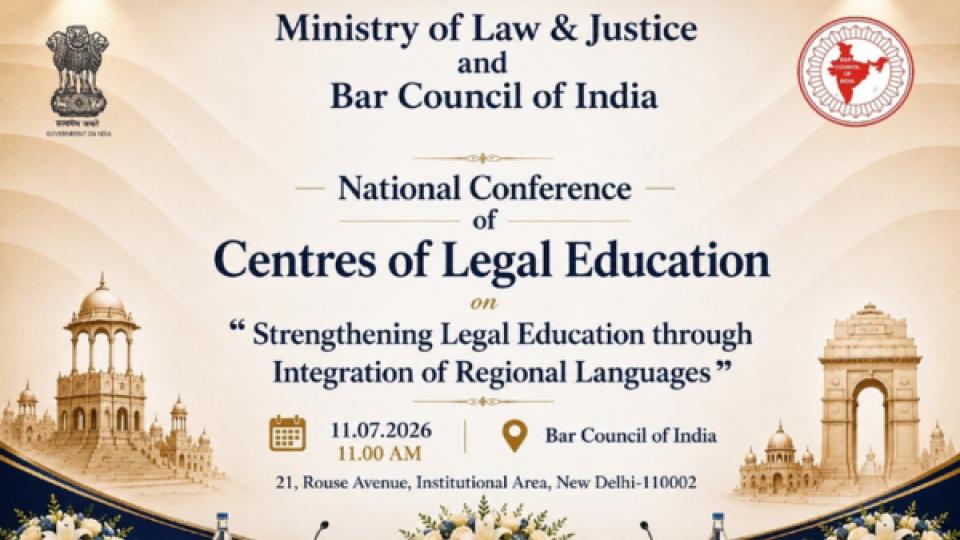
July 11, 2026 : The Department of Legal Affairs under the Ministry of Law and Justice, in collaboration with the Bar Council of India (BCI), organised a National Conference on “Strengthening Legal Education through Integration of Regional Languages” in New Delhi on Saturday. The conference aimed to prepare a comprehensive Ten-Year Perspective Action Plan to promote legal education in Hindi and other Indian languages while strengthening the country’s justice delivery system.
The conference brought together policymakers, legal experts, academicians and other stakeholders to discuss a long-term roadmap for incorporating Indian languages into legal education in a systematic and effective manner. The discussions focused on creating a phased, structured, measurable and quality-assured framework that would encourage the use of Indian languages in legal studies without reducing the importance of English as a vital national and international link language.
Participants emphasised the need for a bilingual and gradually multilingual legal education model that would improve students’ understanding of legal concepts and make legal education more inclusive. The proposed framework is expected to enhance access to justice, strengthen legal aid services, expand clinical legal education programmes and equip future legal professionals to effectively practice before district and subordinate courts across the country.
The conference also highlighted the growing role of technology in supporting language integration within the legal ecosystem. Experts discussed how digital tools, translation technologies and artificial intelligence can help make legal resources more accessible in multiple Indian languages, thereby improving legal literacy and supporting a more inclusive justice system.
The deliberations are expected to contribute to a long-term policy framework that balances linguistic diversity with professional standards, ensuring that legal education becomes more accessible while maintaining its quality and global relevance.