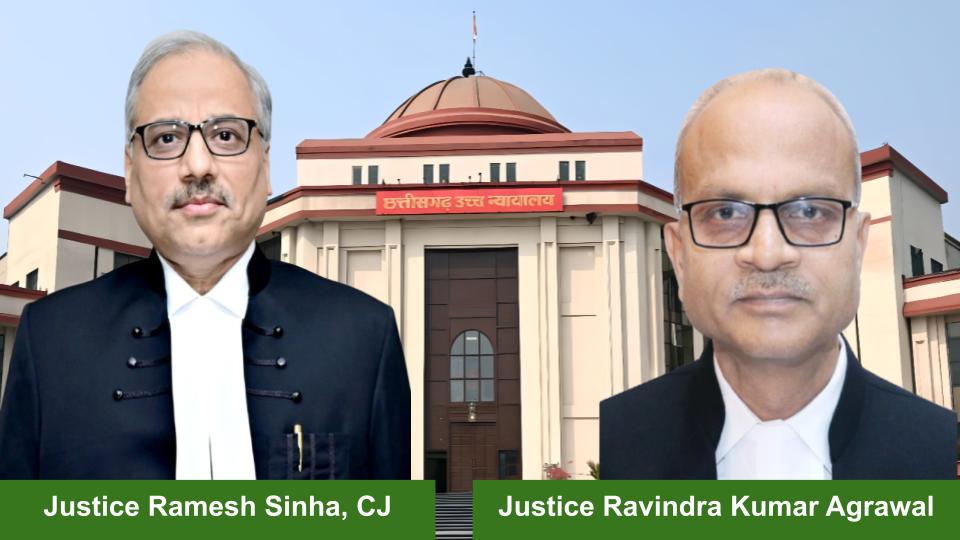
February 28, 2001 : The Chhattisgarh High Court has set aside the death sentence of a man convicted for the murder and dismemberment of his mother, holding that the prosecution failed to prove his guilt beyond reasonable doubt. The court described the trial court’s findings as “contrary to law and evidence” and dismissed the death reference.
The case arose from a gruesome incident in Khairagarh in 1999, where the accused, Bhim Mohammad, was charged under Sections 302 and 201 of the Indian Penal Code for allegedly killing his mother, Khwajan Bi, and cutting her body into pieces. The Additional Sessions Judge had convicted him and awarded the death penalty, leading to a mandatory reference under Section 366 of the Code of Criminal Procedure and a corresponding appeal by the accused.
Justice R.S. Garg, delivering the High Court’s detailed judgment, found that the conviction was based largely on weak circumstantial evidence and procedural irregularities. The bench noted that crucial witnesses were not examined, key documents contained contradictory timings, and several recoveries attributed to the accused were made even before his alleged confession was recorded.
The court observed that the investigating officer’s records were inconsistent, particularly the recovery panchnamas, which mentioned times and events in an impossible sequence. “How can a memorandum under Section 27 of the Evidence Act be referred to in a document prepared two hours earlier?” the court asked, terming the evidence “manufactured and concocted.”
Adding to doubts about the prosecution’s case, the forensic report revealed that the alleged murder weapons and materials supposedly used to conceal the crime such as the axe, sickle, and gunny bags showed no traces of blood. Only the accused’s shirt bore a small stain, which the court said could not be treated as conclusive proof.
The High Court also found that the supposed motive an alleged land dispute between the accused and his mother—was never substantiated by documents or testimony. “No revenue record or witness was produced to show that any property was gifted or transferred,” Justice Garg wrote, concluding that the prosecution had failed to establish either motive or opportunity.
In overturning the conviction, the bench reiterated that suspicion, no matter how strong, cannot take the place of proof. “The prosecution by its evidence has simply pointed the needle of suspicion towards the accused but has failed in proving that it was the accused who committed the crime,” the court held.
On the question of sentencing, the High Court emphasized that even if guilt had been established, the death penalty should be reserved for the “rarest of rare” cases as laid down in Bachan Singh v. State of Punjab and Machhi Singh v. State of Punjab. The trial court, it said, appeared to have been swayed more by the manner in which the body was disposed of rather than by the evidence of the murder itself.
Justice Garg commended advocates Yashwant Tiwari and Kishore Bhaduri, who volunteered to represent the accused during the appeal. The court ordered the immediate release of Bhim Mohammad, noting that he had already spent years in custody.
With this ruling, the High Court reaffirmed the principle that capital punishment demands the highest standard of proof and that every benefit of doubt must go to the accused when evidence is uncertain or improperly obtained.
Case Reference : Criminal Reference No. 1 of 2000 and Criminal Appeal No. 2653 of 2000, State of M.P. vs. Bhim Mohd.; for the Appellant/Petitioner/Plaintiff: Shri Yashwant Tiwari and Shri Kishore Bhaduri, Advocates; for the State: Dr. N.K. Shukla, Deputy Advocate General.