News Citation : 2026 LN (HC) 365 | 2026:CGHC:23580-DB
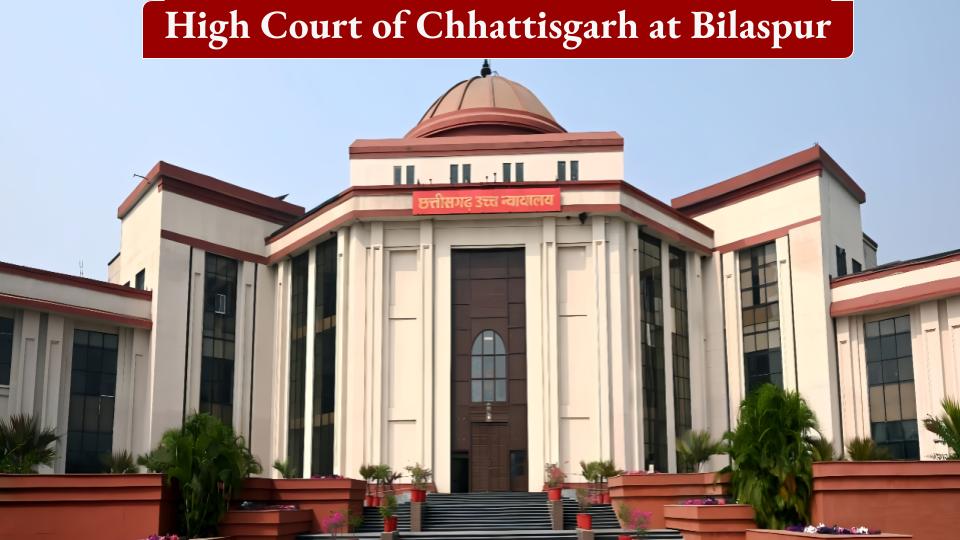
June 4, 2026 : The Chhattisgarh High Court has dismissed an appeal filed by a village Sarpanch challenging no-confidence motion proceedings initiated against her, holding that a procedural defect relating to inadequate notice was effectively cured by judicial intervention and could not be used to derail the democratic process envisaged under the Panchayat laws.
A Division Bench comprising Justice Naresh Kumar Chandravanshi and Justice Bibhu Datta Guru upheld an earlier order of a Single Judge, which had postponed the no-confidence meeting to ensure compliance with the statutory notice requirement instead of quashing the proceedings altogether. The Court observed that where a procedural irregularity can be remedied without causing prejudice, democratic processes should not be frustrated on technical grounds.
The case arose from a challenge filed by Fuleshwari Banjare, the elected Sarpanch of Gram Panchayat Turma in Balodabazar-Bhatapara district. Several Panchayat members had initiated a no-confidence motion against her in May 2026. Pursuant to the proposal, the competent authority issued a notice on May 20, 2026, fixing May 29, 2026 as the date for consideration of the motion.
The Sarpanch approached the High Court under Article 226 of the Constitution, contending that the mandatory seven-day notice period prescribed under Rule 3(3) of the Chhattisgarh Panchayat (Gram Panchayat Ke Sarpanch Tatha Up-Sarpanch, Janapad Panchayat Tatha Zila Panchayat Ke President Tatha Vice-President Ke Virudh Avishwas Prastav) Niyam, 1994 had not been complied with. According to her, although the notice was issued on May 20, it was actually served upon her only on May 24, leaving insufficient time before the scheduled meeting.
After examining the dispatch records, the Single Judge had found prima facie merit in the grievance and concluded that the petitioner had not received the full statutory notice period. However, instead of invalidating the proceedings, the Court directed that the proposed no-confidence meeting be kept in abeyance for two days and conducted only after completion of the required seven-day period, namely on or after May 31, 2026.
Challenging that decision before the Division Bench, the Sarpanch argued that the proceedings should have been quashed entirely. She further alleged that relevant documents relating to the no-confidence motion had not been supplied to her, thereby causing prejudice and affecting her ability to defend herself.
The State Government and supporting respondents opposed the appeal. They argued that the procedural defect had already been rectified through the Single Judge’s directions and that no surviving prejudice remained. The respondents also pointed out that the petitioner herself was aware of the complaints forming the basis of the no-confidence proceedings and had not demonstrated any actual harm caused by the alleged non-supply of documents.
Examining the legal framework, the Division Bench referred to Rule 3(3) of the 1994 Rules, which requires that notice of a meeting convened for consideration of a no-confidence motion be dispatched at least seven days before the meeting. The Court explained that the purpose of the provision is to ensure that elected representatives receive sufficient opportunity to participate in the proceedings and exercise their democratic rights.
At the same time, the Bench emphasized that every procedural lapse does not automatically invalidate an entire democratic exercise. The Court relied upon the Full Bench decision in Bhulin Dewangan v. State of Madhya Pradesh, which held that while compliance with notice requirements is mandatory, non-compliance would invalidate proceedings only where it causes serious prejudice or results in a failure of justice.
Applying those principles, the High Court held that the defect relating to the notice period stood adequately remedied once the Single Judge postponed the meeting and ensured compliance with the statutory requirement. The Bench noted that the appellant failed to show what further prejudice continued to exist after the meeting was deferred.
Rejecting the argument regarding non-supply of documents, the Court observed that the petitioner had neither specifically pleaded the nature of the allegedly withheld documents nor demonstrated how their absence impaired her defence. The Court found that a mere allegation of prejudice, unsupported by particulars, could not justify nullifying proceedings initiated under the Panchayat Raj framework.
In a significant observation, the Bench stated that “every infraction of the procedural requirement contained in Rule 3(3) does not automatically render the entire proceedings void” and that democratic processes should not be defeated by curable procedural defects where no actual prejudice is shown.
The Court further observed that the Single Judge had adopted a balanced approach by protecting the statutory right of notice available to the Sarpanch while simultaneously ensuring that the democratic mechanism of accountability through a no-confidence motion was not frustrated. According to the Bench, there was no jurisdictional error, perversity, or illegality in the order warranting interference in the intra-court appeal.
Dismissing the appeal at the motion stage itself, the High Court reaffirmed that procedural safeguards under Panchayat laws are intended to secure fairness and participation, but should not be interpreted in a manner that obstructs legitimate democratic decision-making when defects can be effectively cured without causing injustice.
Case Reference: Fuleshwari Banjare v. State of Chhattisgarh & Others, WA No. 503 of 2026, decided on June 4, 2026, Counsels : Senior Advocate T.K. Jha with Advocate Parth Kumar Jha appeared for the appellant, Additional Advocate General Shashank Thakur for the State, and Advocate Sunil Sahu for respondents Nos. 9, 10 and 12.