News Citation : 2026 LN (HC) 205 | 2026:CGHC:12943
March 18, 2026 : The Chhattisgarh High Court has acquitted a former SECL official in a long-running corruption case, ruling that the prosecution failed to prove the essential element of bribe demand beyond reasonable doubt.
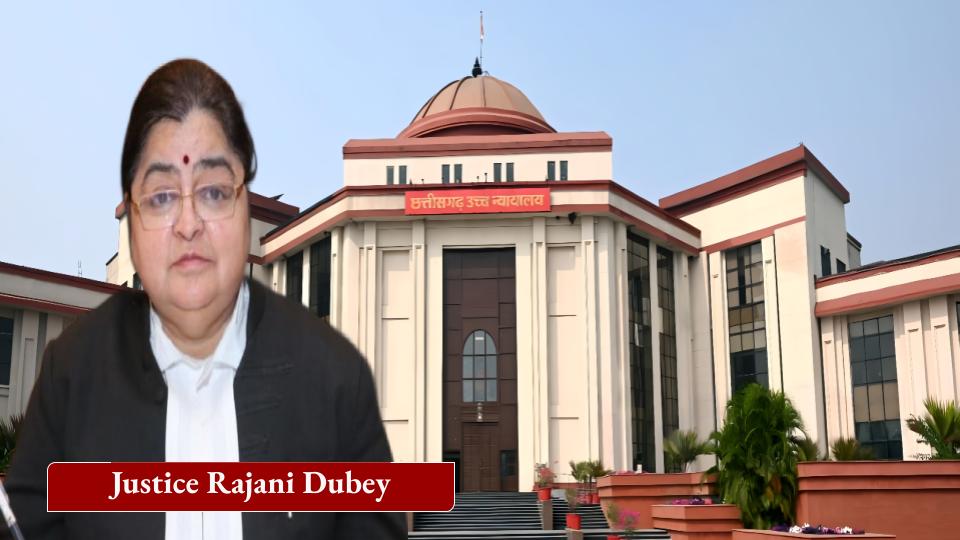
In its judgment delivered on March 18, 2026, Justice Rajani Dubey set aside the 2006 conviction of Jitendra Nath Mukherjee, who had been found guilty by a Special CBI Court in Raipur under provisions of the Prevention of Corruption Act.
The case dates back to 2004, when Michael Masih, an employee at Korea Colliery under SECL, alleged that Mukherjee, then serving as a Personnel Manager, demanded ₹5,000 to process his provident fund advance application worth ₹2.5 lakh.
Following a complaint, the Central Bureau of Investigation conducted a trap operation and claimed to have caught Mukherjee accepting the bribe at his residence. The trial court later convicted him and sentenced him to one year of rigorous imprisonment along with a fine.
During the pendency of the appeal, Mukherjee passed away, and the case was continued by his legal representative.
After examining the evidence, the High Court found serious gaps in the prosecution’s case. The Court emphasized that mere recovery of money is not sufficient to establish corruption unless there is clear proof of both demand and acceptance of a bribe.
One of the major weaknesses identified was the absence of the original provident fund application. Only a photocopy was produced, and several witnesses failed to confirm whether the application had ever reached the accused for processing.
The Court also noted inconsistencies in witness testimonies and a lack of reliable corroboration of the complainant’s claims. Importantly, there was no concrete evidence establishing that Mukherjee had demanded the bribe in the first place.
Reiterating settled law, the Court held that proof of demand for illegal gratification is the “sine qua non” for conviction under the Prevention of Corruption Act. Without this, even recovery of tainted money cannot sustain a conviction.
The judgment relied on multiple Supreme Court rulings which consistently state that suspicion, however strong, cannot replace proof in criminal cases.
Mukherjee had denied all allegations, claiming that the complainant attempted to forcibly hand over money, which he refused. The Court found that this version gained support from procedural gaps and missing documentation in the prosecution’s case.
Concluding that the prosecution failed to establish guilt beyond reasonable doubt, the High Court allowed the appeal and acquitted Mukherjee of all charges. The earlier conviction and sentence were set aside.
Case Reference : CRA No. 860 of 2006, Jitendra Nath Mukherjee Babu vs Union of India through CBI, Jabalpur (M.P.); for Appellant: Mr. Leekesh Kumar and Mr. Manish Kumar Chandra (for Ms. Renu Kochar, Advocate); for Respondent: Mr. Vaibhav Goverdhan, Advocate.