News Citation : 2026 LN (HC) 234
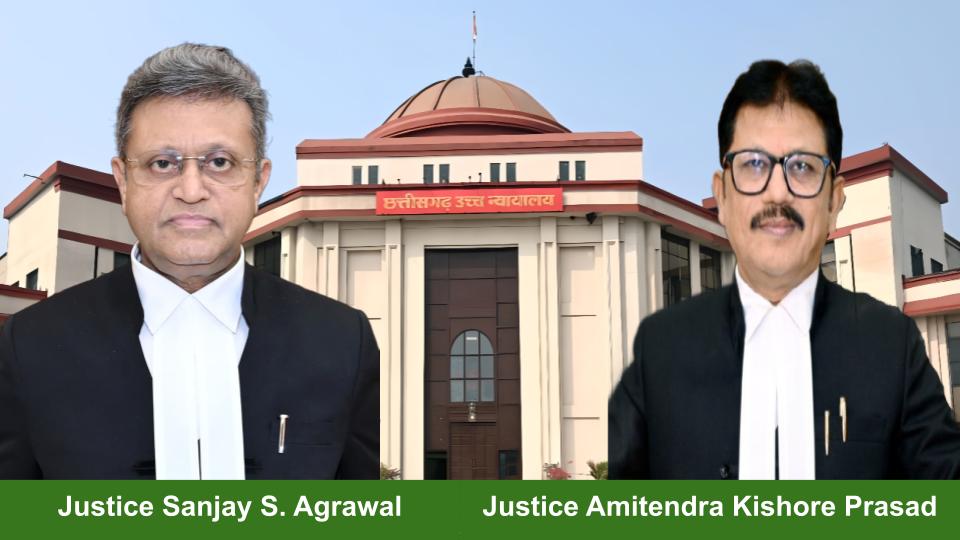
April 6, 2026 : The High Court of Chhattisgarh has firmly rejected a writ petition filed by a Railway officer who sought to challenge a departmental inquiry through repetitive legal filings. In a decisive ruling, the Division Bench comprising Justice Sanjay S. Agrawal and Justice Amitendra Kishore Prasad emphasized that the principle of res judicata which prevents the same parties from relitigating a settled issue applies strictly to writ petitions under Article 226 of the Constitution of India.
The case originated from a 2015 Central Bureau of Investigation (CBI) trap where Piyush Mishra, then serving as an Assistant Divisional Electrical Engineer (ADEE) for South East Central Railway (SECR), was arrested for allegedly demanding and accepting illegal gratification. Following the arrest, the Railway administration initiated major penalty proceedings against him in 2016. For nearly a decade, the inquiry has been stalled by the petitioner’s repeated demands to engage a specific retired Railway employee, Shri M.V.D. Satyanarayana, as his Defence Assistant.
Mishra’s request had been consistently rejected by authorities and was previously dismissed by the Central Administrative Tribunal (CAT) in 2019. Despite this finality, the petitioner filed fresh representations and a subsequent Original Application in 2023, claiming that new amendments to the Railway Servants (Discipline and Appeal) Rules in 2024 granted him a fresh right to his chosen assistant. He argued that the denial of his preferred assistant violated the principles of natural justice and his fundamental rights under Article 311(2) of the Constitution.
However, the High Court found these arguments to be “wholly misconceived.” Justice Prasad, authoring the judgment, noted that a statutory amendment cannot be used to reopen issues already settled by judicial adjudication unless expressly made retrospective. The court observed that the petitioner was regularly participating in the inquiry and had been afforded adequate opportunities to defend himself. The Bench characterized the persistent litigation as an “obstructive tactic” designed to delay the conclusion of a corruption-related inquiry that has already spanned ten years.
Citing Supreme Court precedents such as M. Nagabhushana v. State of Karnataka and the recent Puja Ferro Alloys P. Ltd. v. State of Goa, the court held that allowing a party to repeatedly agitate the same grievance would be an abuse of the legal process. The court concluded that administrative discipline and public confidence in institutions require departmental proceedings to reach a logical end within a reasonable timeframe. Consequently, the petition was dismissed without costs, clearing the way for the long-pending inquiry to proceed.
Case Reference : WPS No. 13990 of 2025: Piyush Mishra vs. Union of India & Others; Mr. Jitendra Pali, Advocate for Petitioner; Mr. Ramakant Mishra, DSG, and Mr. Palash Tiwari, Advocate for Respondents.