News Citation : 2026 LN (HC) 297
February 6, 2026 : The Telangana High Court has dismissed a batch of 21 appeals filed by the Income Tax Department against the Hyderabad Metropolitan Development Authority (HMDA), upholding the grant of retrospective registration under Section 12A of the Income Tax Act, 1961.
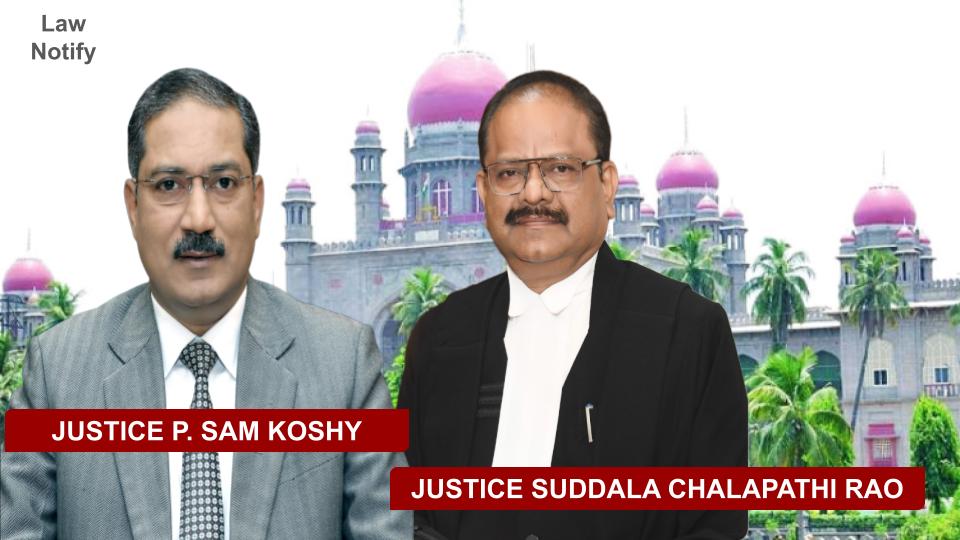
In a common judgment delivered on February 6, 2026, a Division Bench comprising Justice P. Sam Koshy and Justice Suddala Chalapathi Rao ruled that there was no legal or factual error in the decision of the Income Tax Appellate Tribunal (ITAT), which had allowed HMDA’s claim for tax exemption for earlier assessment years.
The dispute centered on whether HMDA, a statutory urban development authority, was entitled to registration under Section 12A with retrospective effect, particularly for the period after April 1, 2003, when Section 10(20A) of the Income Tax Act which earlier granted automatic exemption to such authorities was omitted.
HMDA, originally established as the Hyderabad Urban Development Authority in 1975, had long enjoyed tax exemption under the now-omitted provision. However, after its deletion, the authority did not immediately apply for registration under Section 12A, which is required to claim exemption under Sections 11 and 12. It eventually filed an application in 2007, seeking retrospective benefit from 2003 onwards.
The Income Tax Department opposed this, arguing that registration could not be granted for years prior to the application and that HMDA’s activities involved substantial commercial receipts, disqualifying it from being treated as a charitable institution.
However, the Tribunal had ruled in favour of HMDA, relying on the proviso to Section 12A(2), which allows registration to take effect for earlier assessment years under certain circumstances. This provision came into force on June 1, 2007, before HMDA’s application was decided.
The High Court agreed with this interpretation. It noted that HMDA is a government instrumentality engaged in planned urban development, with no profit motive or distribution of income. Its functions, the Court observed, fall within the ambit of “general public utility,” a recognized category under the definition of charitable purpose in the Income Tax Act.
The Court also pointed out that the delay in seeking registration had already been condoned by the Supreme Court, which had directed authorities to consider the matter on merits. Following this, the competent authority and the Tribunal had both granted relief to HMDA.
Importantly, the Court held that once Section 12A(2) came into force, authorities were empowered to grant registration with retrospective effect, especially in cases involving public bodies like HMDA. It found that the Tribunal had relied on statutory provisions as well as judicial precedents to reach its conclusion.
Rejecting the Revenue’s contention that HMDA’s commercial receipts exceeded permissible limits, the Court observed that the nature and purpose of the authority’s activities remained public-oriented and non-profit in character.
Concluding that the Tribunal’s order was well-reasoned and legally sound, the Court held that the Revenue’s appeals were devoid of merit and accordingly dismissed them.
Case Reference : The Commissioner of Income-tax (Exemptions), Hyderabad v. Hyderabad Metropolitan Development Authority (formerly HUDA); ITTA Nos. 19, 20, 21, 24, 25, 27, 28, 38, 42, 44, 56, 79, 80, 81, 226, 229, 230, 232, 235, 237 of 2019 and 42 of 2020; for Appellant: Mr. Vijhay K. Punna; for Respondent: Mr. A.V. Krishna Koundinya (for Mr. A.V.A. Siva Kartikeya).