News Citation : 2026 LN (HC) 367
June 15, 2026 : In a significant judgment delivered after nearly twenty-five years of litigation, the High Court of Chhattisgarh has upheld the conviction of three men in a 2000 firing incident arising out of a property dispute in Bhilai, while partially reducing the sentence awarded under the Indian Penal Code due to the prolonged passage of time. The Court maintained the conviction of the principal accused under the Arms Act and clarified that recovery of the firearm is not a mandatory requirement for sustaining a conviction when reliable eyewitness and medical evidence establish the offence.
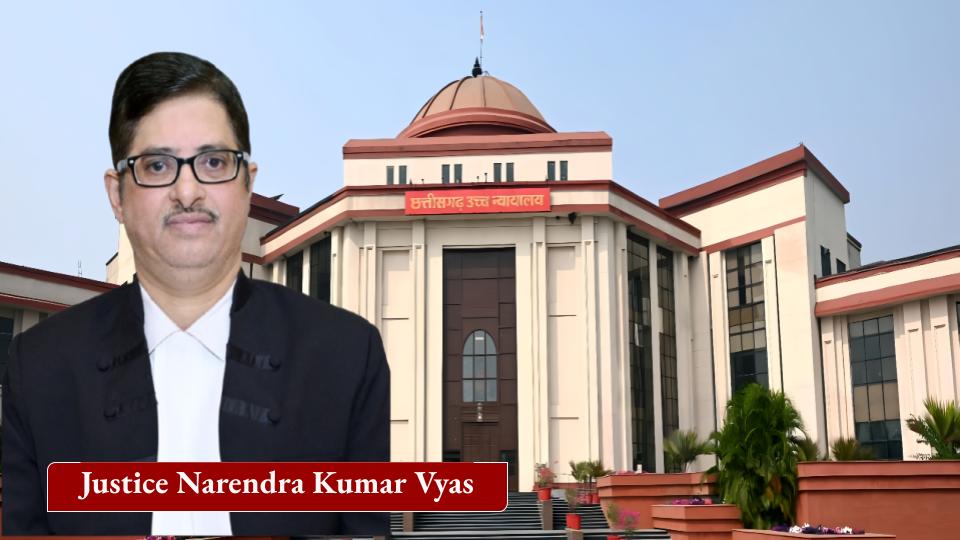
Justice Narendra Kumar Vyas passed the judgment in Criminal Appeal No. 952 of 2005, affirming the findings recorded by the trial court regarding the involvement of the accused in the shooting of Harendra Kumar Gupta. The case originated from an incident that occurred on the night of 26 November 2000 in Bhilai, District Durg, where the victim suffered gunshot injuries allegedly resulting from a long-standing property dispute.
According to the prosecution, the victim’s brother lodged a complaint after receiving information that Harendra Gupta had been shot and was lying injured near his scooter. The injured man was immediately taken for medical treatment, where he reportedly disclosed that Rajendra, Lilambar Singh and Tameshwar Sinha had threatened him earlier over a property dispute and were responsible for the attack. Based on the complaint, police registered an FIR under Section 307 read with Section 34 of the Indian Penal Code and commenced investigation.
During the investigation, police seized relevant articles, recorded witness statements and obtained a dying declaration from the victim. Medical examinations revealed the presence of numerous pellets lodged in the victim’s body, supporting the prosecution’s allegation that a country-made firearm had been used during the attack. Doctors who examined the victim testified before the court that multiple pellets were found in the hip region, corroborating the victim’s account of being shot.
The prosecution relied heavily on the testimony of the injured witness, who stated that Rajendra fired at him from close range while the other accused participated in the incident and threatened him. The victim’s version was further supported by his brother’s testimony, medical evidence and the dying declaration recorded during treatment. The Court observed that the evidence remained consistent despite extensive cross-examination by the defence.
The defence argued that one of the accused, Lilambar Singh, had been falsely implicated and was attending a family function at the relevant time. It was also contended that the prosecution had failed to recover the firearm allegedly used in the offence and that the conviction under Section 27 of the Arms Act could not be sustained in the absence of sanction from the District Magistrate. The appellants further challenged the overall appreciation of evidence by the trial court and sought acquittal.
Rejecting the plea of alibi, the High Court found that the defence had failed to produce convincing evidence demonstrating that the accused could not have been present at the scene of the crime. The Court noted that the defence witness was a relative of the accused and that no independent material such as photographs or other corroborative evidence had been produced to establish the claim.
The Court placed substantial reliance on the testimony of the injured witness and reiterated the settled legal principle that the evidence of an injured witness carries special evidentiary value. Referring to recent Supreme Court precedents, the Court observed that such testimony cannot be discarded lightly unless there are compelling reasons to doubt its credibility. The judgment quoted the Supreme Court’s view that “the evidence of injured witness has greater evidentiary value and unless compelling reasons exist, their statements are not to be discarded lightly.”
A key legal issue before the Court was whether non-recovery of the firearm weakened the prosecution case. Addressing this contention, the High Court held that the presence of pellets in the victim’s body, supported by medical evidence and eyewitness testimony, was sufficient to establish the use of a firearm. The Court relied on Supreme Court rulings holding that recovery of the weapon of offence is not a sine qua non for conviction when direct and reliable evidence is available. It observed that medical evidence often constitutes independent evidence capable of proving crucial facts regarding the nature of injuries and the weapon used.
The Court also examined the appellants’ argument regarding sanction under Section 39 of the Arms Act, 1959. After analysing Sections 5, 27 and 39 of the Act, the Court concluded that prior sanction from the District Magistrate is required only in specific prosecutions under Section 3 of the Arms Act and is not a prerequisite for prosecution under Section 27. Consequently, the challenge to the conviction on this ground was rejected.
While affirming the conviction under Section 324 IPC and Section 27 of the Arms Act, the Court considered the plea for reduction of sentence. It noted that the incident occurred in the year 2000 and that more than twenty-five years had elapsed. The Court also took into account the absence of any criminal antecedents placed on record and the fact that the appellants had not misused the liberty granted to them during the pendency of the appeal.
However, the Court clarified that the sentence imposed under Section 27 of the Arms Act could not be reduced below the statutory minimum prescribed by law. As a result, the three-year rigorous imprisonment awarded to Rajendra under the Arms Act was maintained. At the same time, the sentence awarded to all three appellants under Section 324 IPC was reduced from one year to four months’ rigorous imprisonment. The Court directed that the sentences imposed upon Rajendra would run concurrently.
Partly allowing the appeal, the High Court directed the appellants to surrender before the trial court within two months to serve the remaining sentence after giving them the benefit of set-off for the period already undergone under Section 428 CrPC and the corresponding provision under the Bharatiya Nagarik Suraksha Sanhita.
The ruling is significant because it reinforces two important criminal law principles. First, a conviction can be sustained on the strength of credible testimony of an injured witness corroborated by medical evidence, even if the weapon used in the crime is not recovered. Second, the judgment clarifies the limited scope of the sanction requirement under the Arms Act and confirms that prosecutions under Section 27 do not require prior approval from the District Magistrate. The decision is likely to be cited in future cases involving firearm offences where recovery of the weapon is disputed but medical and eyewitness evidence remains strong.
Case Reference : Rajendra & Others v. State of Chhattisgarh