News Citation : 2026 LN (HC) 368
June 15, 2026 : In a significant judgment reaffirming the evidentiary value of circumstantial and forensic evidence in sexual assault cases, the Chhattisgarh High Court has upheld the conviction of a man found guilty of rape, house trespass and abetment of suicide. The Court dismissed the criminal appeal filed by the accused and affirmed the trial court’s findings that the victim had taken her own life shortly after being subjected to sexual assault, establishing a direct link between the accused’s actions and the suicide.
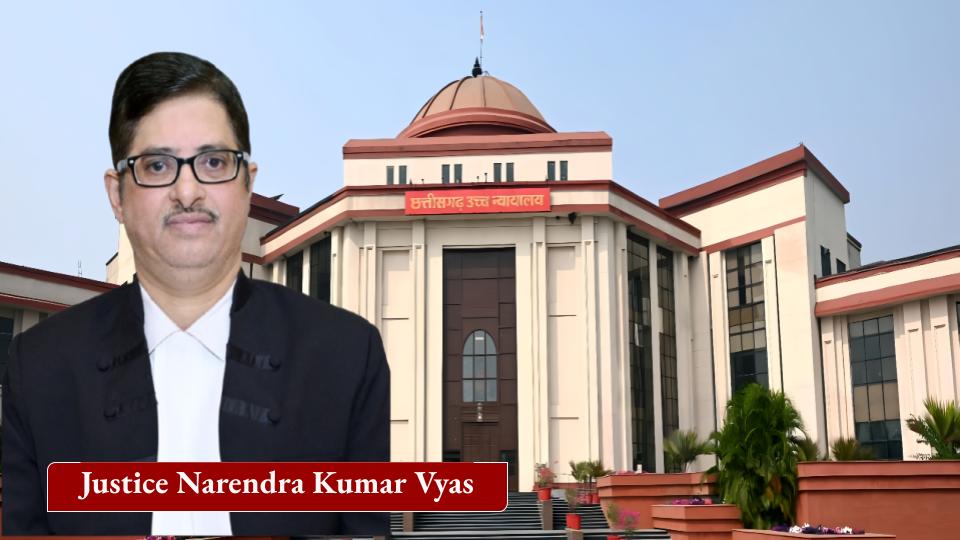
Justice Narendra Kumar Vyas delivered the judgment in Criminal Appeal No. 305 of 2005, confirming the conviction of Vijay Kumar under Sections 376(1), 306 and 450 of the Indian Penal Code (IPC). The appellant had challenged the judgment of the First Additional Sessions Judge, Baloda Bazar, which had sentenced him to ten years’ rigorous imprisonment for rape, seven years for abetment of suicide and seven years for house trespass, with all sentences directed to run concurrently.
According to the prosecution, the incident occurred on August 22, 2004, in Village Koliha under Kasdol Police Station. The victim was alone at home while her brother and sister-in-law had gone to their agricultural field. It was alleged that the accused entered the house, closed the door and forcibly raped her. Shortly thereafter, the victim’s brother returned home and found the accused emerging from the house. The victim disclosed that she had been sexually assaulted. Distressed by the incident, she set herself on fire and later died while being taken to the hospital.
During the investigation, police recovered burnt clothes, torn garments and other articles from the scene. The victim’s clothing, as well as the accused’s undergarments, were sent for forensic examination. The Forensic Science Laboratory (FSL) report detected sperm on several seized articles, including the victim’s slide and the accused’s undergarments, lending strong support to the prosecution’s case.
The defence argued that the accused had been falsely implicated and claimed that he and the deceased were in a consensual relationship. Letters allegedly written by the victim were produced to support the theory of a love affair. It was also argued that several prosecution witnesses had turned hostile and that a key witness had not been examined, creating serious doubts about the prosecution story. The defence further contended that the ingredients required for conviction under Section 306 IPC were absent because there was no evidence of intentional instigation or active participation in the victim’s suicide.
Rejecting these submissions, the High Court found that the evidence of the victim’s brother and sister-in-law was credible and consistent. The Court noted that the victim had immediately informed her sister-in-law that the accused had raped her and that she had set herself on fire because of the assault. The Court held that this statement formed part of the same transaction and was therefore admissible under Section 6 of the Indian Evidence Act under the doctrine of res gestae.
The Court observed that the torn condition of the victim’s clothes and the presence of sperm on seized articles strongly indicated resistance by the victim and undermined the defence claim of a consensual relationship. It further held that the letters produced by the defence were insufficient to establish consent or a romantic relationship between the parties.
Addressing the argument that the principal witnesses were close relatives of the deceased, the High Court relied on several Supreme Court decisions and reiterated that a related witness cannot automatically be treated as an interested witness. The Court observed, “The evidence of a witness cannot be ignored or thrown out solely because it comes from the mouth of a person who is closely related to the victim.” It emphasized that the reliability and consistency of testimony must be assessed on its merits rather than on the basis of familial relationships.
On the charge of abetment of suicide, the Court held that the rape had a direct and immediate nexus with the victim’s decision to end her life. The judgment noted that the trauma, humiliation and loss of dignity resulting from the assault were sufficient to drive the victim to suicide. The Court observed that in Indian society, a woman subjected to rape may experience severe psychological distress and social stigma, which can leave her unable to cope with the consequences of the crime. The Court therefore concluded that the accused’s conduct amounted to instigation within the meaning of Section 107 IPC, making him liable under Section 306 IPC as well.
The High Court also upheld the conviction under Section 450 IPC, holding that the accused had entered the victim’s house when she was alone and had done so with the intention of committing a serious offence. This satisfied all the essential ingredients of house trespass with preparation for committing an offence punishable with imprisonment.
After reappreciating the entire oral, documentary and forensic evidence, the Court concluded that the prosecution had proved the charges beyond reasonable doubt. Consequently, the appeal was dismissed, the conviction and sentence were affirmed, and the appellant’s bail bonds were cancelled. The Court directed him to surrender before the trial court within two months to serve the remaining sentence, failing which coercive steps would be taken to secure his custody.
The ruling is significant because it highlights how courts may establish abetment of suicide where a victim takes her life immediately after a sexual assault and the evidence demonstrates a clear causal connection between the crime and the suicide. The judgment also reinforces the principle that testimony from family members cannot be discarded merely because of their relationship with the victim when it is corroborated by reliable evidence and forensic findings.
Case Reference : Vijay Kumar v. State of Chhattisgarh, Criminal Appeal No. 305 of 2005