News Citation : 2026 LN (HC) 371
June 15, 2026 : In a significant ruling concerning the rights of long-serving daily wage employees, the Chhattisgarh High Court has set aside a state government order rejecting the regularisation claims of 60 daily wage workers employed by the Municipal Corporation, Korba. The Court held that the authorities failed to justify their decision and directed a fresh examination of the workers’ cases within six months.
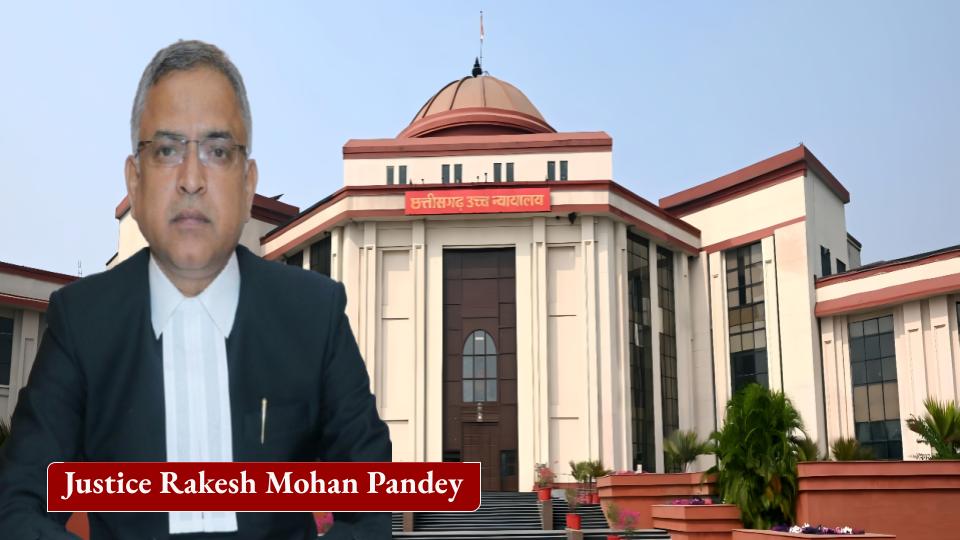
The judgment was delivered by Justice Rakesh Mohan Pandey in a writ petition filed by 60 workers who have been serving the Korba Municipal Corporation for more than two decades. The petitioners challenged a government order dated May 12, 2020, through which their claims for regularisation were rejected on the grounds that they were appointed after December 31, 1997, and had breaks in service exceeding one month in certain years.
According to the petitioners, they were initially engaged as daily wage employees between 1997 and 1999 and had continued to perform perennial and essential municipal functions for over 20 years. They argued that despite the long duration of service and the existence of sanctioned vacant posts in the Municipal Corporation, their services had not been regularised. The workers relied on a 2008 state government circular that laid down guidelines for regularisation of daily wage employees and contended that they fulfilled the requirements for consideration under the policy.
The dispute traces back to earlier litigation. After facing threats of discontinuation, the workers had obtained interim protection from the High Court in 2010. Later, they submitted representations seeking regularisation, and in 2019 the High Court directed the authorities to consider those representations. Acting on that direction, the Municipal Corporation reportedly recommended the names of 57 daily wage workers for regularisation. However, the Urban Administration and Development Department ultimately rejected the claims in May 2020.
During the hearing, the petitioners argued that the nature of their work was permanent and recurring, that they had worked continuously for 23 to 24 years, and that the alleged breaks in service could not be treated as a valid basis for denying regularisation. They also pointed out that several vacancies existed in the Municipal Corporation and relied on recent Supreme Court decisions that recognised the rights of long-serving temporary workers.
The Municipal Corporation and State Government opposed the petition, contending that the workers were not appointed through a regular recruitment process and were not engaged against sanctioned vacant posts. The respondents relied on the landmark Supreme Court judgment in Secretary, State of Karnataka v. Uma Devi (2006), arguing that irregular appointments cannot automatically lead to regularisation.
After examining the record, the High Court found that the petitioners had continued working with the Municipal Corporation since the late 1990s and that their claims had been rejected primarily on two grounds: appointment after December 31, 1997, and alleged breaks in service. The Court observed that recent Supreme Court rulings had significantly clarified the legal position regarding long-serving daily wage workers.
The Court referred extensively to the Supreme Court’s decision in Dharam Singh v. State of Uttar Pradesh, where the apex court criticised the prolonged use of temporary employment for work that is permanent in nature. Quoting the judgment, the High Court noted that, “The State is not a mere market participant but a constitutional employer. It cannot balance budgets on the backs of those who perform the most basic and recurring public functions.” The Supreme Court had also emphasised that where work continues year after year, government establishments must justify why such functions are not reflected in sanctioned staffing structures.
The High Court further relied on the Supreme Court’s recent ruling in Prem Chand v. State of Punjab, where the apex court held that artificial breaks in service should not automatically defeat claims for regularisation, especially when similarly situated employees have already been granted such benefits. The Supreme Court had observed that short interruptions followed by re-engagement do not amount to genuine discontinuity of service and cannot be used to disregard years of work performed by employees.
Addressing the respondents’ reliance on the Uma Devi judgment, the High Court clarified that the decision cannot be used as a blanket justification for continuing workers on daily wages indefinitely. Referring to the Supreme Court’s decision in Shripal v. Nagar Nigam, Ghaziabad, the Court observed that Uma Devi cannot become a shield for exploitation through prolonged ad hoc employment or outsourcing arrangements where the need for permanent staff continues to exist.
A key factor that influenced the Court was the alleged discriminatory treatment of the petitioners. The Court noted that other daily wage employees had already been considered favourably for regularisation, while the petitioners, despite being similarly placed, were denied the same benefit. According to the Court, such unequal treatment could not be sustained in law.
Holding that the rejection order dated May 12, 2020, was legally unsustainable, the High Court quashed the order and allowed the writ petition. The Court directed the State Government and Municipal Corporation authorities to reconsider the petitioners’ claims for regularisation in light of the principles laid down by the Supreme Court and the observations made in the judgment. The entire exercise has been ordered to be completed within 180 days from the date of receipt of the court order.
The ruling is likely to have wider implications for thousands of daily wage and temporary workers employed by local bodies and government departments across Chhattisgarh. It reinforces the principle that long years of continuous service, especially in perennial posts, cannot be ignored merely because workers were initially engaged on a temporary basis. The judgment also underscores constitutional guarantees of equality under Articles 14 and 16 and the obligation of the State to act as a fair employer while dealing with long-serving employees.
Case Reference: Manish Mishra & 59 Others v. State of Chhattisgarh & Others, WPS No. 4605 of 2021