News Citation : 2026 LN (HC) 370
The Chhattisgarh High Court has overturned a trial court’s acquittal in an electricity theft case and convicted the accused under Section 135 of the Electricity Act, 2003, holding that official inspection reports and seizure documents prepared by electricity department officials cannot be discarded merely because no independent witnesses were examined. The Court emphasized that such official records carry a presumption of correctness unless rebutted through credible evidence.
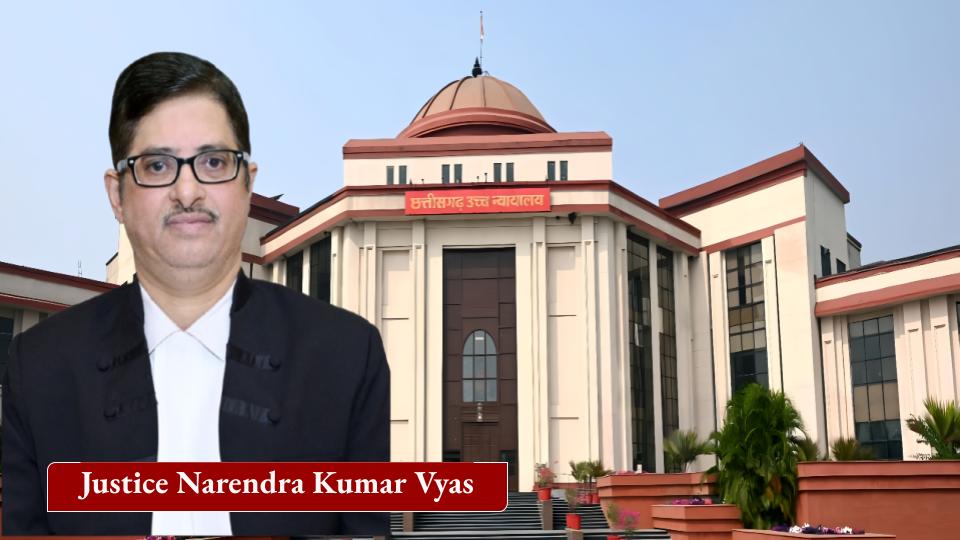
The judgment was delivered by Justice Narendra Kumar Vyas in an appeal filed by the Chhattisgarh State Power Distribution Company Limited (CSPDCL) against the acquittal of Dinesh Chandra by the Special Judge (Electricity Act), Janjgir-Champa. The trial court had acquitted the accused on November 3, 2016, after concluding that the prosecution had failed to establish the offence of electricity theft beyond reasonable doubt. The High Court, however, found that the trial court had misread the evidence and incorrectly applied the provisions of the Electricity Act.
According to the prosecution, a vigilance team of CSPDCL conducted an inspection at the accused’s residence on March 10, 2014. During the inspection, officials discovered that the electricity connection installed at the premises had already been disconnected due to non-payment of dues. Despite the disconnection, the accused was allegedly drawing power directly from a low-tension electricity line through an unauthorized hook connection. The inspection team found electrical appliances including a fan, cooler, television, water pump, bulbs, and CFL lamps operating through the illegal connection. A panchnama, inspection report, seizure memo, site map, and assessment documents were prepared on the spot, and an assessment of ₹43,623 was raised against the consumer.
The trial court had doubted the prosecution’s case primarily because no independent witnesses were examined and no documentary proof of ownership of the property was produced. It also held that certain mandatory procedural requirements under the Electricity Act and related rules had not been followed. On these grounds, the accused was acquitted.
Reversing those findings, the High Court observed that the inspection and seizure documents were prepared by public officials while discharging their statutory duties. The Court held that such records could not be rejected in the absence of evidence showing that they were fabricated or false. Referring to the Supreme Court’s decision in Punjab State Electricity Board v. Ashwani Kumar (2010) 7 SCC 569, the Court noted that official inspection reports enjoy a legal presumption of correctness and the burden lies on the consumer to rebut them through cogent evidence.
The Court observed, “The inspection report is a document prepared in exercise of official duties by the officers of the Corporation. Once an act is done in accordance with law, the presumption is in favour of such act or document and not against the same.”
Justice Vyas further noted that the accused had not produced any defence evidence to challenge the authenticity of the panchnama or inspection report. The accused’s wife was present during the inspection and had signed the relevant documents. The accused himself admitted during his statement under Section 313 CrPC that his wife was present at the premises when the inspection was carried out. These circumstances, according to the Court, strengthened the prosecution’s case.
The High Court also clarified the distinction between Sections 126 and 135 of the Electricity Act, 2003. While Section 126 deals with assessment of charges arising from unauthorized use of electricity, Section 135 creates the criminal offence of electricity theft. The Court held that even if there were procedural irregularities in assessment proceedings under Section 126 or the Chhattisgarh Electricity Rules, such deficiencies would not invalidate criminal prosecution for theft under Section 135.
Addressing the issue of ownership, the Court held that it was unnecessary for the electricity company to produce revenue records proving ownership of the premises. The fact that the electricity connection existed in the accused’s name and that a disconnection notice had been issued to him for non-payment of dues was sufficient to establish his status as a consumer under the Electricity Act. The Court observed that the dispute was not about title to the property and therefore production of ownership records was irrelevant.
The Court further held that the trial court had ignored material evidence and adopted a legally unsustainable approach. It reiterated that while appellate courts ordinarily exercise caution in interfering with acquittal orders, interference is justified where the findings are perverse, based on misreading of evidence, or where only one reasonable conclusion emerges from the record. In the present case, the Court found that the evidence pointed only toward the guilt of the accused.
Consequently, the High Court allowed the appeal, set aside the acquittal, and convicted the accused for the offence of electricity theft under Section 135 of the Electricity Act, 2003. The matter was directed to be listed separately for hearing on the question of sentence in accordance with Section 235(2) CrPC and the corresponding provisions of the Bharatiya Nagarik Suraksha Sanhita (BNSS).
Case Reference: Chhattisgarh State Power Distribution Company Ltd. v. Dinesh Chandra, ACQA No. 714 of 2019