News Citation : 2026 LN (HC) 373
June 15, 2026 : The Chhattisgarh High Court has reaffirmed that compassionate appointment cannot be granted when any member of the deceased government employee’s family is already employed in government service, even if that family member is living separately and is not financially dependent on the deceased employee. In a significant ruling, the Division Bench dismissed an appeal filed by a 21-year-old applicant seeking compassionate appointment following the death of his father, holding that courts cannot dilute the express conditions contained in the state’s compassionate appointment policy.
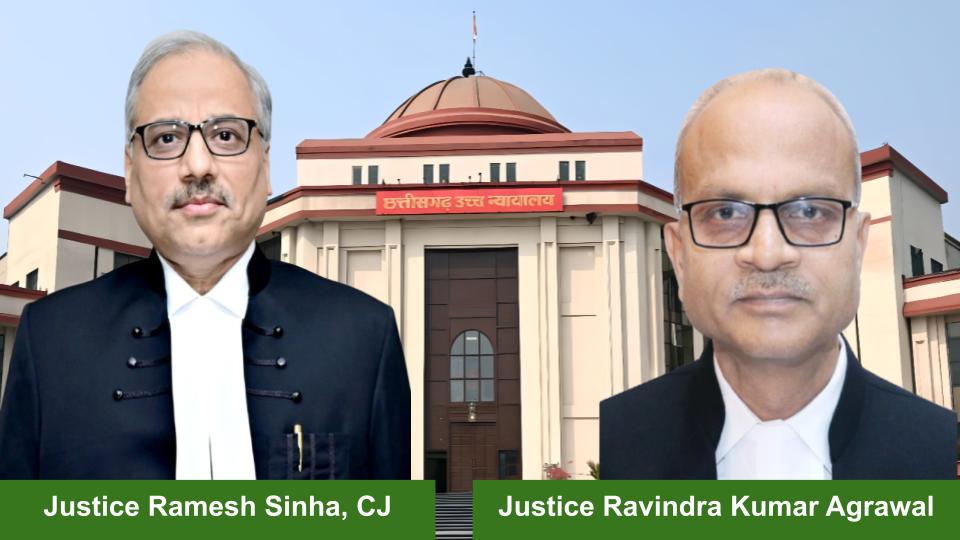
The judgment was delivered by Chief Justice Ramesh Sinha and Justice Ravindra Kumar Agrawal in Henri Rangari v. State of Chhattisgarh & Others, where the court upheld earlier orders passed by a Single Judge rejecting the petitioner’s claim for compassionate appointment. The Bench also condoned a delay of 68 days in filing the appeal before proceeding to examine the merits of the case.
The dispute arose after the death of Ashok Kumar Rangari, an Assistant Grade-II posted in the Tehsil Office at Kurud in Dhamtari district, who died while in service on November 5, 2024. Following his death, his son Henri Rangari applied for compassionate appointment, contending that the deceased employee had been the sole breadwinner of the family and that his mother and sister were entirely dependent upon him.
According to the appellant, his elder step-brother, Virendra Bahadur Rangari, had been residing separately with his own family for several years and was not dependent on the deceased employee. The appellant argued that the step-brother had also informed authorities that he had no objection to compassionate appointment being granted in favour of Henri Rangari. Despite these circumstances, the District Level Compassionate Appointment Committee rejected the application solely because Virendra Bahadur Rangari was already serving in government employment.
Before the High Court, the appellant contended that the authorities and the Single Judge had misapplied the definition of “family” under relevant government notifications. It was argued that only family members who were residing with and financially dependent upon the deceased employee should be considered while assessing eligibility under the compassionate appointment scheme. The appellant maintained that his step-brother had been living separately since 2006, maintained an independent household, and therefore could not be treated as a dependent family member for the purpose of disqualifying him from appointment.
The petitioner further relied on previous judicial decisions, including Ghanshyam Devdas v. State of Chhattisgarh and a Karnataka High Court judgment, to argue that dependency rather than mere relationship should be the determining factor in compassionate appointment cases. He asserted that denying appointment in such circumstances defeated the very purpose of compassionate appointment, which is intended to provide immediate financial relief to families facing hardship after the death of a government employee.
The State opposed the appeal and relied upon Clause 6(A) of the Chhattisgarh Compassionate Appointment Policy, 2013. The government argued that the policy clearly bars compassionate appointment where a member of the deceased employee’s family is already employed in government service. The State further submitted that the issue had already been settled by earlier Division Bench judgments, particularly State of Chhattisgarh v. Kevra Bai Markandey and State of Chhattisgarh v. Smt. Muniya Mukharjee, which interpreted the policy to mean that the existence of any government-employed family member disqualifies other family members from claiming compassionate appointment.
After examining the record and rival submissions, the Division Bench found no merit in the appellant’s arguments. The court observed that the principal issue was whether the appellant’s brother, who was admittedly a government servant, could be excluded from consideration merely because he was living separately and was not dependent on the deceased employee. The Bench answered this question in the negative.
The High Court held that the matter was already covered by binding precedent. Referring to earlier Division Bench rulings, the court reiterated that once a family member of the deceased employee is in government service, the disqualification under Clause 6(A) becomes operative. The Bench emphasized that the policy does not provide any exception based on separate residence or lack of dependency.
In an important observation, the court stated: “If any member of the family of the deceased employee is already in Government service, the other members of the family would not be entitled to compassionate appointment.” The Bench further noted that “the policy does not carve out any exception on the ground that such family member is residing separately or is not dependent upon the deceased employee.”
The court also underscored the settled legal principle governing compassionate appointments, observing that “compassionate appointment is an exception to the normal rule of recruitment and cannot be claimed as a matter of right.” It added that such appointments can only be granted strictly in accordance with the governing policy and that courts cannot ignore or dilute the express conditions laid down by the government.
Legally, the ruling reinforces the restrictive interpretation of compassionate appointment schemes and highlights the importance of adhering to policy conditions rather than examining individual hardship alone. The judgment clarifies that eligibility under the Chhattisgarh Compassionate Appointment Policy, 2013 is determined by the existence of a government-employed family member and not by questions of dependency or separate residence unless the policy itself provides otherwise.
The decision is likely to have broader implications for compassionate appointment claims across the state. Families seeking appointments on compassionate grounds may find it difficult to succeed where any member falling within the policy definition of “family” is already employed in government service, even if such member is financially independent or living separately. The ruling also signals that courts are unlikely to create exceptions that are not expressly contemplated under the policy framework.
Finding no error in the orders passed by the Single Judge or the authorities, the Division Bench dismissed the writ appeal and affirmed the rejection of Henri Rangari’s claim for compassionate appointment.
Case Reference: Henri Rangari v. State of Chhattisgarh & Others, WA No. 370 of 2026