News Citation : 2026 LN (HC) 374
June 15, 2026 : The Chhattisgarh High Court has ruled that a legal heir cannot automatically continue a writ petition solely on the basis of succession or nomination under the Chhattisgarh Co-operative Societies Act, 1960. In a significant judgment concerning the maintainability of legal proceedings after the death of a petitioner, a Division Bench of the High Court dismissed a writ appeal filed by the son of a deceased cooperative society member and upheld earlier orders dismissing both the original writ petition and a subsequent recall application.
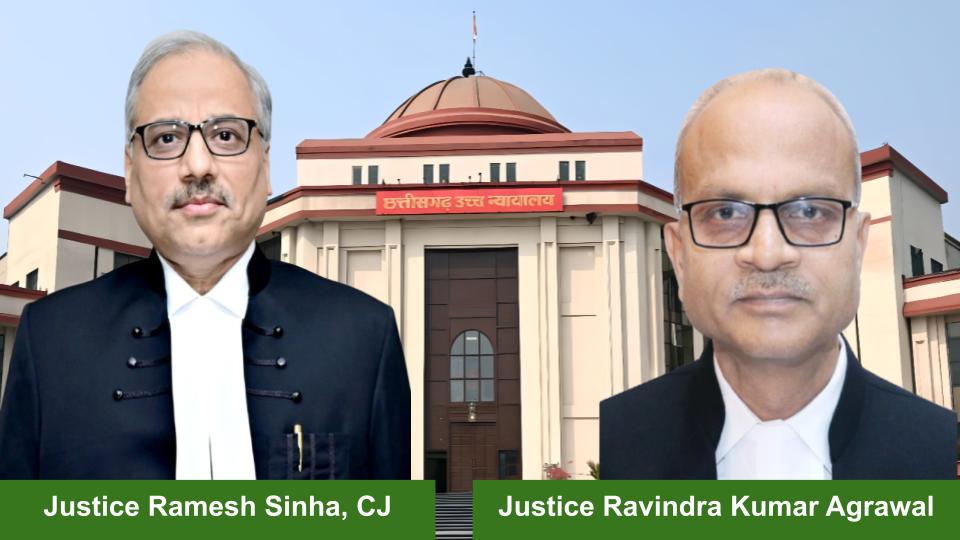
The Division Bench comprising Chief Justice Ramesh Sinha and Justice Ravindra Kumar Agrawal delivered the judgment on June 15, 2026, in Kulwant Chawla (Dead) Through LRs Guruvansh Singh Chawla v. State of Chhattisgarh & Others. The court affirmed the orders passed by a Single Judge on January 6, 2026, and April 16, 2026, which had dismissed the writ petition and a miscellaneous civil case seeking recall of the dismissal order.
The dispute originated from a writ petition filed in 2016 by Kulwant Chawla challenging an order dated April 1, 2016, through which a Liquidator was appointed for Zila Sahakari Sangh Maryadit, Mahasamund. The petitioner had also sought directions regarding the conduct of elections to the Board of Directors of the cooperative society. During the pendency of the proceedings, Kulwant Chawla passed away on April 16, 2021. Despite an application for substitution of his legal heir being filed, the writ petition was eventually dismissed by the Single Judge in January 2026 after being informed that the matter related to the affairs and election of the cooperative society and that the sole petitioner had died.
Challenging the dismissal, Guruvansh Singh Chawla, the son and legal representative of the deceased petitioner, argued before the Division Bench that the writ petition was not limited to election-related issues. According to the appellant, the primary challenge concerned the legality of the Liquidator’s appointment and the winding-up process initiated under Sections 69 and 70 of the Chhattisgarh Co-operative Societies Act, 1960. He contended that these issues involved the assets, liabilities, and statutory rights of society members and therefore survived even after the death of the original petitioner.
The appellant further claimed that he had been nominated as President of the Society by the competent authority and was also recognized by the Cooperative Department. He argued that under Section 26 of the Act of 1960, which deals with succession to the share or interest of a deceased member, he was entitled to continue the proceedings and seek adjudication of the challenge to the liquidation order. He also asserted that the society possessed valuable movable and immovable assets, including land in Mahasamund district, making it necessary for the court to decide the legality of the liquidation proceedings on merits.
The State opposed the appeal and maintained that the dispute essentially related to the management and election of the cooperative society. It argued that the cause of action was personal to the original petitioner and ceased to survive after his death. The State also contended that the recall application was legally untenable because it had been filed in the name of a deceased person.
After examining the record, the Division Bench agreed with the State’s position and found no error in the approach adopted by the Single Judge. The High Court observed that disputes concerning elections and participation in cooperative society affairs are generally personal in nature unless a statute expressly provides otherwise. The Bench noted that the original litigation was intrinsically connected with the affairs and election of the society and that the dispute, as framed by the deceased petitioner, did not survive in the same form after his death.
Explaining the legal principle involved, the court stated, “It is well settled that disputes pertaining to election and the right to contest or participate therein are essentially personal in nature unless the statute specifically provides otherwise.” The Bench concluded that once the sole petitioner died, the original lis effectively ceased to survive in its existing form.
The court also examined the maintainability of the recall application filed after dismissal of the writ petition. It noted that the application had been filed in the name of the deceased petitioner, while the supporting affidavit and vakalatnama were executed by his son. According to the Bench, such a recall application could not be entertained unless the legal representative had first been formally brought on record and recognized by the court in accordance with law.
Rejecting the appellant’s reliance on Section 26 of the Chhattisgarh Co-operative Societies Act, 1960, the High Court clarified that the provision only governs succession to a deceased member’s share or interest in a cooperative society. The Bench emphasized that the section does not create an automatic right of substitution in judicial proceedings. In a key observation, the court held, “Section 26 merely deals with transfer of share or interest of a deceased member and payment of dues to a nominee, heir or legal representative. The said provision neither provides for automatic substitution in judicial proceedings nor creates an independent right to continue a writ petition.”
The judges further observed that even if the appellant possessed independent statutory rights as a nominee, society representative, or legal heir, those rights would have to be asserted before an appropriate forum in accordance with law. Such claims, the court said, could not by themselves revive a writ petition that had already been dismissed.
From a legal perspective, the judgment reinforces the distinction between inheritable statutory rights and the continuation of judicial proceedings. The ruling highlights that succession rights under cooperative laws do not automatically translate into procedural rights before constitutional courts. The decision is likely to have broader implications for cooperative society disputes, election-related litigation, and cases where petitioners die during the pendency of proceedings. It underscores the importance of timely substitution of legal representatives and compliance with procedural requirements before seeking substantive relief.
Finding no jurisdictional error, perversity, or illegality in the orders under challenge, the Division Bench dismissed the writ appeal and affirmed the Single Judge’s decisions. The court held that no sufficient grounds existed for recalling the earlier dismissal order and concluded that the appeal was devoid of merit.
Case Reference: Kulwant Chawla (Dead) Through LRs Guruvansh Singh Chawla v. State of Chhattisgarh & Others, WA No. 462 of 2026