News Citation : 2026 LN (HC) 378
June 15, 2026 : The Chhattisgarh High Court has set aside the murder conviction of a Dantewada resident who had been sentenced to life imprisonment for the 2014 killing of a man allegedly linked to a land dispute, holding that the prosecution failed to establish a complete chain of circumstances necessary to sustain a conviction based solely on circumstantial evidence.
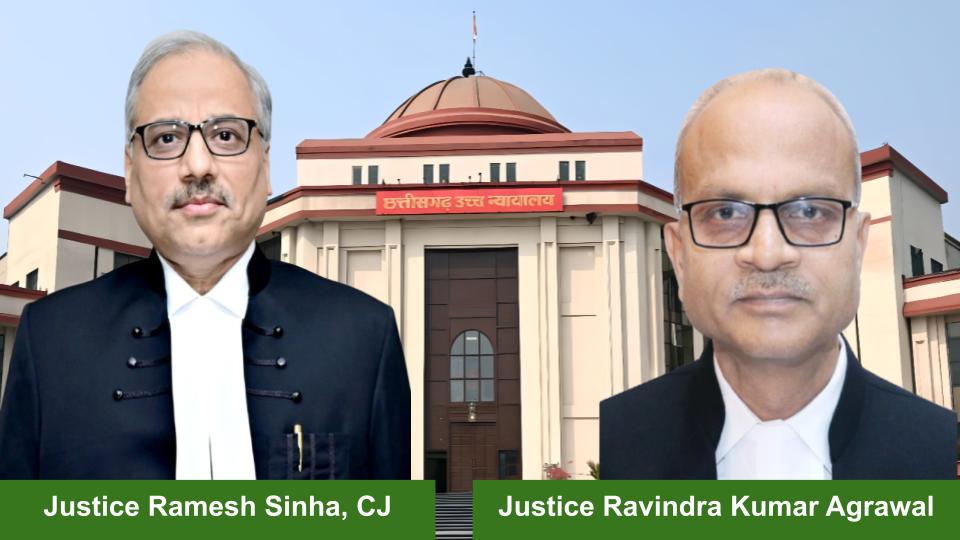
In a significant ruling reinforcing the strict standards governing criminal convictions based on indirect evidence, a Division Bench comprising Chief Justice Ramesh Sinha and Justice Ravindra Kumar Agrawal allowed the criminal appeal filed by Shyam Sunder Baghel alias Kirka and acquitted him of the charge under Section 302 of the Indian Penal Code (IPC). The Court concluded that the prosecution had not succeeded in proving the case beyond reasonable doubt and that the evidence relied upon by the trial court was insufficient to establish guilt.
The case arose from an incident that occurred on the night of May 17, 2014, in Garpadarpara village under Kuakonda Police Station in Dantewada district. According to the prosecution, the accused attacked Mehtar Baghel with a knife at around 11:30 p.m., causing fatal injuries. Following a complaint lodged by the deceased’s father, police registered an FIR and initiated an investigation.
During the investigation, police conducted inquest proceedings, prepared seizure memos, and sent the deceased’s body for post-mortem examination. The medical examination confirmed that the victim died due to hemorrhagic shock resulting from excessive bleeding caused by injuries to the lung. The post-mortem doctor classified the death as homicidal.
After completion of the investigation, a charge sheet was filed against the accused. The trial court convicted him under Section 302 IPC and sentenced him to life imprisonment along with a fine of ₹100. Challenging that conviction, the accused approached the High Court under Section 374(2) of the Code of Criminal Procedure (CrPC).
Before the High Court, the defence argued that the entire prosecution case rested on circumstantial evidence and that no eyewitness had linked the accused to the crime. It was contended that the two primary circumstances relied upon by the trial court—recovery of a knife and motive arising from a land dispute—were weak and legally insufficient to establish guilt.
The prosecution, on the other hand, maintained that the evidence on record adequately proved the accused’s involvement and justified the conviction.
While examining the appeal, the High Court first affirmed the trial court’s finding that the death was homicidal. Relying on the post-mortem report and the testimony of the doctor who conducted the examination, the Bench observed that the conclusion regarding the nature of death was fully supported by medical evidence.
However, the Court found serious deficiencies in the evidence linking the accused to the crime. One of the main circumstances relied upon by the prosecution was the recovery of a knife and clothing allegedly used in the offence pursuant to the accused’s disclosure statement. The Court noted that the Forensic Science Laboratory (FSL) report categorically stated that no blood stains were detected on either the knife or the seized clothes.
Referring to the Supreme Court’s decision in Balwan Singh v. State of Chhattisgarh (2019), the High Court observed that recovery evidence becomes significant only when scientific examination establishes a connection between the recovered article and the crime. Since no blood was found on the seized articles, the recovery could not be treated as an incriminating circumstance against the accused.
The Bench further scrutinised the prosecution’s theory of motive. The prosecution alleged that the accused and the deceased had a longstanding dispute over land and that a quarrel had occurred shortly before the incident. However, the Court found that the deceased’s father, who referred to the dispute while lodging the FIR, admitted during cross-examination that he had not witnessed the assault.
The High Court reiterated the settled legal principle that motive alone cannot form the basis of a conviction. Citing Supreme Court judgments in Sampath Kumar v. Inspector of Police and Mahendra Singh v. State of Madhya Pradesh, the Court emphasized that even if motive is established, it cannot substitute for substantive evidence proving the accused’s involvement in the crime.
The judgment extensively discussed the landmark Supreme Court ruling in Sharad Birdhichand Sarda v. State of Maharashtra, which lays down the five essential principles governing cases based on circumstantial evidence. The High Court reproduced these principles and stressed that every circumstance relied upon by the prosecution must be firmly established, must point only towards the guilt of the accused, and must form an unbroken chain excluding every possible hypothesis consistent with innocence.
Quoting the Supreme Court’s formulation, the Bench observed that “there must be a chain of evidence so complete as not to leave any reasonable ground for the conclusion consistent with the innocence of the accused.”
Applying these principles to the facts of the case, the Court held that the prosecution had failed to satisfy the legal requirements necessary for sustaining a conviction based on circumstantial evidence. The Bench found that neither the recovery evidence nor the alleged motive could conclusively connect the accused with the murder.
The Court stated that “the prosecution has been able to prove neither the complete chain of circumstances nor the five golden principles constituting the panchsheel of proof in a case based on circumstantial evidence.”
Consequently, the High Court set aside the conviction and life sentence imposed by the trial court and acquitted the appellant by granting him the benefit of doubt. Since the accused was already on bail, the Court directed that he need not surrender. However, his bail bonds were ordered to remain in force for six months in accordance with Section 437-A CrPC.
The ruling is significant because it reaffirms a fundamental principle of criminal jurisprudence: suspicion, however strong, cannot replace proof. The judgment serves as a reminder that courts must exercise caution while evaluating circumstantial evidence and that convictions for serious offences such as murder can be sustained only when every link in the evidentiary chain is firmly established. The decision is likely to be cited in future cases involving recovery evidence, motive-based prosecution theories, and the standards required for conviction in circumstantial evidence cases.
Case Reference: Shyam Sunder Baghel @ Kirka v. State of Chhattisgarh, Criminal Appeal No. 1344 of 2017